True Bible Teaching about God’s Purpose and His plan of Salvation for all those who will believe in Him

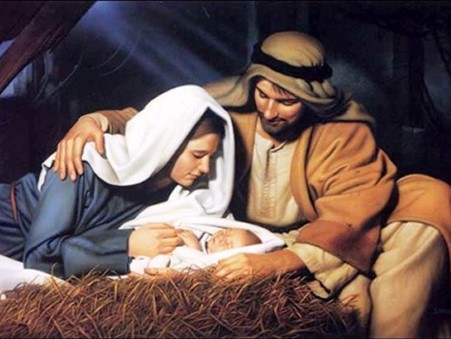
Christ's Birth

Did Jesus Christ Pre-Exist?

Did Jesus Christ Pre-Exist?  – A Bible Study about Jesus Christ

New Testament Teaching

Let us begin by stating the obvious. Only in the New Testament do we read of Jesus asChrist's Birth someone who is alive and taking part in the affairs of human beings living on the earth. And, equally importantly, it is only in the New Testament that we read about the God of heaven being described over and over again as “Father”, a term which is extremely rare in the Old Testament Scriptures.
That does not mean that there is no mention of Jesus in the Old Testament. As the coming Jewish Messiah, much is made of the fact that God would send a Saviour and Deliverer. But the Jewish Scriptures only speak of Jesus in the sense of looking forward to his Coming.

He is not spoken of as already existing, but as someone who would exist one day, when the time was right. Let us look at this more closely.

From the time when Adam and Eve were in the Garden of Eden through to the end of the Old Testament there are repeated prophecies about the future coming of Jesus. Here are some of them.

Old Testament Prophecies

In the Garden of Eden a ‘Seed’ – a descendant of Eve – was promised, who would overcome sin and reverse the problem introduced into the world by Adam and Eve when they disobeyed God.

“I will put enmity between you and the woman, and between your seed and her Seed; he shall bruise your head, and you shall bruise his heel”(Genesis 3:15 ).

In Psalm 22, David wrote about Jesus, using many phrases that pointed forward quite explicitly to the crucifixion. For example “they pierced my hands and my feet” and “They parted my garments among them”.

Once the prophet Isaiah met wicked King Ahaz and made one of the most famous prophecies of the Old Testament. He said that a virgin would one day bear a son:

”Behold, the virgin shall conceive and bear a Son, and shall call his name Immanuel”(Isaiah 7:14 ).

The prophet Micah predicted that a ruler would come from the town of Bethlehem to reign over the people of Israel , adding something of much interest to our theme.

“You, Bethlehem Ephrathah, though you are little among the thousands of Judah, yet out of you shall come forth to me the One to be ruler in Israel, whose goings forth have been from of old, from everlasting”(Micah 5:2). This ruler, he says, has been planned from the beginning of time. We will come back to this point later.

Zechariah predicts the entry into Jerusalem by Jesus, an event that occurred just before Jesus was crucified just outside that very city. He too speaks of Jesus as a king but we know from the events themselves that this prophecy is fulfilled when Jesus is about to suffer his greatest trial (see Zechariah 9:9 and Matthew 21:4-5).

None of the men who wrote these things met Jesus. They did not hear his voice; they did not see him crucified; they do not claim that he existed in their time. They all expected him to appear in the future, at a time to be decided by God himself.

Mortality of Jesus

There is an even more important reason for limiting the existence of Jesus to New Testament times. It has to do with the fact that Jesus came into this world to bring salvation to all people. They had become a mortal race because Adam and Eve disobeyed God and the removal of the curse could only be done if another human being could obey Him perfectly. Jesus came to do this.

For that to really happen it had to be possible for Jesus to be tempted as other humans were, and it had to be possible for him to disobey. That is exactly what happened. His temptations were absolutely genuine and so were his accomplishments.

“For we do not have a High Priest who cannot sympathize with our weaknesses, but was in all points tempted as we are, yet without sin”(Hebrews 4:15).

Jesus perfectly obeyed his Father and salvation for mankind was accomplished. Jesus rose from the dead and became immortal – the first to rise from the dead never to go back into the grave again.

Exalted by God

The notion that Jesus had lived as a spirit before he was born takes away the power of his triumph over sin and death and the Bible knows nothing of such an idea. Indeed it carefully explains that Jesus was rewarded for his faithful obedience by his Father, who exalted him to sit at His right hand in heaven because he had been faithful. He was not returning to somewhere he had been before, but was being elevated to a new status and position by and with his Father:

“Let this mind be in you which was also in Christ Jesus, who, being in the form of God, did not consider it robbery to be equal with God, but made himself of no reputation, taking the form of a servant, and coming in the likeness of men. And being found in appearance as a man, he humbled himself and became obedient to the point of death, even the death of the cross. Therefore God also has highly exalted him and given him the name which is above every name, that at the name of Jesus every knee should bow, of those in heaven, and of those on earth, and of those under the earth, and that every tongue should confess that Jesus Christ is Lord, to the glory of God the Father”(Philippians 2:5-11).

Although he was the Son of God, because God was his Father, Jesus was born a man, lived a life serving others, and was willing to go to the cross – all in obedience to his Father. Then, and only then, did God exalt him and give him a name above every name. It is only at this stage in the plan of salvation that Jesus is given the greatest honour. Again the idea that he had existed before his birth does not fit in with these Bible truths.

In the next article in this series we look at those passages that are sometimes said to teach something quite different about the nature and work of the Lord Jesus.

Did Jesus Christ Pre-Exist?

Key Principles

In our study so far we have seen the following:

  • The Birth of Jesus and important details about his life on earth are often mentioned in the Old Testament, but he is always spoken of there as someone who was to come, when the time was right, not as someone who was already in existence;
  • It was vital that Jesus should be born a mortal man if the purpose of God was to be accomplished – he had to be made like Adam, tempted like him, but obedient – unlike him! As we all know, we inherit characteristics from our father and mother when we are born; Jesus inherited his mortality from Mary, and all that came with that. It was an important part of his makeup; so he could not have lived in heaven before-hand as the same person who then lived on earth – otherwise Mary would have contributed nothing except a mortal body;
  • God rewarded Jesus for his faithful obedience by exalting him to a place at His right hand in heaven. He did not return there because it was his original abode. Scripture says that God his Father, who raised him from the dead, also exalted Jesus to glory.

Perfect Plan

God’s purpose was known to him from the foundation of the world, as the Bible makes clear: “Known to God from eternity are all his works” (Acts 15:18).

Now and again that Divine foreknowledge is specifically referred to. Jeremiah, for example, said that he was known by God even before he had been born:

“The word of the LORD came to me, saying: ‘Before I formed you in the womb I knew you; before you were born I sanctified you; and I ordained you a prophet to – the nations’”(Jeremiah 1:4,5).

One New Testament passage says that the names of all God’s people were both known and recorded from the beginning, and the same passage tells us something very important about the person and origins of the Lord Jesus. Writing about the Dragon power that will oppose the Lord, the vision reveals that:

“Authority was given him over every tribe, tongue, and nation. And all who dwell on the earth will worship him, whose names have not been written in the Book of Life of the Lamb slain from the foundation of the world”(Revelation 13:7,8).

It is the description of the Lamb that we particularly need to notice. He is described as having been “slain from the foundation of the world”. What does this mean? It cannot mean that he was slain at the foundation of the world. We know when the crucifixion took place.

We also know that God was able to predict to Adam, Eve and many others that Jesus would come to bring salvation. The only way we can understand this verse in Revelation is to recognise that God knew from the beginning that His Son would overcome and give his life in a most painful way.

The Right Time

The great truth that arises from these things is that God loved the world from the beginning and put His plan in place at the very start of the creation of the world. This plan centred on Jesus – but Jesus would not appear immediately. He would only appear in the fullness of time. Then he would be born of Mary:

“When the fullness of the time had come, God sent forth his Son, born of a woman, born under the law, to redeem those who were under the law, that we might receive the adoption as sons”(Galatians 4:4,5).

Let us not interfere with the wisdom of God. Clearly Jesus came into existence when the time was right for God’s only-begotten son to be born. He had been in God’s plan and purpose from the beginning; now that plan came into effect.

Jesus before Abraham?

There is a passage in John’s gospel which is perfectly consistent with what we have already considered. Here it is:

“Your father Abraham rejoiced to see my day, and he saw it and was glad.”Then the Jews said to (Jesus), “You are not yet fifty years old, and have you seen Abraham?” Jesus said to them, “Most assuredly, I say to you, before Abraham was, I am” (John 8:56-58).

This passage has often been used to support the idea that Jesus existed before he was born. When reading the Bible we must remember that it always gives us the same message. It is consistent throughout and verses that seem to conflict require closer consideration. If we have questions about a verse we should always look at its setting. In this case one thing is quickly seen.

Heated Debate

There are many other references to Abraham in the discussion Jesus is having with the Pharisees. In v33 they boast of their descent from Abraham. In v39 Jesus tells them that they ought to follow in the ways of Abraham if they were truly his descendants.

Because of what Jesus says they ask an important question in verse 53: “Are you greater than our Father Abraham, who is dead?”

Remember that we have a big advantage when answering this question because we know what happened to Jesus after this and those events established him as much greater than Abraham. But, when the question was asked, the Pharisees did not know and Jesus still had to try to convince all Jews that he really was their Messiah. You sense the hostility from v53: “Who do you make yourself?”

Now look at the answer Jesus gives in v56 – ”Your father Abraham rejoiced to see my day, and he saw it and was glad”. How could this be? The Pharisees were dismissive:“You are not yet fifty years old, and have you seen Abraham?” Note the way in which they have changed round the words of Jesus. He did not claim to have seen Abraham, but that Abraham saw his day. What could that mean?

Gospel to Abraham

In Paul’s letter to the Galatians we are told that God could see in advance the way things would work out for the Gentile nations:

“The Scripture, foreseeing that God would justify the nations by faith, preached the gospel to Abraham beforehand, saying, In you all the nations shall be blessed”(Galatians 3:8).

God knew that Jesus would come into the world and that, through faith in him, all nations would then have the opportunity to be saved. This plan was given to Abraham through one of the major promises of God: “In you shall all nations be blessed” (Genesis 12:3) and, Paul says, this was the gospel preached to Abraham. Note carefully the fact that this development was foreseen by God and was told to Abraham as something yet in the future, something we know was due to happen “in the fullness of time” (Galatians 4:4).

In John chapter 8 therefore – the passage we were looking at – we are told that Abraham saw Jesus’ day – he looked forward to it as something that would happen in the future and, because that day contained so much promise, he rejoiced in the knowledge that he would be there to see the purpose of God come to its fulfilment, when he was raised from the dead.

This the Pharisees did not understand, so Jesus had to spell it out for them. When he said “Before Abraham was I am” he was gently explaining to them that he is more important than Abraham in the purpose of God, because God has built His whole plan of salvation around the Lord Jesus. It was a matter of who has the pre-eminence; not of who pre-existed.

We do well to recognise the truth of God’s plan ourselves, so that we can take our place alongside Abraham and many others who are looking forward to the day when Jesus will be revealed as the Saviour of the world.

The fact is that if you believe in a Christ that pre-existed, then clearly you do not believe in the Christ that is taught in the Bible and therefore by consequence of this you are not on the path to the salvation that only the real Christ brings to all those who believe in him in Truth.

Learn here of the real salvation with have in the Truth of Christ..

Yes there are some passages in the New Testament that some would suggest teach that Christ existed before his natural birth.

Given that Christ’s birth was natural we need to look more carefully at what these passages are saying to us, remembering that God sometimes calls or speaks of “things which be not as though they were” as we read in Romans 4:16-17

16 Therefore it is of faith, that it might be by grace; to the end the promise might be sure to all the seed; not to that only which is of the law, but to that also which is of the faith of Abraham; who is the father of us all, “

17 (As it is written, I have made thee a father of many nations,) before him whom he believed, even God, who quickeneth the dead, and calleth those things which be not as though they were.”

There are principly 2 passages that provide the greatest difficulty to understand what is being said of Christ in the New Testament.

The first of these 2 passages is:

John 1:1-3

“In the beginning was the Word, and the Word was with God, and the Word was God. The same was in the beginning with God. All things were made by him; and without him was not any thing made that was made.”

Problem:

This passage is usually the chief reference on which the pre-existence and deity of Christ are argued.

Explanation:

  1. Christ was not literally the Word. He was the word “made flesh”. (vs. 14). The Greek word “logos” translated “Word” expresses the divine intention, mind, or purpose.1Young defines “logos” as “a word, speech, matter, reason.”2In the A.V. “logos” is translated by more than 20 different English words and is used for utterances of men (e.g., John 17:20) as well as those of God (John 5:38).
  2. “In the beginning was the Word . . . all things were made by him.”3“Logos” does not in itself denote personality. It is personified by the masculine gender in the A.V., The Diaglottavoids confusion by translating the pronouns in the neuter – “through it every thing was done.”4An Old Testament parallel to the personification of logos is the personification of wisdom: “The LORD possessed me in the beginning of his way, before his works of old. I was set up from everlasting, from the beginning, or ever the earth was.” (Prov. 8:22, 23). In this passage, wisdom is personified as a woman. (vs. 1, 2).
  3. “All things were made by him” – John is apparently alluding to the creation recorded in Genesis. God spoke, and it was done (e.g. “And God said, Let there be light: and there was light.” Gen. 1:3. Notice another allusion – John 1:7, 8). But this creation was not accompanied by Christ, but by the “logos” of God. This is indicated by several passages:
    1. “By the wordof the LORD were the heavens made; and all the host of them by the breath of his mouth.” “For he spake, and it was done; he commanded, and it stood fast.” (Psa. 33:6, 9). See also Psa. 107:20; 147:15, 18, 19; Isa. 55:11.
    2. ” . . . by the wordof God the heavens were of old, and the earth standing out of the water and in the water . . . But the heavens and the earth, which are now, by the same word are kept in store, reserved unto fire against the day of judgment and perdition of ungodly men.” (2 Peter 3:5, 7).
    3. See also Hebrews 11:3 cf. Jeremiah 10:12, 13.5
  4. Angels, prophets and Christ have been vehicles by which God has expressed his logos. Christ is the complete manifestation of the logos – “in him dwelleth all the fullness of the Godhead bodily.” (Col. 2:9). It was the “logos” which was in the beginning with God, not Christ. When the “word was made flesh” (John 1:14) then, and then only, Christ became the “Word”. Christ is called the Word (Rev. 19:13 cf. 1 John 1:1; Luke 1:2) since his doctrine and words came from his Father (John 7:16; 17:14). He was the logos lived out in speech and action, not merely written on scrolls.


Footnotes:

  1. This can be supported by evaluating all references to “logos” in the New Testament and the Septuagint. Return
  2. Robert Young, Analytical Concordance to the Holy Bible, (London: Lutterworth Press, 1965). Return
  3. It is sometimes argued that the “beginning” referred to in John 1:1 is the beginning of Christ’s ministry. 1 John 1:1 is offered in support of this interpretation. It should be noted, however, that John’s allusions in John 1 are drawn from Genesis 1 as point 3 outlines, thereby implying that the beginning refers to the same narrative and not to the ministry of Christ. Return
  4. Benjamin Wilson, The Emphatic Diaglott, (Brooklyn: International Bible Students Ass., Watchtower Bible and Tract Society, 1942). Return
  5. It is also noteworthy that although the writer to the Hebrews speaks in exalted terms of Christ (e.g. “express image of his {God’s} person” – Hebrews 1:3), “logos” is used of God’s message, and not of Christ himself. See Hebrews 2:2; 4:2, 12; 7:28; 12:19 and 13:7, 22. Return

The second passage is:

Hebrews 1:1-3

“1 God, who at sundry times and in divers manners spake in time past unto the fathers by the prophets, Hath in these last days spoken unto us by his Son, whom he hath appointed heir of all things, by whom also he made the worlds; Who being the brightness of his glory, and the express image of his person, and upholding all things by the word of his power, when he had by himself purged our sins, sat down on the right hand of the Majesty on high;

Being made so much better than the angels, as he hath by inheritance obtained a more excellent name than they. For unto which of the angels said he at any time, Thou art my Son, this day have I begotten thee? And again, I will be to him a Father, and he shall be to me a Son? And again, when he bringeth in the firstbegotten into the world, he saith, And let all the angels of God worship him.”

Hebrews 1:2

“[God] hath in these last days spoken unto us by his Son, whom he hath appointed heir of all things, by whom also he made the worlds.”

Some cite this passage to suggest that Christ somehow pre-existed his natural birth because “God made the worlds by him”.

It is suggested that if the worlds were made by Christ, then he must be an eternal and therefore a Person with the Godhead which then leads to the false teaching of the Trinity.

Explanation:

  1. There is no case in this verse to be made for the contention that the Son was an “eternal Person” within the Godhead. The Son is “appointedheir” (vs. 2) – his position of power and authority is delegated and not innate. It is by “inheritance” (vs. 4) that he has obtained a more excellent name, not by virtue of being, (as is supposed), a co-equal person within the Godhead.
  2. “By whom [‘through whom’, R.S.V.] he made the worlds [ages, R.V. mg., Greek original word is ‘aion’]”. The “worlds” does not refer to the earth and the other planets but rather to the ages of dispensations on the earth. The Greek world translated “worlds” is not the usual word for worlds – “kosmos”, but “aion” which means, “age, indefinite time, dispensation”.  Jesus Christ is the chief cornerstone of all ages – whether antediluvian (before the flood), patriarchal (Abraham, Isaac, Jacob, etc.), Mosiac, Gentile, or Millennial. The Seed was promised to Eve (Gen. 3:15) and Abraham looked forward to Christ’s day with the eye of faith. (John 8:56 cf. Gal. 3:8). Even the sacrifices of animals under the Law of Moses only had their effectiveness because they pointed to the sacrifices which would be offered once for all time. (Hebrews 10:4, 10). The law was a schoolmaster (custodian, R.S.V.) to bring men to Christ. (Gal. 3:24). The worlds (ages) were made or constituted through Christ since it is in him that they have their meaning and ultimate realization.
  3. Although Christ was the “chief corner stone” (1 Peter 2:6) in the divine purpose, “foreordained before the foundation of the world” (1 Peter 1:20), he was not formed or manifest until “these last times”. (2 Peter 1:20). He had no personal existence until he was born of the virgin Mary. (Luke 1:31-35).
  4. The reference to “he made the worlds” is referring to the new creation, not the old creation. This is made clear in Hebrews 2:5 – “It is not to angels that he has subjected the world to come, about which we are speaking.”   The writer to the Hebrews is referring to THE WORLD TO COME. Jesus is the creator of the this new world to come. The redeemed are described as a new creation, and Christ our creator. Christ will create “new heavens and a new earth”, wherein dwells righteousness.

Now in addition to this explanation we are told in scripture that the true believers also existed before the world was made.

Ephesians 1:1-6

“1 Paul, an apostle of Jesus Christ by the will of God, to the saints which are at Ephesus, and to the faithful in Christ Jesus: Grace be to you, and peace, from God our Father, and from the Lord Jesus Christ.

Blessed be the God and Father of our Lord Jesus Christ, who hath blessed us with all spiritual blessings in heavenly places in Christ: According as he hath chosen us in him before the foundation of the world, that we should be holy and without blame before him in love: Having predestinated us unto the adoption of children by Jesus Christ to himself, according to the good pleasure of his will, To the praise of the glory of his grace, wherein he hath made us accepted in the beloved.”

So this is to be understood in the same way ie. God who knows the end from the beginning as He tells us in Isaiah.

Isaiah 46:5-10

“5 To whom will ye liken me, and make me equal, and compare me, that we may be like? They lavish gold out of the bag, and weigh silver in the balance, and hire a goldsmith; and he maketh it a god: they fall down, yea, they worship. They bear him upon the shoulder, they carry him, and set him in his place, and he standeth; from his place shall he not remove: yea, one shall cry unto him, yet can he not answer, nor save him out of his trouble. Remember this, and shew yourselves men: bring it again to mind, O ye transgressors. Remember the former things of old: for I am God, and there is none else; I am God, and there is none like me, 10 Declaring the end from the beginning, and from ancient times the things that are not yet done, saying, My counsel shall stand, and I will do all my pleasure.”

So God knew us before we were and all the true believers names are already written in the “book of life”.

Revelation 3:5

“5 He that overcometh, the same shall be clothed in white raiment; and I will not blot out his name out of the book of life, but I will confess his name before my Father, and before his angels.”

So all true believers were know to God just as God’s son was known to him and the generations on the earth were framed in such a way that Christ came exactly at the appointed time to bring salvations to all those who believed in him before and after.

Note the appointed time of Christ in Matthew 1:17

“17 So all the generations from Abraham to David are fourteen generations; and from David until the carrying away into Babylon are fourteen generations; and from the carrying away into Babylon unto Christ are fourteen generations.”

This is truly amazing and shows that God brought Jesus to life at exactly the right time in his Purpose.

14 = 2×7 and 7 is the number in the Bible that is used of ‘divine perfection’, and we have 3 x 2 x 7 here or 3 x 14 generations, the number 3 in the Bible is used for ‘completeness’.

So Christ came at the right or complete time according to God’s divine plan of salvation


Loading

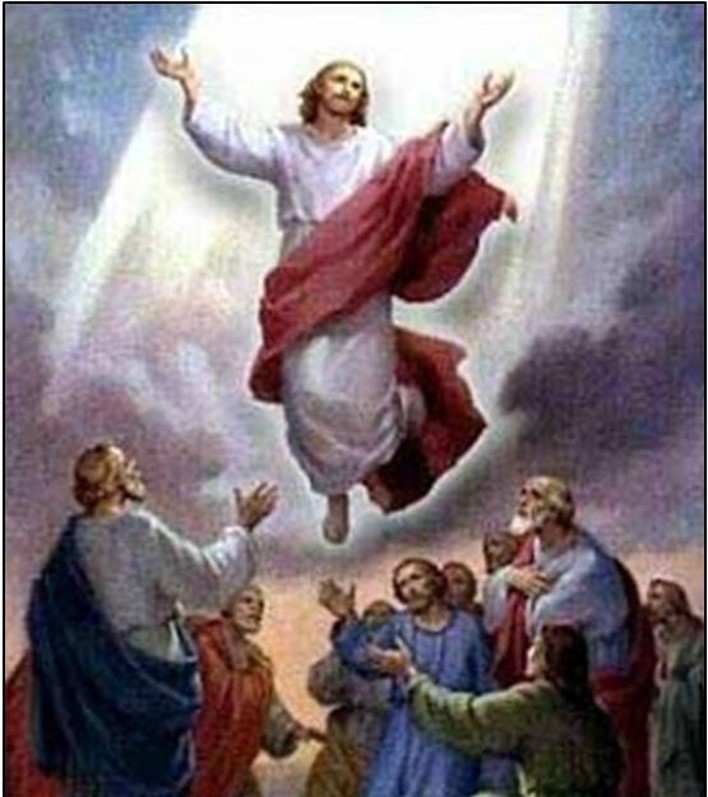
Christ ascending into heaven

Did Jesus Christ really come down from Heaven?

Did Jesus Christ really come down from Heaven?

Introduction

Before we begin it is necessary to make one thing absolutely clear.Did Christ descend from heaven?

The Lord Jesus Christ is the Son of God. He is the greatest Being in all the universe, apart from God Himself. The purpose of this article is to honour the Lord Jesus, as he should be honoured.

Unfortunately, the Bible’s teaching about the Lord Jesus is often misunderstood. In a well-meaning but misguided attempt to honour Jesus, many churches teach things about him that are not Biblical. This booklet sets out to correct these wrong ideas.

This is not from a desire to criticise anybody’s religion, but simply to show what the Bible really teaches about Jesus, the Son of God. Only when we understand this can we give the Lord the glory that he deserves.

By Alan Hayward

“I Came Down from Heaven”

The title of this article is a question: did Jesus Christ come down from heaven? In Chapter 6 of the Gospel of John there is a verse which appears to answer that question. Jesus said:

“I have come down from heaven, not to do my own will, but the will of him who sent me.” (Verse 38.)

But we must not jump to a conclusion. This subject is not nearly as simple as it might seem.

A difficulty arises because there are two very different kinds of language, literal language and figurative language. Both kinds are used by Jesus in the chapter we are considering.

In verse 64 he said, “There are some of you that do not believe.” This is literal language. It means exactly what it says. Even a child could not mistake its meaning.

But many other verses are not like this. Take verses 53 and 54, for instance. Here Jesus said:

“I say to you, unless you eat the flesh of the Son of man and drink his blood, you have no life in you; he who eats my flesh and drinks my blood has eternal life.”

This is figurative language. It does not mean what it appears to say; instead, it carries a deeper meaning. You have to think carefully to discover its real meaning. Consequently, if we are not careful we can easily misunderstand it.

As a matter of fact the unbelieving Jews did misunderstand this and similar sayings of Jesus. They said, “How can this man give us his flesh to eat?” Perhaps they thought Jesus was preaching cannibalism! Whatever they thought, they were very much mistaken.

Well, what about the statement, “I came down from heaven.” Is this literal, or figurative?

There is good reason to think that it could be figurative. In verse 31 of the same chapter there is a mention of what the Old Testament called “manna”. This was a kind of bread which God provided, by a miracle, for His people to eat while they were in the desert. The words of verse 31 are, “He (God) gave them bread from heaven to eat.”

This is obviously figurative language. This miraculous bread was not baked in heaven and then delivered to the earth. The statement that it came from heaven informs us that the God of heaven created it on earth.

There is a famous hymn which people sing at harvest time. The chorus begins, “All good gifts around us are sent from heaven above.” These words are taken straight from the New Testament, from James 1:17, which says that every good gift “is from above, coming down from the Father.” When farmers sing that hymn, they do not imagine that their crops literally come down “from heaven above.” They simply mean that God gives us our harvests.

More Figurative Language

The Bible uses this sort of figurative language about men, as well as about things. It tells us that “there was a man sent from God, whose name was John.” (John 1:6.) Yet John was never in heaven. “Sent from God” simply means that God gave him a special job to do.

But this explanation could only apply to those verses that actually speak of Jesus “coming down” from heaven. There are a number of other passages which seem to suggest, in one way or another, that Jesus once lived in heaven, long before he appeared on earth. This is one of them:

“Father (said Jesus), glorify me in your own presence with the glory which I had with you before the world was made.” (John 17:5)

What are we to make of verses like that? Are they literal, or figurative? Did Jesus really live with God in heaven before the world was made? Or do the words carry some deeper meaning than this?

The purpose of this article is to let the Bible speak for itself and answer those questions for us.

Three Views of Jesus

People who do not believe the Bible usually say that Jesus was just an ordinary man. They are wrong. He was the Son of God. We need not waste any time considering their point of view.

But we shall have to consider the three different views of Jesus that are held by Bible-believing Christians. *

The first view is by far the most widely held. This is that Jesus is God Almighty in human form. People who believe this often refer to Jesus as “the Second Person in the Trinity,” although it is not easy to discover exactly what they mean by that phrase. According to this view, Jesus lived in heaven for ever and ever before he appeared on earth.

The second view is taught by the body known as “Jehovah’s Witnesses,” and a few smaller sects. They say that Jesus is not God, but is a mighty angel who was created by God long ago. They, too, believe that Jesus lived in heaven for a very long time before he lived on earth.

People who hold either of these views, of course, take literally the verses that speak of Jesus coming from heaven.

The third view is held by Christadelphians and some others. According to this view Jesus did not live personally in heaven before he was born on earth; and the verses which refer to his heavenly origin must be understood figuratively.

This is the view that will be explained in this article. If the thought of it surprises you, please be patient and read on. There is a great weight of Bible evidence to support this view.

Jesus Was a Real Man

Jesus was not an ordinary, sinful man. Let us make ho mistake about that. He was a unique man. He was the Son of God. Nevertheless, in a very real sense he was a man and not God Almighty.

This does not mean that he ceased to be a man as soon as he went bodily to heaven. The Bible teaches us to think of him as a man, even now. Long after Jesus had risen from the dead and ascended to heaven, the New Testament was making statements like this:

“God’s grace is much greater, and so is his free gift to so many men through the grace of the one man, Jesus Christ…. How much greater is the result of what was done by the one man, Jesus Christ… many will be put right with God as the result of the obedience of the one man.” (Romans 5:15-19, Today’s English Version.)

“There is one God, and there is one mediator between God and man, the man Christ Jesus.” (1 Timothy 2:5.)

So Jesus really is a man. This is the undoubted teaching of the New Testament. Now compare that with these words by the former Bishop of Woolwich, Dr. Robinson, in his book, “Honest to God,” in a passage where he was explaining how most Christians view Jesus:

“Jesus was not a man born and bred, he was God for a limited period taking part in a charade. He looked like a man, but underneath he was God dressed up – like Father Christmas.”

Many church people find the bishop’s reference to Father Christmas offensive. Yet apart from that, they agree that this is a fair statement of church teaching. If Jesus was really God, or even a mighty angel who once lived in heaven, then he was never a real man, but a Divine Person dressed up in human flesh.

But the New Testament disagrees. It describes Jesus as a man.

This is our first reason for thinking that the usual view of Jesus is mistaken.

The Birth of Jesus

The birth of the Lord Jesus Christ was the result of a mighty miracle. His mother was a young unmarried woman of excellent character. She was a virgin. This was how it happened:

“The angel said to her, ‘Do not be afraid, Mary, for you have found favour with God. And behold, you will conceive in your womb and bear a son, and you shall call his name Jesus… ‘And Mary said to the angel, ‘How shall this be, since I have no husband?’

“And the angel said to her, ‘The Holy Spirit will come upon you, and the power of the Most High will overshadow you; therefore the child to be born will be called holy, the Son of God’.” (Luke 1:30-35.)

Study those words closely. There is much to be learnt from them.

The child was to be Mary’s own son. The angel did not say, “Mary, you will produce a body of flesh for a Divine Person to come and live in.” He said, “You will conceive in your womb and bear a son.” These words were obviously intended to be understood literally. They describe the beginning of a new human life – not the coming to earth of a Divine Person.

Also, if Jesus had been a Divine Person, millions of years older than Mary, could he have been, in any real sense, her son? Yet he washer son, and not just an unusual sort of foster child. Throughout the gospels she is called his mother, and never his foster-mother.

On the other hand, although the man Joseph, who afterwards married Jesus’ mother, is sometimes called his father, we are not left in any doubt about the real facts. Luke refers to Jesus as “the son, as was supposed, of Joseph.” (Luke 3:23.)

So Jesus was truly the son of Mary, not a Divine Person pretending to be the son of Mary. As children do, he took after his mother in many ways. That is what made Jesus truly a man. Real men do not live in heaven before they are born, and neither did this man. His miraculous conception and birth was the very beginning of his existence as a person.

Human nature is weak, and full of temptations. As we shall see later, Jesus inherited the weakness of human nature from his mother.

But that is only half the story. The angel made it plain that the son of Mary was to be also the Son of God. “The power of the Most High will overshadow you; therefore the child to be born will be called holy, the Son of God”, said the angel. (Luke 1:35.)

Jesus also inherited many things from his other parent. God was his father, and from God he inherited the desire to do what was good, always. It was this which helped him to overcome the weakness of his human nature – to’ fight temptation and to conquer it.

To read this complete article click on the pdf… About Christ

Loading

Bible Teaching about Demons

DEMONS EXPLAINED

DEMONS EXPLAINED – Based on a Biblical and Historical Study

The Truth About Demons

As one begins reading the New Testament one is faced with a problem that does not occur in the OldBible Teaching about Demons Testament. In the Old Testament from Genesis right through to Malachi we do not find the problem of demons, devils and demon possession. The Old Testament is completely silent about these things. For 4000 years the Jews knew little about it.

Some might argue that because the word “daimonian”, translated in the King James Version as ‘devil”, (or more correctly, ‘demon’) is Greek, this is the reason that it only occurs in the New Testament. However, the fact still remains that the terms ‘demons’ and ‘demon possession’ do not exist in the Old Testament. The closest word or phrase we can find to demons or demon possession in the Old Testament is the term ‘evil spirit’. In both the New Testament and the Old Testament we find this particular phrase ‘evil spirits’ (or ‘unclean spirits’) occurring.

Demons and Evil Spirits

1 Sam 16 records the period of Israel’s kings, specifically the first mortal king of Israel’s history, Saul, the son of Kish.

During this period of history, Saul was dismissed by God from being king because of his disobedience. The rival to his throne was the shepherd boy, David the son of Jesse, who was anointed by the prophet Samuel:

Then Samuel took the horn of oil, and anointed him in the midst of his brethren: and the Spirit of the LORD came upon David from that day forward. So Samuel rose up, and went to Ramah. But the Spirit of the LORD departed from Saul, and an evil spirit from the LORD troubled him.” 1 Sam chapter 16 verses 13 & 14

Notice those words carefully

An evil spirit from the Lord troubled Saul

There’s a very important pattern to be noticed here. God’s Holy Spirit was upon Saul. It was removed and placed upon David. The result was “an evil spirit from the Lord” came upon Saul. In chapter 19 of the same book we read of a similar situation, but at that time Saul tried to kill David because of his intense jealousy towards him

And there was war again: and David went out, and fought with the Philistines, and slew them with a great slaughter; and they fled from him. And the evil spirit from the LORD was upon Saul, as he sat in his house.” 1 Sam chapter 19 verse 8

Further proof that an ‘evil spirit’ in the Old Testament came from the Lord is in 1 Samuel 18:10

And it came to pass on the morrow, that an evil spirit from God came upon Saul,”

A very important principle again to be noticed here is that God leaves us in absolutely no doubt that an evil spirit comes from him. He’s told us three times already in the Old Testament. We find that the Old Testament is silent about demons and demon possession. The closest phrase, situation or condition that we can find to that in the New Testament is that of “an evil spirit from the Lord” In case we think that the evil spirit from the Lord only came upon men during this particular period in history, let’s look at a completely different period in Israel’s history but again the exact same situationJudges 9 – the time of Gideon and Abimelech :

“When Abimelech had reigned three years over Israel, Then God sent an evil spirit between Abimelech and the men of Shechem; and the men of Shechem dealt treacherously with Abimelech:”  Judges chapter 9 verses 22 & 23

Good and Evil comes from God

Wherever you go in the history of the Old Testament you will find that an evil spirit was brought about by God.. There are literally hundreds of references in the Old Testament showing that evil came from the Lord Let us look at one more – the book of Exodus ch 4. This is an important reference because it deals with a condition; the condition of blindness and deafness. This is the time in history of Israel’s Exodus from Egypt, approximately 1500 years before Christ and about 500 years before the situation we have just read about, in the time of Saul and David.

God spoke to Moses and instructed him to lead his people out of the Egyptian bondage into the desert of Sinai:

“And Moses said unto the LORD, O my Lord, I am not eloquent, neither heretofore, nor since thou hast spoken unto thy servant: but I am slow of speech, and of a slow tongue.”  Exodus chapter 4 verse 10

God had said to Moses, “Go and speak for me”, and Moses said, “Don’t send me because I am slow of speech and slow of tongue” but notice what the Lord said in verse 11 The LORD said to Moses

” Who hath made man’s mouth? or who maketh the dumb, or deaf, or the seeing, or the blind? have not I the LORD?”

Clearly we see that these people that believed openly in one God, believed that evil spirits and infirmities such as blindness, deafness, etc. all came from God. They attributed all these things to the hand of their God. If blindness was created by their God the solution to blindness was also in the hands of their God. That is a very important principle to realize. If God creates blindness, He has the solution to blindness: if He creates deafness, He has the solution to deafness.

No wonder the prophet Isaiah would write, some 700 years later that the Lord would “open the eyes of the blind, that the ears of the deaf would be unstopped and that the lame man would leap as an hart” (Isaiah chapter 35 verses 5-6). Obviously the prophet had that same understanding that if God had created a condition, He also had the solution to that condition.

Do we have a God of the Old Testament and a God of the New Testament?

Let us contrast our findings in the Old Testament to what we find now in the New Testament.

About 450 years lapsed between the last prophet, Malachi and the coming of Messiah, the Lord Jesus Christ. It is here in the New Testament that we find the phenomena of demons, devils and demon possession, a situation previously unknown in the Old Testament writings. How strange! When God Himself says, “I am the same yesterday, today and tomorrow”

Did God change his mind? Or is it a different God that we worship? Do we have a God of the Old Testament and a God of the New Testament?

New Testament Demons

Let’s examine a few passages in the New Testament and see whether we can solve the problem. Let us start by looking at Luke chapter 8.

And it came to pass afterward, that he (Jesus) went throughout every city and village, preaching and shewing the glad tidings of the kingdom of God: and the twelve were with him, And certain women, which had been healed of evil spirits and infirmities, Mary called Magdalene, out of whom went seven demons, Joanna the wife of Chusa and many others”  Luke chapter 8 verses 1-2

Notice the close association between demons and infirmities and evil spirits. They are all synonymous terms.

A small aside here, when we read the word ‘devils’ in the KJV (King James Version) it is translated from a Greek word ‘daimonian’ and should read ‘demon’ and not ‘devil’ The word for devil in the New Testament comes from the word ‘diabolos’, therefore, from this point on, the word ‘demon’ will be substituted for the word ‘devil’ wherever applicable Now as we go through the New Testament, we find that although the nature of demons is different, it is nearly always associated with an infirmity or a disease. Sometimes the word demon is related to human governments, but on most occasions we find that the word demons is related to infirmities and diseases.

Remembering that we read in Exodus 4 that dumbness is an affliction brought about by God, let us then, try and identify the nature of one of these demons – not the demons as we have seen them now in Luke chapter 8, but in Luke chapter 11:

And he was casting out a demon, and it was dumb, And it came to pass when the devil was gone out, the dumb spake”  Luke chapter 11 verse 14

Notice it was the demon that was dumb, that is the terminology we now find. The ‘demon’ not the man – but the demon was dumb. That is what the scripture says.

Who actually spoke? That’s the question we have to ask ourselves, Was it the demon that spoke or the man that spoke? Obviously it was the man that spoke, because if the demon (that had really been cast out) spoke, then clearly the man was not healed: but if the demon that was dumb was cast out and the man spoke, then the man was healed. Very simple.

Clearly it was the man that spoke. We find here therefore, that the manifestation of demon presence depends entirely on their having a host. There is no such thing as a demon outside a body. It’s not to be found in scripture. Wherever we find a demon, it has to have a host. It has to have a body in which it dwells. When demons are able to speak we find again, that it is the man that does the speaking, not the demon.

Although the text here says that it was the demon that spoke, clearly it was the man that did the speaking.

Either that, or the man was not healed. We can choose. So here we find a demon described. The nature of this particular demon was a dumb demon.

Demons, Diseases & Infirmities

Let us look at another characteristic of a demon, in Luke chapter 13

Although the word demon is not actually found in this passage, we find the phrase, “the spirit of infirmity“, which brings us into the bounds of our subject. As we read, see if you can identify the nature of this woman’s infirmity

“And, behold, there was a woman which had a spirit of infirmity eighteen years, and was bowed together, (that means she was buckled up- she was bowed) and could in no wise lift up herself. And when Jesus saw her, he called her to him, and said unto her, Woman, thou art loosed from thine infirmity. And he laid his hands on her: and immediately she was made straight, and glorified God.”  Luke chapter 13 verses 11-13

Notice the language at the end of v 12 ” thou art loosed from thine infirmity.” She was loosed from her infirmity – by inference before that she was bound by her infirmity. Do you agree with that? Well if you do, you are wrong! Look at verse 16, Jesus speaking says,

“And ought not this woman, being a daughter of Abraham, whom Satan hath bound, lo, these eighteen years, be loosed from this bond on the sabbath day?” (not the spirit of infirmity – but Satan)

What does Satan mean to you? Well simply Satan means in the Old Testament ‘satan’ – adversary. This woman was in an adverse situation. She had arthritis – she was buckled up, she couldn’t straighten up. So can we see that the spirit of infirmity is synonymous here with the term ‘satan’? She was bound by her infirmity or we might say she was bound by ‘satan’ and the nature of this satan was arthritis. She had been bent up with arthritis, and now she was made straight.

So as far as the natures of demons was concerned we have a few natures that we’ve looked at: one a dumb demon, and the other an arthritic satan. Although that might sound a little humourous that’s essentially what the scripture has told us.

Let us take one more example of how demons are associated with infirmities and diseases. Matthew 17, Again, as we’re reading from this particular passage let us see whether we can diagnose the problem. Let us see if we can identify this young man’s demon – because this man was demon possessed:

“And when they were come to the multitude, there came to him a certain man, kneeling down to him, and saying, Lord, have mercy on my son: for he is lunatic, and sore vexed: for ofttimes he falleth into the fire, and oft into the water.” Matt 17 :14-15

There are four points that we want to draw to your attention here:-

1.     “He was a lunatic” The word lunatic simply means that he was affected by the moon

2.     “He was sore vexed

3.     Oftimes he fell into the fire and oftimes he fell into the water

4.     Jesus rebuked the demon; and he (that is, the demondeparted out of him: and the child was cured from that very hour.” Verse 18

Notice the result – “He was cured” Before that he had a demon, when the demon left he was cured. By inference, he was sick, he had an infirmity. When that infirmity was healed, the scripture tells us that he was cured.

How would you diagnose that particular problem? A person that was ‘lunatic’ that often fell into the fire and often into the water? Most doctors would say that child suffered from epilepsy. Anyone who has ever experienced epilepsy would say that often, when a person had an epileptic seizure, he would suddenly fall to the ground. He would have literally no control and sometimes he would froth at the mouth when he had a seizure. This condition, to these people was ‘lunatic, sore vexed, often falling into the fire and often into the water’ The child suffered from epilepsy, and when the epilepsy departed from him he was cured.

The three situations that we’ve looked at:-

A

· a man is dumb

· the dumbness is cast out

· the man is healed.

B.

· a woman suffers from arthritis

· she is loosed from her arthritis

· the woman is cured

C.

· a boy suffers from epilepsy

· the epilepsy departs out of him

· the boy is cured.

Demons, then, are often associated with or synonymous with diseases and infirmities.

Personification & Language of the Day

The next question that we have to look at, and it’s possibly one of the most difficult, is why then, does the language of the New Testament suggest that demons were actual creatures, actual people, or whatever we’d like to suggest they were?

Why or how is it that demons could talk? The reason is twofold. The first suggestion is that it is a figure of speech. In English we have a figure of speech called personification. When we take something that is inanimate and we make it alive by making it sound as if it is a person. We must be very careful not to restrict figures of speech to English only.

Greek and Hebrew are both very colourful languages and both in Greek and Hebrew we find this figure of speech of personification.

Reading from Proverbs we find a delightful personification of wisdom. Pay careful attention to these words:

Doth not wisdom cry? and understanding put forth her voice? She standeth in the top of high places (she referring to wisdomShe crieth at the gates, at the entry of the city, at the coming in at the doors” Proverbs chapter 8 verses 1-3.

And again at verse 12

“I wisdom dwell with prudence, and find out knowledge of witty inventions.”

Here, in the Old Testament, we see that wisdom and prudence and their characteristics are personified as if they are real people. In this particular case, wisdom is given the feminine gender. She standeth at the top of high places…She crieth at the gates – I wisdom dwell with prudence…etc.

In the New Testament we find words just as expressive. This time listen to some words from the book of Revelation…

The apostle John writes:

And I saw three unclean spirits like frogs” – (what a description for unclean spirits, “like frogs”!come out of the mouth of the dragon, and out of the mouth of the beast, and out of the mouth of the false prophet.. For they are the spirits of demons,”  Revelation chapter 16 verses 13,14

There we have it… the spirits of demons look like frogs! Nobody in his right mind is going to say that an unclean spirit, or an evil spirit is a frog! We find the language of the New Testament and the Old Testament colourful in that they are trying to describe to us something that is hard to understand in ordinary language.

Let’s draw an analogy in English. If someone says to you, “Father Time has taken his toll on George”., you know that George is suffering from the effects of old age. That person is personifying the effects of age on George. He is not saying that time is a man. It’s much more colourful than saying, “George is getting old”

We can also see that this kind of language belongs to the Old Testament as well as to the New Testament; to Hebrew as well as to Greek.

That’s the first reason we would suggest that we find the personification of demons in the New Testament.

Why different terminology between Old and New Testaments?

The second, and we think far more important reason for this change in terminology is that something happened in Jewish history between the time of Exodus, Samuel, Moses, some of the prophets, and the coming of Messiah. An extraordinary event occurred in Jewish history. The Jews, who inherited the land of Israel from their fathers, were temporarily taken out of their land to Babylon, and there they served the king of Babylon for a period of some 70 years. It wasn’t only the king of Babylon they served. They also served the kings of Media and Persia for a period of time. Because of their unfaithfulness to God the Jews now found themselves exile in Babylon. They were surrounded by Babylonians who practiced a religion called, Zoro-Astrianizm.

This religion featured prominently during the period after the exile, especially during the 2nd century B.C. and its effects are with us to this day. The reason we say that is because most people who claim that they are Christians believe that when they are ‘demon possessed’ the angel of the devil, or the angel of satan is within them. This idea comes from Babylon. It does not come from scripture.

God is in Control

The big difference between the Zoro-Astrianism belief, which the Babylonians practiced, and the mono-theistic belief which the Jews practiced, was that the Zoro-Astrians had two gods. They had a god of light and a god of darkness. The god of light was called Ahura Mazda. The god of darkness was Ach Rimmon.

There was a man, Cyrus, king of Persia. He was Zoro-Astrian. He believed in two super-natural powers vying for control in the heavens. He believed in a good god and a bad god; a god of light and a god of darkness.

In this context. Isaiah chapter 45 is a very important scripture, written by Isaiah, approximately 750 years B.C. (and 150 years before Cyrus king of Persia was even born.)

Thus saith the LORD to his anointed, to Cyrus, whose right hand I have holden, to subdue nations before him; ” Isaiah chapter 45 verse 1

Cyrus wasn’t to be conceived for another 150 years – and here he was, mentioned by name in scripture, and God was going to raise up this man for a special purpose. That purpose was to send the Jews back to Jerusalem to rebuild their temple.

For Jacob my servant’s sake, and Israel mine elect, I have even called thee by thy name: I have surnamed thee, though thou hast not known me“. Isaiah chapter 45 verse 4

Cyrus never came to know the God of Israel, NEVER! But God had called him by his name, and surnamed him, “though thou hast not known me

I am the LORD, and there is none else, there is no God beside me: I girded thee, though thou hast not known me: (BUT) That they may know from the rising of the sun, and from the west, that there is none beside me. I am the LORD, and there is none else. form the light, and create darkness:” Isaiah chapter 45 verses 5-7

There’s no god of light and god of darkness. God is saying specifically to this Zoro Astrian “form the light – create darkness – make peace, create evil. I the Lord do all these things” That is the answer to anybody who believes that there are two supernatural powers vying for power in the heavens.

God is in control of everything!

Although God sent the prophets to his people Israel, “rising up early in the morning”, the problem with human nature, as it is this day, is that people never listen. The Jews never listened. They did not hearken unto the prophets that God sent “rising early in the morning” They got involved in pagan worship.

They served other gods, yea gods of wood and stone, which neither see nor hear, nor think“, as the prophet Moses had prophesied about so many years before. They corrupted themselves and they began to believe in the pagan gods of Babylon; two gods – a god of light, and a god of darkness vying for power in the heavens.

The people to whom Jesus preached

It is to this superstitious, apostate Jewish people that Jesus came to preach the glad tidings of the kingdom of God. So we find the Jews, during the time of Jesus attributing their infirmities and their diseases to demons and to devils. That’s what they believed and that belief came from Babylon. At this time they didn’t call this particular god, Ach Rimmon, because that was too pagan orientated. They called him Beelzebub, the prince of the devils. It’s interesting to notice that Beelzebub was the god of the Philistines, a pagan god. So we find that they attributed their infirmities to Beelzebub, in fact they accused Jesus of casting out demons in the name of Beelzebub, the prince of the demons.

And the scribes which came down from Jerusalem said, He hath Beelzebub, and by the prince of the devils casteth he out devils” Mark chapter 3 verse 22

In other words they were saying, “This man, Jesus of Nazareth is mad. He has got a demon and because he is possessed with evil, he casts out evil”

Quite an absurd argument. It needs a distorted belief to come up with a distorted argument like that. Look at the logic of Jesus’ answer in verse 23:

he called them unto him, and said unto them in parables, How can Satan cast out Satan?”  Mark chapter 3 verse 23

In other words, If what you believe is true, that there are supernatural forces trying to destroy what is good and what is right, how can they achieve their ends by destroying one another? Surely if I were the prince of the demons I would rather have destroyed the victim, and by so doing, achieve the demons’ own ends” How can evil cast out evil? It cannot. Therefore their own argument recoils upon themselves and can no longer stand.

And if a kingdom be divided against itself, that kingdom cannot stand.” Verse 24

And neither could theirs. Their argument, based on a false belief, was self-destructive.

Here then we see the light of this world expelling the darkness of this world. The Son of God healing the sons of men.

What conclusions can we draw so far?

On the one hand we find that there was a people, the Jews of the Old Testament. They believed in one God, and one God only and they attributed everything to their God; life, death, light, darkness, sickness, health, good, evil – everything was attributed to their God. On the other hand we have people that believed in two gods, as did the Zoro-Astrians in Babylon, and they attributed everything that is good to one god on the one hand and everything that is evil to another god, on the other hand. We may call that god whatever we wish, we may call that god ‘Ach Rimmon’, we may call that god ‘Beelzebub’ we may call him ‘Satan’ and we may call him ‘The Devil’ Whatever we may call him, it boils down to the same thing, that we have two forces in heaven: one good, one bad.

The other conclusion we can draw is that in Old Testament times the Jews were mono-theistic

Hear O Israel, the Lord our God is one Lord, and thou shalt worship the Lord thy God with all thy heart and with all thy strength and with all thy might”

On the other hand, in New Testament times these same people, the Jews of the New Testament had followed the ways of the Gentiles. No longer did they attribute evil to their God, but this time they attributed evil to the gods of the Gentiles, Beelzebub, Satan and the Devil. So we find that the problems concerning demons only occurred after the exile and was manifested well and truly in New Testament times, during the life of Christ. We find too, that demons are often personified because people believed that they were real. They believed that if they were sick, or dumb or deaf that they possessed a demon. Also because this personification was accepted as a figure of speech and was the vernacular of the day. it is often found in the New Testament that if the person afflicted, or the people in his company, believed in supernatural demons, the language of demons is then found.

We also find in the New Testament, on the other hand, that if someone did not believe that they were demon possessed, and the people in their company did not believe in demons, then the language of demons is not used

Jesus rebukes a fever

To illustrate this point of the language of demons not being used let us look at Luke chapter 4 – this time the healing of Simon’s mother in law. Incidentally, the apostle John records all the miracles of Jesus without ever referring to the casting out of demons, which substantiates the point, that the language used to describe the healing is of a secondary matter.

Some spoke of afflictions as a person being possessed by demons, and others did not; and it depended upon the individual’s belief. We feel here, that Simon Peter’s mother in law did not believe that she was possessed by demons.

Therefore the language of demons is not used.

“And he arose out of the synagogue, and entered into Simon’s house. And Simon’s wife’s mother was taken with a great fever; (not a demon – a great fever) and they besought him for her. And he stood over her, and rebuked the fever; (he did not rebuke the demon – but rebuked the fever) and it (that is the fever) left her and immediately she arose and ministered unto them” Luke chapter 4 verses 38 -39

Here we find the affliction is addressed as though it were a person, but clearly the affliction was not a person. This is very, very important. The affliction is addressed as though it were a person but the affliction is not a person – neither is wisdom, nor is prudence. It is a “personification”. Notice here that because Simon Peter’s mother in law does not believe in demons the language of demons is not used. He rebukes the fever. If Simon Peter’s mother in law had believed that she was possessed by a demon, v 39 would have read, “Jesus rebuked the demon and the demon left her”

Points covered so far.

1.    Before the Jews went into Babylon, they attributed good and evil to one God. We’ve looked at some cases: 1 Samuel chapter16 verse 14 and Exodus chapter 4 verse 11.

2.    Zoro Astrianizm – the belief in demons and demon possession comes from Babylon, where they believed in 2 gods, two supernatural forces, Ahora Mazda the god of light and Ach Rimmon, the god of darkness. It was to Cyrus, king of Persia, who believed in these two gods, that Isaiah wrote, “I form the light and I form the darkness. I create good and I create evil. I the Lord do all these things

3.    We only meet the problem or the phenomena of demons, in the New Testament.

4.    The Greek word for demon is ‘daimonion’ not to be confused with the Gk word ‘diabalos’ which is the word rendered ‘devil’ or ‘the Devil’ in the New Testament.

5.    Demons are often associated with diseases and infirmities. We looked at the reference in Luke chapter 8 verse 2 “there were certain women which had been healed of evil spirits, infirmities, of which Mary Magdalene was one, out of whom was driven seven demons”

6.    The nature of some of these demons. We looked at a demon that was dumb (Luke 11:4), a woman that was ‘bound by Satan’ (she was an arthritic – Luke 13:11), and a boy who was an epileptic, (Matt 17:14). You will never find in the scriptures, a demon without a host, that is without a body to dwell in. When a demon spoke, the speech came from the one possessed and not the demon itself. No demon ever spoke without a host – conclusion: the person had to do the speaking. Luke chapter 11 verse 14

7.    Beelzebub, the god of Ekron was actually called the Lord of the Flies, or the god of the flies, (read it for yourself in 2 Kings chapter 1 verses 1-16) Notice that Beelzebub, in actual fact, had nothing to do with demons. If Beelzebub was the god of Ekron in the Old Testament and the Old Testament knows nothing of demons, clearly then Beelzebub also has nothing to do with demons – although that’s what they substituted in the New Testament. It was the Pharisees that did it, by the way.

8.    The last case that we considered, depended upon the belief, or superstition of the person involved. Jesus would either rebuke the demon or he would rebuke the fever. In Luke 4:38 we read that he rebuked the fever; but exactly the same terminology is used as rebuking a demon in Luke chapter 9 verse 42

The Healing of Legion

With this background in mind, let us then consider the healing of Legion:

And they came over unto the other side of the sea, into the country of the Gadarenes. And when he was come out of the ship, immediately there met him out of the tombs a man with an unclean spirit, Who had his dwelling among the tombs; and no man could bind him, no, not with chains: Because that he had been often bound with fetters and chains, and the chains had been plucked asunder by him, and the fetters broken in pieces: neither could any man tame him. And always, night and day, he was in the mountains, and in the tombs, crying, and cutting himself with stones. But when he saw Jesus afar off, he ran and worshipped him, And cried with a loud voice, and said, What have I to do with thee, Jesus, thou Son of the most high God? I adjure thee by God, that thou torment me not. For he said unto him, Come out of the man, thou unclean spirit. And he asked him, What is thy name? And he answered, saying, My name is Legion: for we are many. And he besought him much that he would not send them away out of the country. Now there was there nigh unto the mountains a great herd of swine feeding. And all the devils besought him, saying, Send us into the swine, that we may enter into them. And forthwith Jesus gave them leave. And the unclean spirits went out, and entered into the swine: and the herd ran violently down a steep place into the sea, (they were about two thousand;) and were choked in the sea. And they that fed the swine fled, and told it in the city, and in the country. And they went out to see what it was that was done. And they come to Jesus, and see him that was possessed with the devil, and had the legion, sitting, and clothed, and in his right mind: and they were afraid. And they that saw it told them how it befell to him that was possessed with the devil, and also concerning the swine. And they began to pray him to depart out of their coasts. And when he was come into the ship, he that had been possessed with the devil prayed him that he might be with him.

Howbeit Jesus suffered him not, but saith unto him, Go home to thy friends, and tell them how great things the Lord hath done for thee, and hath had compassion on thee. And he departed, and began to publish in Decapolis how great things Jesus had done for him: and all men did marvel.  Mark chapter 5 verses 1-20

Here then we’d say is a possible interpretation of the healing of Legion. In Mark 5 we find a man who was insane.

He was deranged. Verse 3 tells us that “he had his dwelling among the tombs and no man could bind him, not even with chains” The man himself, believed the superstitions that came from Babylon which were cultivated and taught by religious leaders. The Jews, mainly the Pharisees, believed that his condition was the result of demon possession. That was what this man believed, because that was what he was taught to believe. He believed that his condition was as a result of sin.

In this connection, consider the situation in John chapter 9 where a man was born blind, and they brought him to Jesus, asking

Who sinned, this man or his parents, that he was born blind?”

What a strange situation! They believed that this man was possessed by demons either because of his sin, or his parents sin.

This is the same situation. This man believed that his condition was a result of either his parent’s sins or his own sins. He also believed that the only one that could cast out his insanity was the Messiah. Now while the Pharisees taught the people that when they were ill or deranged they were demon possessed, on the other hand they taught that when Messiah

came, he would rid them of their evil.

In Mark 5 Verse 6 & 7 we read:

But when he ( that is the man, not the demon) saw Jesus afar off, he ran and worshipped him, And cried with a loud voice, and said, What have I to do with thee, Jesus, thou Son of the most high God? “

He believed that the Messiah could heal him. So we see light and darkness coming face to face. The light of truth as it is in Jesus Christ, on the one hand, and the darkness of superstition on the other hand.

Jesus said unto him (verse 8), “Come out of the man, thou unclean spirit.” Or in other words, “Come out of the man, insanity” And because of this man’s superstition, because of the simplicity of this man’s belief he needed a physical, literal illustration of his insanity coming out of him otherwise he would never have believed at all that he was cured. So Jesus took the insanity that existed in the man and he transferred it into the pigs.

Remember what happened (in 1 Samuel 16: 13 & 14) when the Spirit of God was upon Saul? God took that Spirit from Saul and placed it upon David, and an evil spirit from the Lord came upon Saul.

This is the same type of situation. Jesus took this condition of insanity and put it upon the pigs, to give this man a literal illustration that whatever he believed he suffered from had now been inflicted upon the pigs. But Jesus took the precaution here against further contamination of superstitious religious teaching. Those pigs ran into the lake and were drowned. They were destroyed. and so were the demons. That’s the important point. The demons were destroyed with the swine.

Conclusion: there can be no such thing as a supernatural demon. Supernatural things don’t die.

Notice the condition of the man after his experience:

“And they come to Jesus, and see him that was possessed with the devil, and had the legion, sitting, and clothed, and in his right mind:” Mark chapter 5 verse 15

In the parallel version in Luke chapter 8 of the healing of Legion, we read that this man was naked. He had no clothes and now he was clothed.

Doesn’t that remind you of Eden where we find a man and a woman in a situation where they had sinned?

They had transgressed against God and were naked? They were ashamed of their nakedness, and hid from God in the garden. What happened? God clothed their nakedness with coats of skins. Here was Legion, clothed with the righteousness which comes by faith in Christ.

How’s your clothing? Are you clothed with Christ? Have you “put on Christ” through belief and baptism?

It is only if you have put on Christ, like Legion, that you can sit quietly, clothed and in your right mind.

By Barry Van Heerden, South Africa

Loading

Death ends in a grave

Death is the end and not the start of an afterlife

Death is the end and not the start of an afterlife

Among the ancient pagan religions a single core religious belief is clear to see from theDeath ends in a grave tombs that have survived from those eras – namely the belief in an afterlife. The Babylonians placed weapons and implements in their tombs to help the ‘spirit’ of their dead ones protect itself and be able to hunt on its way to the afterlife. The Egyptian “book of the dead” shows how that they believed that upon death the “Weighing of the Heart” judgment ceremony was performed before the god Osiris. This would determine if the one whose heart was being weighed was worthy of spending eternity in the fields of Hetep and Iaru. The Greeks also believed in an immortal soul. The teachings of Pluto declared that everyone had an “immortal soul” which, depending on how an individual had lived their life, would mean they would either spend an eternity of torture in Hades or Tartarus or spend their time in paradise in Elysian. The Romans also adopted the same doctrine as the Greeks. So the ancients then, believed in the immortality of the soul and an afterlife upon death.
What about the moderns of today? A startling similarity of beliefs exist in current world religions. In Islam the idea of an immortal soul is a fundamental belief. The Buddhist religion teaches that upon death we live on as an ever-changing entity. In Sikhism we find a belief in the “Atma” or “Soul” which continues on after death. The Hindu religion teaches that all have a ‘spirit’ or soul which is reborn, again and again. The Catholic Church and many of the churches that have split off from her, believe in an immortal soul as a core doctrine. The doctrine of the ancients is alive and well in the many world religions we find being practiced today.

However, the important question is: what does the Bible teach about death? We know the Bible is the inspired word of God because of the authority of evidence that is found in its prophecy which surpasses all other religious texts, many of which do not contain a word of prophecy and those that do are untestable. So what does the Bible teach then in regards to death?

The nature of our life

And THE LORD God formed man of the dust of the ground, and breathed into his nostrils the breath of life; and man became a living soul. Genesis 2:7

The Spirit of God hath made me, and the breath of the Almighty hath given me life. If thou canst answer me, set thy words in order before me, stand up. Behold, I am according to thy wish in God’s stead: I also am formed out of the clay. Job 33:4-6

Thou (God) hidest thy face, they (the beasts) are troubled: thou takest away their breath, they die, and return to their dust. Thou sendest forth thy spirit, they are created: and thou renewest the face of the earth. Psalm 104:29-30

So the Bible teaches that man is a creature formed from the dust and he lives by the energy that God has breathed into him. This is something man shares with all living things that God has created.

But note the facts here from the Genesis record. The Bible does not teach man became an “immortal” soul. He was a “living soul”. This “living” was threatened to be taken away upon disobedience:

But of the tree of the knowledge of good and evil, thou shalt not eat of it: for in the day that thou eatest thereof thou shalt surely die (Hebrew = “dying thou shalt die”). Genesis 2:17

So if man disobeyed God he would die. The apostle Paul, through inspiration, puts it like this:

Wherefore, as by one man sin entered into the world, and death by sin; and so death passed upon all men, for that all have sinned. Romans 5:12

When the power of God is removed from man, like beasts, man returns to the dust which he was created from. The following verses prove this:

All flesh shall perish together, and man shall turn again unto dust. Job 34:15

I said in mine heart concerning the estate of the sons of men, that God might manifest them, and that they might see that they themselves are beasts. For that which befalleth the sons of men befalleth beasts; even one thing befalleth them: as the one dieth, so dieth the other; yea, they have all one breath; so that a man hath no preeminence above a beast: for all is vanity. All go unto one place; all are of the dust, and all turn to dust again. Ecclesiastes 3:19-21

Then shall the dust return to the earth as it was: and the spirit shall return unto God who gave it. Ecclesiastes 12:7

Life is a vapour that vanishes away

The sad truth then is that our life is a temporary thing. We are here today but gone tomorrow. The scriptures describe life in these poetical ways:

Whereas ye know not what shall be on the morrow. For what is your life? It is even a vapour, that appeareth for a little time, and then vanisheth away. James 4:14

Man is like to vanity: his days are as a shadow that passeth away. Psalm 144:4

What exactly is death & what happens when we die?

For the living know that they shall die: but the dead know not any thing, neither have they any more a reward; for the memory of them is forgotten. Also their love, and their hatred, and their envy, is now perished; neither have they any more a portion for ever in any thing that is done under the sun. Ecclesiastes 9:5-6

Return, O LORD, deliver my soul: oh save me for thy mercies’ sake. For in death there is no remembrance of thee: in the grave who shall give thee thanks? Psalm 6:5

Put not your trust in princes, nor in the son of man, in whom there is no help. His breath goeth forth, he returneth to his earth; in that very day his thoughts perish. Psalm 146:3-4

For the grave cannot praise thee, death can not celebrate thee: they that go down into the pit cannot hope for thy truth. The living, the living, he shall praise thee, as I do this day: the father to the children shall make known thy truth. Isaiah 38:18-19

As the above verses demonstrate, the Bible clearly teaches that death, in itself is a punishment. When a man dies, we are told that he is unconscious, knowing nothing. Dead in every sense of the word. The truth of the matter then is that there is no afterlife of the sort the ancients of old believed in – with their pagan concept of an immortal soul. Our life is not eternal. There is no clear evidence of any afterlife and such an idea of a spirit life after death is not presented in the Bible.

The clear Bible teaching about the soul

The Bible is clear about the idea of a soul. It teaches simply that the soul can die and is therefore not immortal. Consider these passages:

“…the soul that sinneth, it shall die.” Ezek 18:4

“my soul chooseth strangling, and death rather than my life.” Job 7:15

“Let him know, that he which converteth the sinner from the error of his way shall save a soul from death, and shall hide a multitude of sins.” James 5:20

“But God will redeem my soul from the power of the grave: for he shall receive me.” Psalm 49:15

“And the second angel poured out his vial upon the sea; and it became as the blood of a dead man: and every living soul died in the sea.” Revelation 16:3

“He made a way to his anger; he spared not their soul from death, but gave their life over to the pestilence;” Psalm 78:50

“All they that be fat upon earth shall eat and worship: all they that go down to the dust shall bow before him: and none can keep alive his own soul.” Psalm 22:29

Contradictions with the immortal soul theory

One who claims to believe in man having an immortal soul might want to think about the following contradictions which arise from such a belief:

  • Men would not perish like beasts if they had an immortal soul:
    Like sheep they are laid in the grave; death shall feed on them; and the upright shall have dominion over them in the morning; and their beauty shall consume in the grave from their dwelling. Psalm 49:14-20
  • Immortality would not only be for the righteous if men had it already:
    Who will render to every man according to his deeds: To them who by patient continuance in well doing seek for glory and honour and immortality, eternal life: But unto them that are contentious, and do not obey the truth, but obey unrighteousness, indignation and wrath. Romans 2:6-8
  • Immortality would not be a gift if we had it already:
    For the wages of sin is death; but the gift of God is eternal life through Jesus Christ our Lord. Romans 6:23
  • Immortality would not now be hidden if it is something which happens all the time:
    For ye are dead, and your life is hid with Christ in God. Colossians 3:3
  • Immortality could not have been brought to light by Jesus if it was around before him in every man who had lived:
    But is now made manifest by the appearing of our Saviour Jesus Christ, who hath abolished death, and hath brought life and immortality to light through the gospel. 2 Timothy 1:10
  • Immortality would not be dependent upon a belief of Jesus and the gospel:
    And this is the will of him that sent me, that every one which seeth the Son, and believeth on him, may have everlasting life: and I will raise him up at the last day. John 6:40
  • There would be no need of a resurrection:
    For if the dead rise not, then is not Christ raised: And if Christ be not raised, your faith is vain; ye are yet in your sins. Then they also which are fallen asleep in Christ are perished. If in this life only we have hope in Christ, we are of all men most miserable. But now is Christ risen from the dead, and become the firstfruits of them that slept. 1 Corinthians 15:16-20
  • The soul would not be something which could be lost or exchanged:
    For whosoever will save his life (Greek = “psuche” translated “soul” elsewhere) shall lose it: and whosoever will lose his life for my sake shall find it.

Why do we die?

After Adam sinned God passed a sentence on him:

And unto Adam he (God) said, Because thou hast hearkened unto the voice of thy wife, and hast eaten of the tree, of which I commanded thee, saying, Thou shalt not eat of it: cursed is the ground for thy sake; in sorrow shalt thou eat of it all the days of thy life; Thorns also and thistles shall it bring forth to thee; and thou shalt eat the herb of the field; In the sweat of thy face shalt thou eat bread, till thou return unto the ground; for out of it wast thou taken: for dust thou art, and unto dust shalt thou return. Genesis 3:17-19

The Bible teaches that all of mankind dies because they have inherited Adam’s nature – a nature related to sin, which is sin-prone and mortal. Man is therefore in a position which is in need of reconciliation with God.

Man dies because of this nature he inherits and because of the transgressions he commits when he chooses to follow the temptations of this rebellious nature and break God’s law (called sinning):

Wherefore, as by one man sin entered into the world, and death by sin; and so death passed upon all men, for that all have sinned. Romans 5:12

For the wages of sin is death; but the gift of God is eternal life through Jesus Christ our Lord. Romans 6:23

For as in Adam all die, even so in Christ shall all be made alive. 1 Corinthians 15:22

Where has the idea of the immortal soul come from?

We hope, dear reader, that you can see clearly now that the idea of having an immortal soul is not one that comes from the Bible. Why then do churches all over the world hold to this view and teach it?

To understand this one must understand the Bible’s prophecies about it’s message becoming corrupted. Please read our article “Christianity Teaching Corrupted“…

It’s worthy of note that the idea of the immortal soul was not actually taught by the very early churches but came in much later. Once inculcated into the Catholic church, this doctrine was carried with it into all the split-offs from the Catholics which is why the doctrine is so prevalent no matter what church you go to.

This is what one of the early church Fathers proclaimed about this subject:

 “For some things are known even by nature: the immortality of the soul, the instance, is held by many … I may use, therefore, the opinion of Plato, when he declares: ‘Every soul is immortal”  Tertullian, 220 AD

Notice where he is quoting from to support the concept of an immortal soul. He quotes from Greek Philosopher Plato and not from the Bible. So to answer the question where has the idea come from Tertullian is telling us it came from – Greek paganism!

The teaching of the immortal soul was not officially declared by a Catholic church council until 1513. This is what was decreed at the Lateran Council:

Whereas some have dared to assert concerning the nature of the reasonable soul that it is mortal, we, with the approbation of the sacred council do condemn and reprobate all those who assert that the intellectual soul is mortal, seeing, according to the canon of Pope Clement V, that the soul is immortal and we decree that all who adhere to like erroneous assertions shall be shunned and punished as heretics. Lateran Council of 1513

Where is the basis of argument? On the scripture or on what  a previous Pope had written? A protestant called William Tyndale, an early translator of the Bible into English, could see the false teaching that had arisen within the church:

“In putting departed souls in heaven, hell, and purgatory, you destroy the arguments wherewith Christ and Paul prove the resurrection, which we be warned to look for every hour.  The true faith putteth the resurrection; the heathen philosophers, denying that (i.e. the resurrection) did put that souls did ever live.  And the pope joineth the Spiritual doctrine of Christ, and the fleshy doctrine of philosophers together, things so contrary that they cannot agree, and because the fleshy minded pope consenteth unto the heathen doctrine, therefore, he corrupteth the Scripture to establish it……..If the souls be in heaven, tell me why they be not in as good case as the angels be, and then what cause is there for the resurrection?” William Tyndale

Is death the end?

In Genesis God makes promises to the faithful man Abraham:

Now the LORD had said unto Abram, Get thee out of thy country, and from thy kindred, and from thy father’s house, unto a land that I will shew thee: And I will make of thee a great nation, and I will bless thee, and make thy name great; and thou shalt be a blessing: And I will bless them that bless thee, and curse him that curseth thee: and in thee shall all families of the earth be blessed. Genesis 12:1-3

And the LORD said unto Abram, after that Lot was separated from him, Lift up now thine eyes, and look from the place where thou art northward, and southward, and eastward, and westward: For all the land which thou seest, to thee will I give it, and to thy seed for ever. And I will make thy seed as the dust of the earth: so that if a man can number the dust of the earth, then shall thy seed also be numbered. Arise, walk through the land in the length of it and in the breadth of it; for I will give it unto thee. Genesis 3:14-17

These promises which were directly given to Abraham and his ‘seed’ (descendant) were not to do with a fanciful realm in the clouds but were directly related to the earth. In Galatians Paul, through inspiration says that these very promises were the gospel, the good news, preached to Abraham (see Galatians 3:8 & 16). Abraham was to inherit land on the earth. Abraham lived and died and did not receive this promise:

And he (God) gave him (Abraham) none inheritance in it, no, not so much as to set his foot on… Acts 7:5

These (faithful men and women of old, Abraham among them, see v8) all died in faith, not having received the promises… Hebrews 11:13

So this promise of inheriting the land and all nations being blessed is still unfulfilled. How then will Abraham be able to inherit the land “forever” seeing that he is dead? There is a clue in Hebrews 11:17-19:

By faith Abraham, when he was tried, offered up Isaac: and he that had received the promises offered up his only begotten son, Of whom it was said, That in Isaac shall thy seed be called: Accounting that God was able to raise him up, even from the dead; from whence also he received him in a figure. Hebrews 11:17-19

Abraham believed in a resurrection from the dead. This teaching of a resurrection from death at a future time is confirmed in many parts of the Bible:

I shall be satisfied, when I awake, with thy likeness. Psalm 17:15

And many of them that sleep in the dust of the earth shall awake, some to everlasting life, and some to shame and everlasting contempt. Daniel 12:2

Thy dead men shall live, together with my dead body shall they arise. Awake and sing, ye that dwell in dust: for thy dew is as the dew of herbs, and the earth shall cast out the dead. Isaiah 26:19

So then there is to be a resurrection of the dead. However a resurrection in itself is not enough. Lazarus, for example, was raised from the dead (John 12:17) but in due time he died again. The problem of the nature he inherited from Adam still caused him to sin and therefore he died. What is the Bible’s answer?

The Judgment

Following on from the resurrection there is to be a judgment:

Marvel not at this: for the hour is coming, in the which all that are in the graves shall hear his voice, And shall come forth; they that have done good, unto the resurrection of life; and they that have done evil, unto the resurrection of damnation. John 5:28-29

…for thou shalt be recompensed at the resurrection of the just. Luke 14:14

A resurrection from the dead is one thing but there is a process of judgement which will take place to determine whether the one raised is worthy of the gift of life or the damnation of death.

If the one who is judged is found acceptable then we read that the person’s body will be changed – changed from having Adam’s nature to something far more wonderful:

…we look for the Saviour, the Lord Jesus Christ: Who shall change our vile body, that it may be fashioned like unto his glorious body, according to the working whereby he is able even to subdue all things unto himself. Phil 3:21

For in this we groan, earnestly desiring to be clothed upon with our house which is from heaven: 2 Corinthians 5:2

For this corruptible must put on incorruption, and this mortal must put on immortality. 1 Corinthians 15:53

This is the teaching of the Bible but the message of salvation is not a universal one. It is only offered to a select few who God calls.

How can I be saved?

It was the mission of Jesus Christ to open up a way of salvation and a way to immortality for doomed mankind. Sin had brought death and only righteousness would bring life. Jesus, although bearing Adam’s sin prone nature, never gave into it and showed forth God’s righteousness in obedience to God. His sacrifice provided a way whereby others could become acceptable in the sight of God and have their sins forgiven.

The next day John seeth Jesus coming unto him, and saith, Behold the Lamb of God, which taketh away the sin of the world. John 1:29

For the wages of sin is death; but the gift of God is eternal life through Jesus Christ our Lord. Romans 6:23

For as in Adam all die, even so in Christ shall all be made alive. 1 Corinthians 15:22

So to obtain this hope of salvation then, a person must move from being “in” Adam to being “in” Christ. How is this possible?

For as many of you as have been baptized into Christ have put on Christ. Galatians 3:27

Therefore the Bible teaches that only those who have been baptised, those “in Christ” have opportunity to be saved. This is God’s revealed way of salvation. Through belief and baptism. There is no other way:

For God so loved the world, that he gave his only begotten Son, that whosoever believeth in him should not perish, but have everlasting life. John 3:16

When will eternal life be given?

The Bible teaches that this gift of eternal life is to be given in the future when Jesus returns:

But every man in his own order: Christ the first fruits; afterward they that are Christ’s at his coming. 1 John 15:23

And, behold, I (Jesus) come quickly; and my reward is with me, to give every man according as his work shall be. Revelation 22:12

I charge thee therefore before God, and the Lord Jesus Christ, who shall judge the quick and the dead at his appearing and his kingdom… 2 Tim 4:1

The Bible records how that when this gift is given, those who receive it will live and reign on the earth in God’s Kingdom. It is through those who are accepted that God’s glory will be seen and cover the earth (Habakkuk 2:14).

So then, we have an opportunity to accept the call of salvation offered to us in the Bible and in God’s mercy, obtain a place in His Kingdom.

An appeal

The Bible then, teaches that there is a way to escape death but it is not an easy way – where at death our inner being floats off to the pearly gates in the sky. The true way of escape from death is in a humble recognition of God’s righteousness and our weakness. It requires a belief in the Gospel and the Lord Jesus Christ, followed by baptism and the leading of a life in accordance with God’s commands. It requires us to listen to the still small voice of the Bible. If we can do this then, in God’s mercy, when Jesus returns to the earth we can be given the gift of immortality. Consider this verse:

But without faith it is impossible to please him: for he that cometh to God must believe that he is, and that he is a rewarder of them that diligently seek him. 1 Corinthians 15:25-26

Our appeal then is to you, dear reader, to find out more about this Gospel, to accept the true teaching of the Bible and to follow the Lord Jesus Christ:

For he must reign, till he hath put all enemies under his feet. 1 Corinthians 15:25

By Matthew Davies

If you would like to find out more about the Bible’s message for you, then please go to our website and explore the True Bible Teaching concerning the Purpose of Almighty God with this earth and your opportunity to be a part of it.

To learn about God’s Promises to You here

Loading

Christ's Coming

BIBLE TEACHING ABOUT CHRIST’S COMING!

BIBLE TEACHING ABOUT CHRIST’S COMING!

It was once fashionable in religious circles to say that Jesus Christ would never return to the earth. There are still plenty of professing Christians who believe that. But there are now many others who have come to believe that the Second Coming is a very important event.

Christ's ComingTrue Bible Students have always taught that the Return of Jesus Christ to the earth is vital to the fulfillment of the purpose of God. This article reviews Bible teaching about the Second Coming, both the events that will lead up to that miracle and the reason for the Lord’s Return.
New Testament Teaching
Someone has counted the New Testament references to this great event, and they number 318 occurrences! If you reflect that the number of times the word for Christian love occurs is only 115, you will begin to see the importance of this topic. Nor is it simply the case that only one or two New Testament writers refer to the matter in their writings. Treatment of the subject is widely spread.

Jesus spoke often about the Kingdom of God and his Second Coming. His parables, for example, were told to those who thought the Kingdom of God was to appear immediately. He was like a nobleman who had to go “into a far country to receive for himself a Kingdom and to return” (Luke 19:12). More than once he spoke of the Coming of the Son of Man (e.g. Matthew 24:27,30,37,39,48; 25:27; 26:64). And when he assured his disciples of his continuing spiritual, but invisible, presence “even unto the end of the world” (Matthew 28:20), he inferred that then he would be visibly present with them for ever.

The testimony of the Apostles was equally plain. They had been clearly taught by the Risen Lord who, during the forty days before his ascension into heaven, instructed them about the Kingdom of God, the restored kingdom of Israel (Acts 1:3,6). It was the opening theme of his post-resurrection appearances that all the Old Testament promises were coming to their fulfilment in him (Luke 24:27). At the time of his ascension, as he was being taken up from the Mount of Olives into the clouds, God sent His angels to explain.

“Ye men of Galilee”, they said to the watching apostles, “Why stand ye gazing up into heaven? This same Jesus, which is taken up from you into heaven, shall so come in like manner as ye have seen him go into heaven” (Acts 1:11).

It is not therefore surprising that when the Apostles began to teach in the streets of Jerusalem, they said that their Lord Jesus Christ was to return to the earth as King. Peter gave the lead when he boldly announced that the grave could not keep Jesus imprisoned. He referred his hearers to a statement in Psalm 110:1, used also by his Lord, to show that he had gone to heaven only until his enemies have been subdued (2:34,35). Note the authoritative use of the Old Testament.

But also note a vital point. Bible teaching is never given just for the sake of informing us what happens next. It always has a deeper intention, for we are meant to use the knowledge it confers to prepare ourselves for those coming events:

“Therefore let all the house of Israel know assuredly that God hath made that same Jesus, whom ye have crucified, both Lord and Christ . . . Repent and be baptized every one of you in the name of Jesus Christ for the remission of sins” (Acts 2:36,38).

It should follow that our consideration of Bible truth concerning the Return of the Lord should also cause us to search our hearts.

Other New Testament Writings
But what of the writings of other New Testament authors? Let us look at just one of the New Testament letters, the First written by Paul to the Thessalonians. Notice how he centers his entire message on the truth of the personal return to the earth of the Lord:

“wait for his Son from heaven . . . which delivereth us from the wrath to come” (1:10);
“what is our hope or joy? Are not ye in the presence of our Lord Jesus Christ at his coming?” (2:19);
“he may stablish your hearts unblameable . . . at the coming of our Lord Jesus Christ with all his saints” (3:13);
“the Lord himself shall descend from heaven with a shout” (4:16);
“the day of the Lord so cometh as a thief in the night” (5:2);
“I pray God your whole spirit and soul and body be preserved blameless unto the coming of our Lord Jesus Christ” (5:23).

You could try extending this investigation, if you wish. The emphasis on the Lord’s Coming continues in all the New Testament letters, but it is always related to practical Christian living. Because the Lord is coming again, there were matters in their lives that required attention! And it is so for us.

Old Testament Teaching
The same person who counted 318 references in the New Testament extended the search to the Old Testament, and discovered 1,527 such references to an event in God’s purpose which can be no other than the Coming of Christ as King. Let it be clear that the exact number is unimportant; there is always room for some difference of opinion about the occasional passage. But it is perhaps startling to some readers to consider that there could be five times as many references to the Second Coming in a part of the Bible which has suffered widely from neglect over the years.

The fact of the matter is this: the New Testament can only be understood once the Old Testament has also been studied. The two Testaments belong together as interdependent parts of God’s revealed truth. What the Old Testament foretells the New Testament fulfils, in part. But a very large amount of Old Testament prophecy remains unfulfilled.

Consider these promises of a King who will reign over God’s Kingdom on earth, and ask yourself whether they have ever been fulfilled:

GENESIS:“Thy seed (a descendant of Abraham) shall possess the gate of his enemies; and in thy seed shall all the nations of the earth be blessed” (22:17,18; see Acts 3:25; Galatians 3:16).
2 SAMUEL:“And when thy days (David) be fulfilled, and thou shalt sleep with thy fathers, I will set up thy seed (descendant) after thee, which shall proceed out of thy bowels, and I will establish his kingdom. He shall build a house (a Temple) for my name, and I will stablish the throne of his kingdom for ever” (7:12,13).
“He (the promised king) . . . shall have dominion also from sea to sea, and from the river unto the ends of the earth” (72:6-8).
PSALMS:“The LORD hath said unto me, Thou art my Son; this day have I begotten thee. Ask of me, and I shall give thee the heathen for thine inheritance, and the uttermost parts of the earth for thy possession” (2:7,8; see Acts 4:25,26);
ISAIAH:“It shall come to pass in the last days, that the mountain of the LORD’s house (His Temple) shall be established in the top of the mountains (at Jerusalem) . . . and all nations shall flow unto it . . . for out of Zion shall go forth the law, and the word of the LORD from Jerusalem. And he shall judge among the nations” (2:2-4);
“Of the increase of his government and peace there shall be no end, upon the throne of David and upon his kingdom, to order it and to establish it with judgment and with justice from henceforth even for ever” (9:7);
JEREMIAH:“Behold, the days come, saith the LORD, that I will raise unto David a righteous Branch (descendant), and a King shall reign and prosper, and shall execute judgment and justice in the earth. In his days Judah shall be saved, and Israel shall dwell safely: and this is the name whereby he shall be called, THE LORD OUR RIGHTEOUSNESS” (23:5,6).

The Kingdom of God
Many times God has promised that He will rule the earth. What man has failed time and again to achieve, God will establish. The King will be a descendant of both Abraham and David (see Matthew 1:1). He will rule from Jerusalem, on David’s throne (see Luke 1:31-33). His Kingdom will be one of justice and righteousness; it will involve Divine education, Temple worship, and the exercise of Kingly power to establish peace on earth (see Revelation 11:15-18).

The Kingdom of God was once before established on earth. King David and his descendants reigned upon the throne of the Kingdom of the Lord (1 Chronicles 28:5). There was nothing special about the throne itself. The Divine appointment was what mattered and when king after king had neglected God’s law, He brought that arrangement to an end. But even when the prophet Ezekiel announced the end of the Kingdom to King Zedekiah (in 21:25-27), he promised that God would restore the Kingdom on earth when he should “come whose right it is”.

The Second Coming of the Lord Jesus Christ to the earth has therefore to be understood against that powerful Old Testament background. When Jesus began his public ministry by announcing that the Kingdom of God was at hand (Mark 1:15), he was saying to those who knew the Old Testament promises that he was the promised King. But Jesus had first come to achieve personal righteousness, and to make it possible for others to become right with God.

It is now possible for us to find peace with God through the forgiveness of our sins, by association with the saving work of the Lord Jesus. First we have to understand the Gospel, including Bible teaching about the work and person of the Lord Jesus, and the Kingdom over which he is now the King. Then we have to be baptized as believing adults into his saving Name (see Acts 8:1 2).

Behold Your King!
But what is the Second Coming of the Lord going to be like? For example, would it be possible to miss it altogether and not even be aware that it had occurred? Will it be visible or invisible? Will Jesus be there in person or merely a spiritual presence? And will he come to the earth or only towards the earth?

Jesus Christ rose bodily from the grave. He was not an invisible spirit creature but One who could be seen, handled and held (1 John 1:1; Luke 24:39,40). His body was marked by the evidence of his suffering on the cross. Yet he was no longer subject to the limitations of human existence. He could come and go despite locked doors, and on Mount Olivet he ascended bodily to heaven, defying the law of gravity. The disciples had seen him go; he would return visibly. As the angel later said: “Behold, he cometh with clouds; and every eye shall see him” (Revelation 1:7). Or as Zechariah the Old Testament prophet had predicted, long before the crucifixion, “They shall look upon me whom they have pierced and they shall mourn for him” (12:10).

So it will not do to say that only those who look with faith will see the Lord. Some will look, see, and mourn (Revelation 1:7). Nor will it do to say that Jesus will come invisibly, for the Lord himself warned:

“Then if any man shall say unto you, Lo, here is Christ, or there; believe it not. For there shall arise false Christs and false prophets . . .” (Matthew 24:23,24).

Nor will it do to argue that the Bible talks of the presence of the Lord, meaning that it will be an invisible one. The New Testament also talks about the revelation of the Lord, using a word that means uncovering or manifesting. In fact, the presence (Greek: parousia) of the Lord turns out to be an especially suitable term. One of the most authoritative Greek Lexicons available says of the word:

“It became the official term for a visit of a person of high rank, especially of kings and emperors visiting a province” (Arndt and Gingrich).

It is such a visit by a King that the Scriptures foretell. The crowds who welcomed King Jesus into Jerusalem when he sat astride a donkey and they threw coats and’ palm branches before him, shouted out greetings that referred right back to the Promises of God: “Blessed be the kingdom of our father David that cometh in the name of the Lord” (Mark 11:10). Matthew comments that the rejoicing was a foretaste of what had been forecast by Zechariah the prophet, when he wrote “Behold, thy King cometh unto thee”.

Now if the initial royal visit was attended by such joy and rejoicing, consider what the next one will be like! The prophet had declared:

“Rejoice greatly, O daughter of Zion; shout, O daughter of Jerusalem: behold thy king cometh unto thee: he is just, and having salvation. . . and he shall speak peace unto the heathen; and his dominion shall be from sea even to sea, and from the river even to the ends of the earth” (Zechariah 9:9,10).

Dual Fulfillment
This Scripture illustrates a widely used feature of Bible prophecy: its joint short and long-term character. Jerusalem rejoiced at the Kingly coming of Jesus — “Lowly and riding upon an ass, and upon a colt the foal of an ass” — just as the prophet had said. But their joy was short-lived, for he did not then go on to establish worldwide peace, or commence to rule from Jerusalem over a Kingdom that was to last for ever. Jesus completed enough of the prophecy at that time to demonstrate that he was the Coming One, and to give us confidence that he will return to complete the promised transformation of the earth. Zechariah compressed the two comings in such a way that there appeared to be no interval between them. This has led some people to argue that the Kingdom will never come, because, they say, even Jesus expected it in the First Century, or at most shortly afterwards. It has thus been dismissed by some as an early Christian hope, which has now been superseded by a superior understanding. But when all the Scriptures are studied carefully, it becomes clear that the Coming of Jesus was not to occur immediately after his ascension to heaven. The Day and the Hour

Any attempt to show that Jesus was mistaken about the time of his Coming is doomed to failure. He clearly stated, more than once, that he did not know:

“Of that day and hour knoweth no man, no, not the angels of heaven, but my Father only” (Matthew 24:36).

As he later said, this was something that the Father had reserved within His own authority (Acts 1:7). But Jesus did know that some long time would elapse before his Second Coming. He told parables to indicate that his coming would not “immediately appear” (Luke 1 9:11), that it would be “after a long time” (Matthew 25:19), and that there might be some delay for those who were waiting (25:3). Like their Lord, his followers were to appreciate that they could “not know what hour” he would come.

The apostles also acknowledged that they could not know the precise time of the great event for which they waited. Peter warned about people who would scoff, as so many have, at the “promise of his coming” (2 Peter 3:4). Indeed he poured scorn on their faithlessness, what he called “willful ignorance” — people believing what they wanted to believe, regardless of the evidence. And Paul was in no doubt either, for he went on record as saying:

“But of the times and the seasons, brethren, ye have no need that I write unto you. For yourselves know perfectly that the day of the Lord so cometh . . .” (1 Thessalonians 5:1,2).

Can you complete that quotation? It holds the key to two vital matters concerning the early return of the King. Notice first what the verse above says. There would be general indications available — what Paul calls “times and seasons” — which would help keep the believers prepared. And the verse continues:

“. . . the day of the Lord so cometh as a thief in the night.”

When it happens the Lord’s Coming will be swift, sudden and unexpected. No-one expects thieves to strike. But they often succeed because people overlook the dangers. It is also the case that speed is vital to a successful robbery, which is why the figure is used by Jesus (Matthew 24:43), Paul (1 Thessalonians 5:2), and Peter (2 Peter 3:10), to emphasise the vital point. We must be on our guard, watchful, prepared, vigilant. The Lord could come at any time! He will come when we least expect him!

The Times and Seasons
That is why when Jesus explained what was to happen before his Return, he very carefully emphasised the need for watchfulness. Sitting with his disciples one day on the Mount of Olives, from where he would later ascend to heaven, he gave them some general indications of what was to happen prior to his “coming and the end of the world” (Matthew 24:3). This prophecy presents a fascinating challenge, for it combines a short-term prediction about the fall of Jerusalem and the destruction of the temple, with a long-term forecast of world events.

A list of the predicted events in the three Gospel accounts (Matthew 24, Mark 1 3 and Luke 24), which does not claim to be a structured sequence of prophetic events, shows the following:

  1. The rise of false Christianity and false Christs
  2. The persecution of true Christians.
  3. Wars and rumors of wars, nation against nation.
  4. Earthquakes, famines and pestilences.
  5. Jerusalem surrounded by armies.
  6. The Jewish nation dispersed.
  7. Jerusalem in non-Jewish occupation.
  8. Tribulation and distress.
  9. Signs in the sun, moon and stars.
  10. The powers of heaven shaken.

Notice how believers are warned about the rise and growth of false Christianity. It is the Lord’s first concern. His words were fulfilled by the rapid development of wrong teaching in New Testament times (e.g. Acts 20:29), and are being fulfilled again at the close of this age. Elsewhere the message is that the true believers will comprise a very small remnant, compared with those who hold a distorted form of Christianity.

Antichrist
The apostles also warn about this development. Paul was emphatic that there would be manifestations of false Christianity, for he prophesied that the Day of the Lord:

“shall not come, except there come a falling away first, and that man of sin be revealed, the son of perdition; who opposeth and exalteth himself above all that is called God, or that is worshipped” (2 Thessalonians 2:3,4).

The apostle Paul describes the man of sin in language that refers back to the prophet Daniel, who accurately foretold the rise and fall of four empires that exercised power in the Middle East. He traced the development from them to a false religious system, involving the Holy Roman Empire and the papacy, that is opposed to Christ and his true followers. This is counterfeit Christianity, and the apostle Paul describes it as “the mystery of iniquity” which was already at work, and “a strong delusion”.

The other thread of teaching in the Lord’s catalogue of future events concerned trouble. There were to be wars and rumors of wars, both within and between nations; there would be natural disasters and widespread hardship, earthquakes, famines and epidemics; terrors and fearful sights would be in the heavens, causing much fear and distress. People would not know which way to turn for fear of what was about to happen on earth.

To some extent these problems are as old as man. The tendency to war against one another is evident even in the first book of the Bible, and famine features there too. But even within Bible history the atrocities of which man is capable become increasingly ugly, and since then even more widespread horrors have been seen. The powers now available to mankind are enough to make any sane person fear for the future. More than ever before, these words of Jesus are coming true:

“There shall be . . . upon the earth distress of nations, with perplexity; the sea and the waves roaring; men’s hearts failing them for fear, and for looking after those things which are coming on the earth: for the powers of heaven shall be shaken. And then shall they see the Son of man coming in a cloud with power and great glory” (Luke 21:25-27).

Tribulation
The reference to the sea and waves roaring, like others to signs in the sun, moon and stars, may be either symbolic or literal or some combination of both. The prophet Isaiah, for example, wrote about the wicked being “like the troubled sea, when it cannot rest, whose waters cast up mire and dirt” (57:20). Jesus may have been drawing upon such imagery to describe a world that was full of trouble because it was full of wickedness. He may also have been teaching us to look out for some upheaval of the physical order, like tidal waves, which would also be an indication of the end of the age. Certainly there have been many earthquakes and natural disasters over the past few years, all over the world. The apostle Paul described the whole world order as groaning and travailing in pain (Romans 8:22), like a woman waiting to be delivered of a child. It is thus evident that our present troubles are the birthpangs of a new and better world, soon to begin.

In both Testaments we are told that the tribulation that will come at the end of human government is the final herald of the Second Coming. It will be:

“a time of trouble such as never was” (Daniel 12:1);

“the time of Jacob’s (Israel’s) trouble” (Jeremiah 30:7);

“great tribulation” (Matthew 24:21).

Will the believers waiting for their Lord have to suffer this trouble, or will they be spared? The likelihood is that present-day believers will live through this time of trouble, indeed that they have already begun to do so. Jesus promised that for the elect’s sake that time would be shortened (Mark 13:20). But those who finally stand approved before the Judge are those “which came out of the great tribulation, and they washed their robes, and made them white in the blood of the Lamb” (Revelation 7:14).

As that trouble increases, and God pours out His wrath upon the earth, there are indications that true believers will be sheltered from that outpouring. Isaiah describes the great shake-up of human society when God intervenes:

“Come, my people, enter into thy chambers. . . hide thyself as it were for a little moment, until the indignation be overpast. For, behold, the LORD cometh out of his place to punish the inhabitants of the earth for their iniquity” (24:18-23, 26:20,21).

We must therefore consider carefully what Jesus said:

“When these things (the signs of which he spoke) begin to come to pass, then look up and lift up your heads, for your redemption draweth nigh” (Luke 21:28).

We should not wait until total disaster has struck, and there is no escape route left. It is better to learn the lesson now, that this is the time immediately before the Second Coming of the Lord Jesus Christ.

The Nation of Sign
There is one great sign which removes all doubt concerning his imminent return. The nation of Israel is back occupying the land promised by God. The history of the Jewish nation has been a guide throughout the ages to the outworking of God’s purposes. They were called as a special people, because of the great promises that had been made to their Fathers. They were given the right to occupy the land we now know as Israel, conditional upon their faithful obedience to God. They were the people whose kings occupied the throne of God’s Kingdom on earth.

They forfeited these rights when, after centuries of indifference, they not only refused to accept the Lord Jesus as their Messiah, but were involved, with the Romans, in effecting his death by crucifixion. Because of that rejection, Jerusalem was overthrown. Throughout the intervening centuries Jews have wandered the earth as a stateless people, hated and persecuted almost everywhere they went, just as Scripture said they would be.

But Scripture also forecast a better future for this nation of sign, not because they would change their behavior and live to deserve better treatment, but because God would take pity on their plight and act to redeem them. He would remember the promises made of old to the Fathers and act to vindicate His great name. At the time of the end they would be brought back from the nations and once more be settled in their own land-the land of promise! So the prophets said:

ISAIAH:“The remnant shall return . . the ransomed of the Lord shall return, and come to Zion” (10:21; 35:10).
JEREMIAH:“He that scattered Israel will gather him” (31:10).
EZEKIEL:“I will even gather you from the people, and assemble you out of the countries . . . then shall they dwell in their land . . . yea, they shall dwell with confidence” (11:17; 28:25,26).
ZECHARIAH:“I will bring them, and they shall dwell in the midst of Jerusalem” (8:8).

And so it came to pass. After nearly two thousand years of dispersion and down-treading, in 1948 the State of Israel was born by the decree of the United Nations, and in 1 967 the whole of Jerusalem was repossessed by Jews. It had taken all that time for the words of Jesus to be fulfilled:

“They shall fall by the edge of the sword, and shall be led away captive into all nations: and Jerusalem shall be trodden down of the Gentiles, until the times of the Gentiles be fulfilled” (Luke 21:24).

Everything now indicates that the Times of the Gentiles are rapidly drawing to a close and the Time of the Kingdom of God is once more at hand. The bringing together of troublous times and the return of the Jews to the Land removes any doubt. Shortly King Jesus will return to Jerusalem as World Ruler, to reign over Israel and over all nations. Of all the available Signs of the Times given by Jesus and the prophets, the establishment of Israel-the Nation of Sign-is the clearest witness that the End is now at hand.

The “Rapture”

What then awaits the faithful follower of Jesus? Can he expect to go to heaven with the Lord at his Return? Hardly, for the Lord is coming to reign on earth, from Jerusalem. An elaborate scheme has been devised by some Bible readers which requires not one Coming but two. According to this, Christ’s Coming would be first for the Church only and would be a secret “rapture”. He would come again with the Church, for the world, and this would be visible and public. In some versions of this theory the interval between the two comings is very small; in others as much as seven years is thought to separate the two events.

There is very little Scripture that can be used to attempt to support these theories, for whilst there are some indications that a separation will occur between companions when Jesus comes (Luke 17:34-36), the main teaching about the circumstances of the Return is that given in Paul’s First Letter to the Thessalonians:

“The Lord himself shall descend from heaven with a shout, with the voice of the archangel, and with the trump of God: and the dead in Christ shall rise first: then we which are alive and remain shall be caught up together with them in the clouds to meet the Lord in the air: and so shall we ever be with the Lord” (4:16,17).

The phrase caught up is that from which the whole idea of a rapture has evolved; and the links with a supposed seven year period of tribulation have been achieved by the unsatisfactory interpretation of other Scriptures, especially from the Revelation. Clearly there is to be a catching away of true believers, both of the living and the resurrected dead, “to meet the Lord in the air”. They are to form a welcoming party who, with the angels who attend his coming, will make up his entourage. But they go to meet him, not he them. And their destination is made clear in the Scriptures already considered: the Lord and his followers are bound for Jerusalem (Zechariah 14:4), “the city of the great king” (Matthew 5:35).

The Lord will come!
In these dying moments of human government, the powers of heaven will be shaken as men’s hearts fail them for fear. The nations will be engaged in a battle around Jerusalem. Then the Lord will come! Unexpectedly, suddenly, in great power and glory, bringing salvation for those who have faithfully waited and prepared for this central event in their lives; but bringing judgement upon all those who have wilfully ignored the faithful promises and gracious invitation of God:

“The Lord Jesus shall be revealed from heaven with his mighty angels, in flaming fire taking vengeance on them that know not God, and that obey not the gospel of our Lord Jesus Christ: who shall be punished with everlasting destruction from the presence of the Lord, and from the glory of his power: when he shall come to be glorified in his saints, and to be admired in all them that believe” (2 Thessalonians 1:9,10).

It is vital therefore that we believe what the Bible so clearly promises. We cannot simply “wait and see”, because Jesus is coming to save those who already believe, not to give reasons for faith to those who have had clear evidence, but no inclination for the things of God.

When the Lord spoke to his followers about his eventual return to earth, he focused their attention more on the consequences of his Coming than on the sequence of events itself. To this day we cannot know for sure when Jesus will come. But we know perfectly clearly that when he comes he will call us to account, and ask us how we spent our lives on the eve of his return:

“Take heed . . . be not led astray . . . be not troubled . . . take heed to yourselves . . . preach the gospel . . . be not anxious . . . endure to the end . . . flee . . . pray . . . believe not false prophets . . . take heed . . . look up and lift up your heads . . . take heed to yourselves . . . watch . . . BE READY” (Matthew 24; Mark 13; Luke 21).

The apostles make the very same points as they reflect on the nearness of the Lord’s Return.

“What manner of persons ought ye to be in all holy conversation and godliness . . . be diligent that ye may be found of him in peace, without spot, and blameless” (2 Peter 3:11-14).

“Denying ungodliness and worldly lusts, we should live soberly, righteously, and godly, in this present world; looking for that blessed hope, and the glorious appearing of the great God and our Saviour Jesus Christ” (Titus 2:12,13).

“When he shall appear, we shall be like him; for we shall see him as he is. And every man who has this hope in him purifieth himself, even as he is pure” (1 John 3:2,3).

Take Heed to Yourselves
The Bible is our guidebook to the future, just as it is our handbook for the present. It alone will show us what God wants us to do. From it we can learn God’s purpose and promises. The first thing is to understand and believe those things that are true. We shall then come to appreciate the need for obedience to God, starting with baptism. And thus we shall be doing what Jesus commanded.

The coming Kingdom of God on earth will transform human experience. We need to learn to live now in harmony with our Creator. The Lord is at hand! It is now an urgent matter for us all to examine our lives, so that we are properly prepared for the Coming of the King.

BY TECWYN MORGAN

Loading

Angels - God's Servants

Angels – God’s Servants

Angels – God’s Servants

Angels are mentioned over 300 times in the Bible. But many people do not know much about them. 8Popularly we have the image of angels as ‘men with wings, dressed in white’, but really have little idea of what angels do. The purpose of this article is to learn more about angels so that we may be more aware of the way God works in the world, and in our lives.

Angels - God's ServantsFirstly let us look at the Hebrew and Greek words used for what appears in our Bible as the English word “angel”.
The Hebrew word is ‘mal-awk’ and it comes from a root meaning to despatch as a deputy. It occurs 111 times, “messenger” 98 times, “ambassadors” four times, and “variant” once. It is used of one who is: 1 messenger, representative. 1a messenger. 1b angel. 1c the theophanic angel.

The Greek word is ‘ang-el-os’ and is derived from a word that means ‘to bring tidings’.

There are 186 occurrences; AV translates as “angel” 179 times, and “messenger” seven times.  It is used of one who is: 1 a messenger, envoy, one who is sent, an angel, a messenger from God.

So in both cases we see that the word “angel” in our bible is used to describe one who is a messenger or representative of another.  It has been used of both messengers of God and of men.

THE WORSHIP OF ANGELS

However we must be careful not to lose balance in our appreciation of this subject. People’s natural curiosity concerning these beings has sometimes led them into complicated fantasies about the hierarchies of the heavens, into inventing names for angels who are never mentioned in the Bible, and stories about them. Some have even gone as far as to claim visions of angels.

Paul warned the early church against this kind of unhealthy interest in angels:

“Do not let anyone who delights in false humility and the worship of angels disqualify you for the prize. Such a person goes into great detail about what he has seen, and his unspiritual mind puffs him up”. (Colossians 2:18)

As Paul says, we must not worship angels. An example of an angel saying the same thing was recorded by John:

“And when I (John) had heard and seen them, I fell down to worship at the feet of the angel who had been showing them to me. But he said unto me, ‘Do not do it! I am a fellow servant with you and with your brothers the prophets and of all who keep the words of this book. Worship God.” (Revelation 22:8-9).

Angels doing God’s work

Angels have played an important role in revealing God’s purpose. They have often been closely involved with important events in His plan to save mankind and the earth. For example,

  • · The angel Gabriel told Mary that she would give birth to the Christ (Luke 1:26-38).
  • ·  Angels also informed the shepherds about his birth (Luke 2:8-14).
  • ·  Angels told people about the resurrection of Jesus (Matt. 28:2-7).
  • ·  When Jesus went up to heaven, angels told the disciples that Jesus would come again in the same way. (Acts 1:11)

The birth, resurrection, and return of Jesus, are among the most important events in God’s dealings with man. So angels were chosen to announce them.

THE APPEARANCE OF ANGELS

Often, angels appear to have looked like people. In Genesis 19:5 we read that two angels came to Sodom, and, that later that night, the men of Sodom called to Lot, “Where are the men who came to you tonight…?”, making it clear that those men thought that the angels were ordinary men. Likewise we read:

“Do not forget to entertain strangers, for by doing so some people have entertained angels without knowing it.” (Hebrews 13:2)

This shows that those angels appeared as people.

Similarly, when Daniel’s friends were thrown into the fiery furnace and were saved by an angel, Nebuchadnezzar said, “Look! I see four men walking around in the fire.” (Daniel 3:25).

Nebuchadnezzar goes on to say that the fourth “looks like a son of the gods”, but his appearance was otherwise as a man.

Sometimes, as in the case of the angel above, angels look like people, but with shining faces or shining clothes, or something else quite distinctive.

At the resurrection of Jesus, for example, there was an angel like this:

“his appearance was like lightning, and his clothes were white as snow.” (Matthew 28:2-3).

However this glory is not unique to the angels. For example the Bible says of Moses that:

“his face was radiant because he had spoken with the Lord.” (Exodus 34:29)

And in the New Testament, when Stephen saw Christ in heaven at the right hand of God, those who looked on saw that Stephen’s face “was like the face of an angel.” (Acts 6:15).

In Revelation 19:8 there is reference to the Bride of Christ – meaning those believers found worthy at the day of judgement – wearing “fine linen, bright and clean”. So a shining appearance is not only given to the angels.

As well as appearing like men, whether shining or not, angels sometimes appeared in other forms too.

In Exodus an angel appeared to Moses “in flames of fire from within a bush” (Exodus 3:2). Later, an angel was seen in a pillar of cloud which could be light on one side but dark on the other. (Exodus 14:19).

Indeed, angels can choose whether to be seen or to be invisible; there was an occasion when a donkey was able to see the angel, but a man, Baalam, could not. (Numbers 22:21-30)

Angels with wings?

Some people may be wondering where the traditional picture of angels with wings comes from. It probably originates with artists who painted angels in pictures for the church.

The Bible never says that angels have wings. In Daniel 9:21 we read about an angel “coming in swift flight”, but that doesn’t mean that an angel must have wings to be able to fly.

Alternatively, there are creatures called cherubim, which do have wings (see Ezekiel chapter 1 for a description). But the Bible never says that cherubim are angels. They appear to be symbolic beasts which are vehicles of God’s glory. The cherubim never appear physically, unlike angels.

Other heavenly beings which appear only in visions are the Seraphim (Isaiah 6:2,6).

These appear as winged serpents, but again they are symbolic creatures, reflecting God’s glory, and do not appear within the Bible in the historical record.

Numbers of Angels

How many angels are there? The only sure answer is “a lot”. Jesus said:

“Do you think I cannot call on my Father, and He will at once put at my disposal more than twelve legions of angels? (Matt. 26:53)

That is 72,000 angels. Also in Daniel we read that:

“Thousands upon thousands attended him, then a thousand times ten thousand stood before him.” (Daniel 7:10)

As this may well be poetic, it does not prove that there are at least 100,000,000 angels!

All the same, it strongly suggests that there are a lot of angels.

THE ACTIVITIES OF THE ANGELS

Angels bearing the name of God

We know from the Bible that no man has seen, or can see, God (1Timothy 6:15-16).

Yet when three angels appeared to Abraham it says:

“The LORD appeared to Abraham.” (Genesis18:1)

And when his grandson, Jacob, wrestled with the angel he was able to say:

 “I saw God face to face” (Genesis 32:30).

When “the angel of the LORD” spoke to Moses from the burning bush it reads as if it was God himself:

“When the LORD saw that he (Moses) had gone over to look, God called to him from within the bush” (Exodus 3:4, compare vs.2)

What this means is that God was working through the angel and the angel was giving God’s message. The angel was speaking with God’s authority and in God’s name, so he was called “God”. (Other examples can be found in Matthew 4:11 and 1 Kings 19:5-7).

Angels rejoicing

Jesus said this about the angels:

“I tell you, there is rejoicing in the presence of the angels of God over one sinner who repents.” (Luke 15:10, cf vs.7)

So angels rejoice when sinners repent. Now if we rejoice over something, we try to make it happen; so we would expect angels to try to help people to repentance.

In Acts 8:26 we learn of how an angel sent Philip to meet the Ethiopian eunuch and of how the man was subsequently baptised. In the same way, in Acts 10:3 there is the record of how Cornelius was told by an angel to send for Peter. Cornelius was later baptised.

Angels may also call people out to serve God even before their birth. The angel Gabriel, who appeared to Mary before Jesus was born, also appeared to Zechariah before the birth of John the Baptist (Luke 1:11-20). Similar events are recorded in the Old Testament. (Judges 6:11-24 and chapter 13).

God’s Word was sometimes revealed to men by angels. Stephen, speaking of Moses says,

“He was with the assembly in the desert, with the angel who spoke to him on Mount Sinai, and with our fathers; and he received living words to pass on to us.” (Acts 7:38, cf.vs.53)

This shows that the Law was revealed to Moses by an angel.

The angels also revealed future events to the prophets (see Ezekiel 40:3, Daniel 8:16, Zechariah 1:9)

However, angels did not reveal the entire Bible, because Hebrews 2:2-3 explicitly contrasts the Law given by angels, with the Gospel given by Christ.

Strength and Guidance

Angels sometimes strengthen and guide those who have already chosen to follow God.

Many examples can be given. Abraham was blessed by an angel because he had obeyed God (Genesis 22:15-18). Similarly, an angel was with Jacob (Genesis 31:11-13).

SAVING ANGELS

When necessary angels can save people from death.

A good example of this is the time when Peter had been arrested, and was being threatened with death, but an angel enabled him to escape from the prison. (see Acts 12:6-11).

Another example is to be found when angels saved Lot and his daughters from the destruction of Sodom:

“With the coming of dawn the angels urged Lot, saying, “Hurry! Take your wife and your two daughters who are here, or you will be swept away when the city is punished”. When he hesitated, the men (the two angels) grasped his hand and the hands of his wife and of his two daughters and led them safely out of the city, for the LORD was merciful to them.” (Genesis 19:15-16)

Again, in the days of the prophet Ezekiel, an angel was commanded to:

“Go throughout the city of Jerusalem and put a mark on the foreheads of those who grieve and lament over all the detestable things that are done in it.” (Ezekiel 9:4)

So, when other angels were sent to “kill without showing pity or compassion” (vs.5), they would also be commanded not to touch anyone who has the mark. Therefore, the first angel was saving some people from the other angels, so that they would not be killed.

As these last two examples show, the angels are also sometimes commanded to destroy people.

DESTROYING ANGELS

In the incident mentioned above, where Lot was rescued, we read how angels destroyed a whole town. Genesis 19:13 clearly states that angels would do the destroying. But then in verse 24 it says that the LORD did the destroying. We should understand this to mean that the LORD destroyed the city by His angels.

Again when the people of Israel were released from captivity in Egypt it was an angel, or angels, which struck the Egyptians with plagues – until the king of Egypt agreed to release the Israelites.

 “He unleashed against them his hot anger, his wrath, his indignation and hostility – a band of destroying angels” (Psalm 78:49)

In some older Bible versions this verse reads “a band of evil angels”, which is an accurate literal translation, but the angels were only ‘evil’ in that they caused ‘evil’ – meaning disaster – to come on the Egyptians. These angels were not morally ‘evil’, but obedient servants of God, doing his will.

“When the angel stretched out his hand to destroy Jerusalem the Lord was grieved because of the calamity and said to the angel who was afflicting the people ‘Enough! Withdraw your hand’.” (2 Samuel 24:16)

On a later occasion when Jerusalem was threatened by a foreign army we read that:

“That night the angel of the LORD went out and put to death a hundred and eighty five thousand men in the Assyrian camp.” (2 Kings 19:35).

GOOD ANGELS AND BAD ANGELS?

These “destroying angels” and “saving angels” are not two separate groups of angels, but rather the same angels who perform God’s work whatever it might be, depending on the orders of the day. As we have seen the “destroying angels” who struck the Egyptians were at the same time “saving angels” as far as the Israelites were concerned.

The same is true in Revelation 21:9 where an angel having had a bowl of the last plagues (which killed people, Rev. 16), is told to present the Bride of Christ – the church – a very encouraging role.

There are all kinds of traditions about ‘wicked angels’ and ‘fallen angels’ in popular legend. But in the Bible, there are no bad angels. No bad angels, without exception:

“Are not all angels ministering spirits sent to serve those who will inherit salvation?” (Hebrews 1:14)

God makes light and darkness

This may surprise many readers, because ideas about ‘fallen angels’ are so popular. But the Bible never allows such ideas, because if angels can rebel against God, then God is not ‘Almighty’ as the Bible teaches.

God himself has contradicted these ideas:

“I form the light and create darkness, I bring prosperity and create disaster, I, the LORD, do all these things.” (Isaiah 45:7)

Again, as we saw with the “band of evil angels” that God sent upon Egypt, the word ‘disaster’ here literally means ‘evil’, but it is not evil in the moral sense. That same word ‘evil’ is found again at the conclusion of the book of Job, a man who experienced more ‘evil’ than anyone:

“all the trouble (evil) that the LORD had brought on him” (Job 42:11)

Did Job blame ‘bad angels’? No. Instead he recognised that his troubles came from God, and only God (Job 2:10).

Angels at the Judgement

So, if angels can both save and destroy, we would expect that they will be closely involved with judging people in the last day. Jesus confirms this:

“He will send his angels with a loud trumpet call, and they will gather his elect from the four winds, from the one end of the heavens to the other.” (Matthew 24:31)

This verse concerns those judged to be worthy, but there is also this:

“The Son of Man will send out his angels, and they will weed out of his kingdom everything that that causes sin and all who are evil.” (Matthew 13:41).

This shows that the angels are equally involved with the removal of the wicked. There are other passages too which show that the angels will be with Jesus in the Day of Judgement.

And finally, the angels praise God, along with those who are found worthy in the judgement.

“Praise the LORD. Praise the LORD from the heavens, praise Him in the heights above. Praise Him all His angels, praise Him all His heavenly host.” (Psalm 148:1-2).

And again:

“Amen! Praise and glory and wisdom and thanks and honour and power and strength be to our God for ever and ever. Amen!” (Revelation 7:12)

Like the Angels

The angels and the redeemed praising God together is not as strange as it might sound, because, after the judgement, those who are found worthy will be “like angels”:

“Jesus replied, ‘The people of this age marry and are given in marriage. But those who are considered worthy of taking part in that age (i.e. the Kingdom age) and in the resurrection from the dead, will neither marry nor be given in marriage, and they can no longer die; for they are like the angels.” (Luke 20:34-36)

These verses show that when believers are resurrected from the dead they will be like the angels.

It also tells us something about the angels now. Angels cannot marry. And if angels cannot die, that means that angels cannot sin, because death comes as a result of sin (Romans 6:23).

PERSONAL ANGELS?

Now is a good time to ask; ‘Do we have personal angels?’. Unfortunately the Bible is not clear on this, however it seems likely that we do. The evidence is this:

  1. Jacob, in Genesis 48:16 seems to recognise that an angel has been with him throughout his life since he refers to “… the Angel who has delivered me from harm.”
  2. The early believers seem to have believed in personal angels. When Peter escaped from prison, and came at night to the house, the other disciples mistook him for his personal angel: “it must be his angel” (Acts 12:15).
  3. Finally, Jesus, when speaking about children referred to “their angels in heaven” (Matthew 18:10).

So, although these passages are not conclusive, perhaps we do, each of us, have an angel appointed to look after us individually.

In any case we can be confident that the angels are watching over us:

“The angel of the LORD encamps around those that fear him, and delivers them.” (Psalm 34:7)

CONCLUSION

We have been looking at angels, now perhaps it is right to conclude with looking at ourselves. We have seen how the angels are all, without exception, “sent to serve those who will inherit salvation”.

But what about us?

We saw how an angel described himself as a “fellow-servant”, with John and all believers. We have seen how angels serve God. So let us try to do likewise.

“Jesus answered, “Worship the Lord your God and serve him only”.” (Luke 4:8)

Then, incredible as it may seem to us now, we will, one day, be made “like the angels” when Christ returns.

By Ian Budden

Loading

The Book of Revelations Banner

Book of Revelation Explained – Part 3

The Book of Revelation Explained – Part 3

The Book of Revelations BannerThe Book of Revelation is a series of visions, seen and recorded by John, one of Jesus’ apostles. We saw in the last two issues how the book uses imagery to depict the history of the Roman Empire from its early phases through to its eventual fall. In this concluding article we find that history is now being viewed from a different perspective: a spiritual one.

In the last ten chapters of the book, the reader sees everything working together towards the great climax of God’s purpose – the establishment of God’s Kingdom on earth.

The Seed of the Woman

In Revelation chapter 12, we catch up with events inside the church, and the picture is not encouraging. John sees a vision of a pregnant woman in heaven who gives birth to a son. There is a conflict with a large red dragon, which is thrown out of heaven. This unusual imagery is based on the first prophecy in the Bible – the promise to Adam and

Eve that a descendant of the woman would destroy the serpent which deceived them andThe Serpent in the Garden of Eden led them to commit the first sin (Genesis 3:15).

That promise was fulfilled in the Lord Jesus, son of the virgin Mary, and therefore the seed of the woman, who defeated the power of sin in his death and resurrection. But that was long before and the Revelation now uses this Old Testament language to describe the fourth century battle between Constantine and the pagan emperor (Licinius) who ruled over the eastern third of the Empire. Paganism was overthrown and Christians could briefly rejoice that they could worship in peace, a short-term foretaste of the peace of God’s coming Kingdom.

Compromise and Corruption

But shadows lay ahead. The woman represents the church. She is no longer a virgin, pure and separate from the world, awaiting the return of the Lord as her husband–to–be (see 2 Corinthians 11:2). She is pregnant, unfaithful to him, and now in a position of power as a partner of emperors and princes. That is why in the vision she is depicted in heaven, and crowned with the sun and stars.

The effect of power was compromise and corruption; the true gospel of the First Century church was corrupted.

New teachings crept in from Greek philosophy, such as humans having immortal souls, and the myth that Jesus is God. A hierarchy of priests, bishops and archbishops replaced the simplicity of the early church. Christians once refused to fight in the Roman army, but now joined its ranks.

Persecution of True Believers

Persecution of the True BelieversThere were some who protested against this corruption. A tiny minority, they championed the true gospel as preached by the apostles, and they suffered in consequence. There is no intolerance like religious intolerance. As the centuries passed, they faced exclusion, imprisonment and death. The ousted pagan dragon is replaced in the next chapter by another composite beast, with seven heads, which has great power and we read:
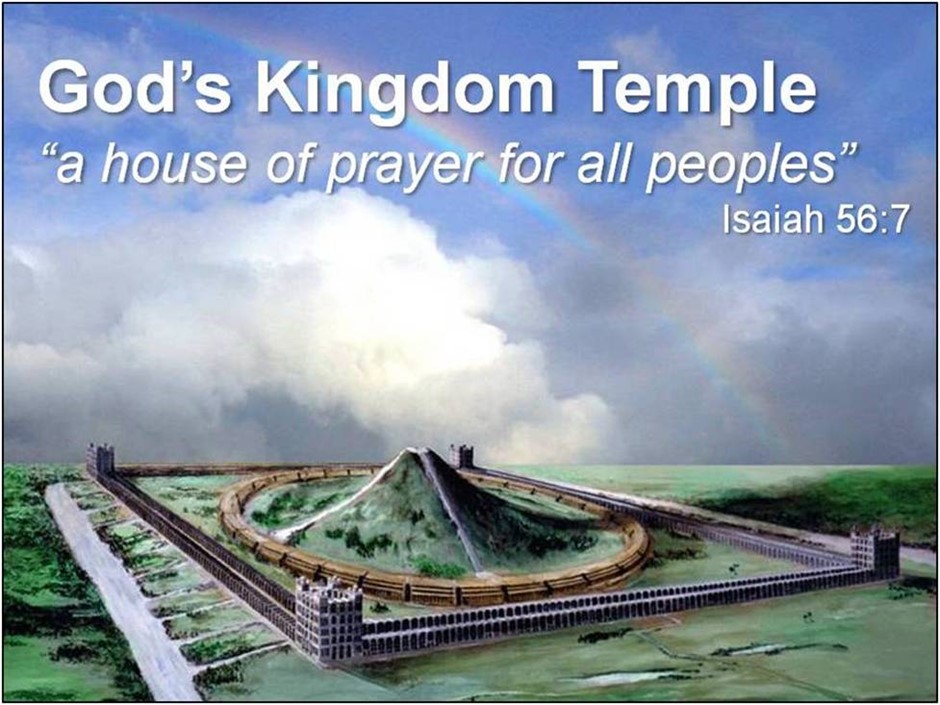
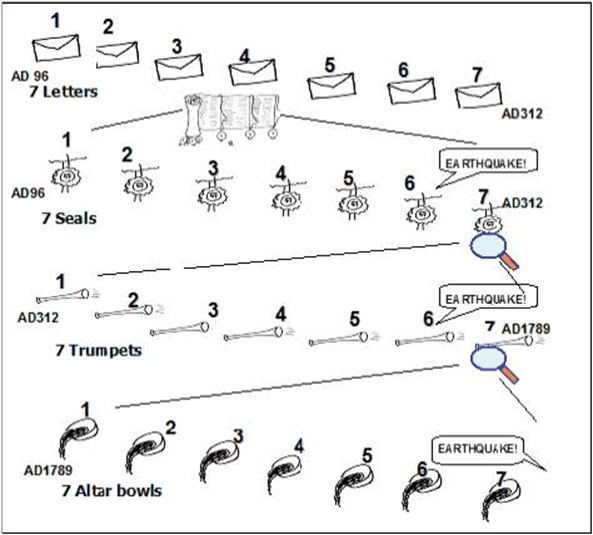
“And it was given unto him to make war with the saints, and to overcome them…”  Revelation 13:7

The record goes on to describe harsh persecution – including captivity and execution – for true believers, really testing their faith and endurance.

More Beasts

Another beast appears, this time with two horns. It makes an image of the previous beast and forces people to worship it. It has the number 666.

What is all this about?

The different beasts are different phases of Rome’s religious development. The seven heads are explained for us in chapter 17, when we come to consider the last phase – a red beast ridden by a harlot.

The red beast still has the seven heads, and they are identified as a city of seven hills, ruling over the earth.

Rome was the political and religious power of the time, well fitting the various descriptions in the different phases. It was Rome that killed Christians when the pagan emperors reigned. When they were gone it was Catholic Rome, the new religion, which persecuted those faithful believers who protested against her.

Moving to the End

Chapters 14 and 15 comfort the true believers (called ‘saints’) with a picture of them with Jesus at the Day of Judgment, when their innocent blood will be avenged.

As we near the end of the story, the spotlight swings back to the secular world of politics, to see how this will be accomplished. In chapter 16, seven bowls are now poured in sequence onto the world. These are described as “the wrath of God”, a series of judgments on a world and a religious system that has persecuted God’s saints for too long.

These outpourings are setting the scene for the return of Jesus. And then he comes!

Like the thief in the night who catches us unprepared, he steals into the world:

“Behold, I am coming as a thief. Blessed is he who watches, and keeps his garments, lest he walk naked and they see his shame” (Revelation 16:15).

War!

The appearing of Jesus initiates the war of Armageddon, the climactic confrontation that runs through all the scriptures, when the united forces of the world set themselves against God and His son.

The outcome is clear: defeat for the opponents of God and the Lord Jesus. The battle is marked by an earthquake which shatters the world, and the coalition is destroyed by giant hailstones, like the enemies of Israel in Joshua chapter 10.

The religious conflict reaches its finale in chapters 17–18, where the adulterous harlot is thrown down into a fiery and fatal destruction.

In the meantime, Jesus’ faithful bride–to–be prepares herself for the marriage supper of the Lamb. This is a picture of the true body of believers getting ready for the Kingdom of God to begin.

A Glorious Conclusion

Through chapters 19–20 John observes amazing events, foretold throughout the Bible. In the vision, he witnesses the resurrection of the dead, and the day of judgment. The wicked are condemned to death, but the faithful are granted to live for ever and to reign on the earth with their Lord, with great rejoicing.

The final chapters of the Revelation paint a glorious picture of the new world, the Kingdom of God.

And I heard a loud voice from heaven saying, “Behold, the tabernacle of God is with men, and He will dwell with them, and they shall be His people. God Himself will be with them and be their God. And God will wipe away every tear from their eyes; there shall be no more death, nor sorrow, nor crying. There shall be no more pain, for the former things have passed away” (Revelation 21:3-4).

Ultimately, God will live with men in His holy city Jerusalem, and living waters will glide out of that capital city to bring healing and peace to all nations. We can read about this in Revelation 22:2.

God's Kingdom Temple on Earth

The good news, the Gospel, which flows through the whole of the Bible, is that we can be there. If we read and learn from the pages of the Bible, and we live faithfully watching for Jesus’ coming, then, in the beautiful words of Revelation 22:14, we will be given the right to eat of the tree of life and live forever.

By David M Pearce

See Book of Revelations Explained – Part 1

See Book of Revelations Explained – Part 2


See The Kingdom of God on Earth – What will it be like?

Loading

The Book of Revelations Banner

Book of Revelation Explained – Part 1

The Book of Revelation Explained – Part 1

The Book of Revelations BannerThis last book of the Bible was penned by the apostle John, probably towards the end of the First Century. He writes in a time of persecution, when he has been sent into exile by the Roman authorities, marooned on the island of Patmos “on account of the word of God and the testimony about Jesus” (Revelation 1:9). Patmos is a tiny island off the coast of Turkey, about 13 square miles (34 square kilometers) in area.

Inspired Visions

The Revelation is the record of a series of inspired visions in which John sees and hears his Master Jesus talking to him, passing on a message for the Christian brothers and sisters. The opening verse is important – “The Revelation of Jesus Christ, which God gave him to show His servants—things which must shortly take place” (Revelation 1:1).

In doing this we are told that this message of the future of mankind ie. the rise and fall of world powers and governments, was revealed to John in a symbolic way ie. in Revelation 1:1 it goes on to say that “he (Christ) sent and signified it by his angel unto his servant John.”

The symbols used are the same as those found in earlier prophecies in Isaiah, Ezekiel and Daniel. So in understanding Revelation we much first appreciate this way in which it was written and that much of what we read is a symbol of a future power and powers to arise and that the depictions of them and the events they would bring about are not to be interpreted in a literal sense but by the symbols used.

The vision was to show John things that must take place, so it was a prophecy, like the prophecies of Isaiah, Jeremiah, Ezekiel and Daniel. It predicted the course of events far into the future, so that God’s servants would be prepared and strengthened in times of persecution, knowing that world events are in God’s hands, and move steadily towards the goal of His Kingdom being established on earth.

To appreciate the book of Revelation we need to have read the rest of the Bible first, because it is full of links and allusions to the earlier writings. Practically every phrase and theme has been plucked from the Old Testament (in some cases the New Testament), and applied to a new but similar situation.

We will find strong links to the visions of the prophet Daniel, who saw four amazing beasts with features that foretold the course of history from his day up to the First Century. John’s visions take over where Daniel’s left off, and we shall meet Daniel’s beasts in a new guise, used this time to predict the events of European history through many centuries.

Perfect Number

A key idea in the Revelation is the number seven. Seven is the perfect number, the cycle of days that completes a week and then starts again.

The book is divided into groups of sevens – seven lampstands and seven letters, seven wax seals on a scroll, seven trumpets that blow in turn, and seven altar bowls poured out on the earth.

There is another twist – seven in seven. This concept comes from the conquest of Jericho by Joshua.

The soldiers of Israel marched round the city of Jericho once a day for six days. But on the seventh day they marched round seven times, and on the 13th circuit, the walls collapsed and the city fell. So in the Revelation there are six seals, but when the seventh is cut through it is found to enclose the seven trumpets, and when the seventh trumpet begins to blow it conceals the seven bowls. Only when we reach the seventh bowl does the Kingdom of God finally arrive in all its glory.

Here is a schematic diagram which illustrates the way the book of Revelation is laid out in sets of sevens:

Unfolding Drama

In the opening chapter John sees his master, the Lord Jesus, in heavenly glory. Jesus is walking amongst seven golden lampstands, which John is told represent seven Christian congregations in the province of Asia. Each in turn is given a written report, dictated to John, outlining their successes and their weak points, just like the traditional end-of-term report at school. Each letter ends with a beautiful promise, held out to “him who conquers”.

The Book of Revelations unfolding historical eventsIt is a surprise to find seven churches in the same area with such a variation in their spiritual health, from Ephesus – patiently enduring and bearing up for Jesus’ sake; to Laodicea – smug and complacent, but in Jesus’ view close to death (see Revelation 1:11 to 3:22).
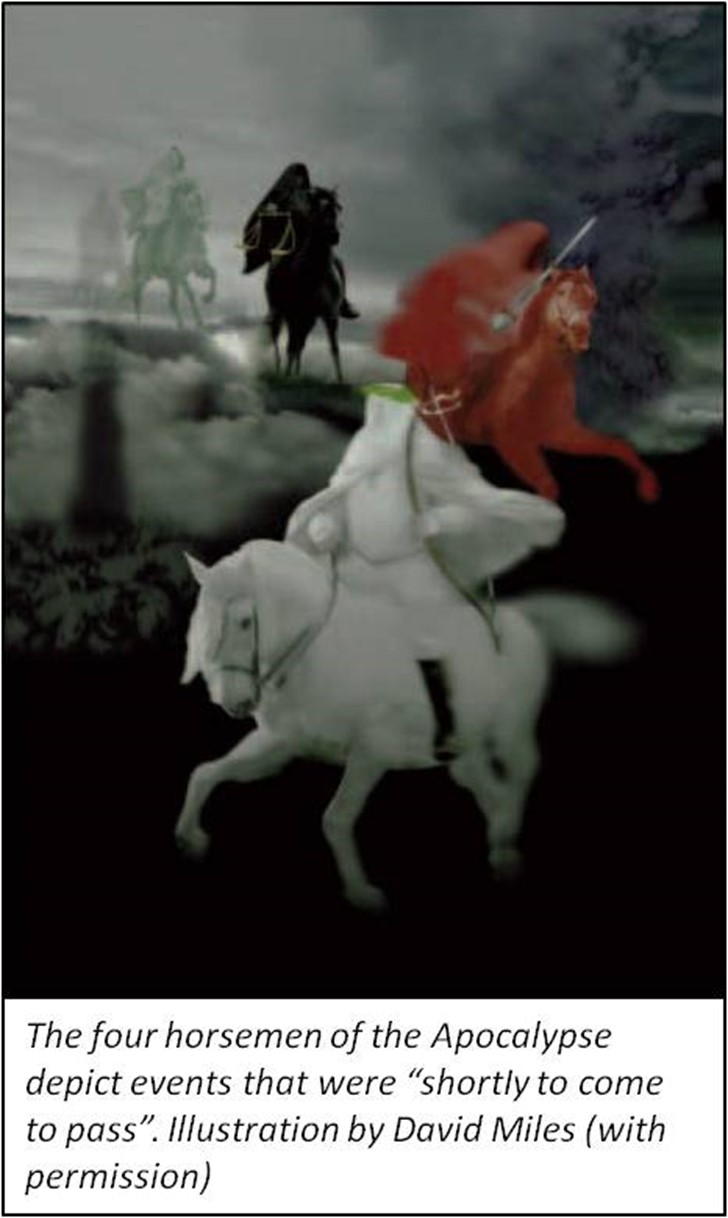
At this point John is invited to come up into heaven so that he can watch history unfold before his eyes.

Unlike the Seven Letters, which were sent to his contemporaries, the rest of Revelation relates to events after John’s lifetime. To understand the setting from this point onwards, we need to imagine a drama, a historical pageant acted out as a series of scenes on the stage of a theatre. John the observer is invited up into the royal box for the performance.

Looking down, he sees the earth and the sea below him.

As each act is announced, the characters come and go, accompanied by appropriate sound effects. As an added refinement, the ‘royal box’ is defined in chapter four as the Temple from the Old Testament, complete with:

❖an Ark (the ‘throne’ on which God’s angel once sat as His representative),

❖an incense altar, an altar for sacrifices,

❖a great reservoir or ‘sea’ for water,

❖a lampstand, and

❖four cherubim or ‘living creatures’.

He also sees in the foreground 24 elders, who serve the Lord as did the 24 orders of Levites in the Temple of Solomon.

The Scroll Opened

In the opening scene, John sees the Lord God, seated on the throne, holding a scroll in his hand. It is made up of seven sections, each separately sealed with a string and a wax pendant. Nobody could read the scroll until the strings were cut. John sees a wounded Lamb approach the throne. It is Jesus, the Lamb of God, and he is given the right to open the scroll.

He cuts the first string, and as the scroll flies open a white horse gallops across the stageThe Third Horseman of Revelations with a warrior on his back. The next seal introduces a red horse ridden by a man with a dagger.
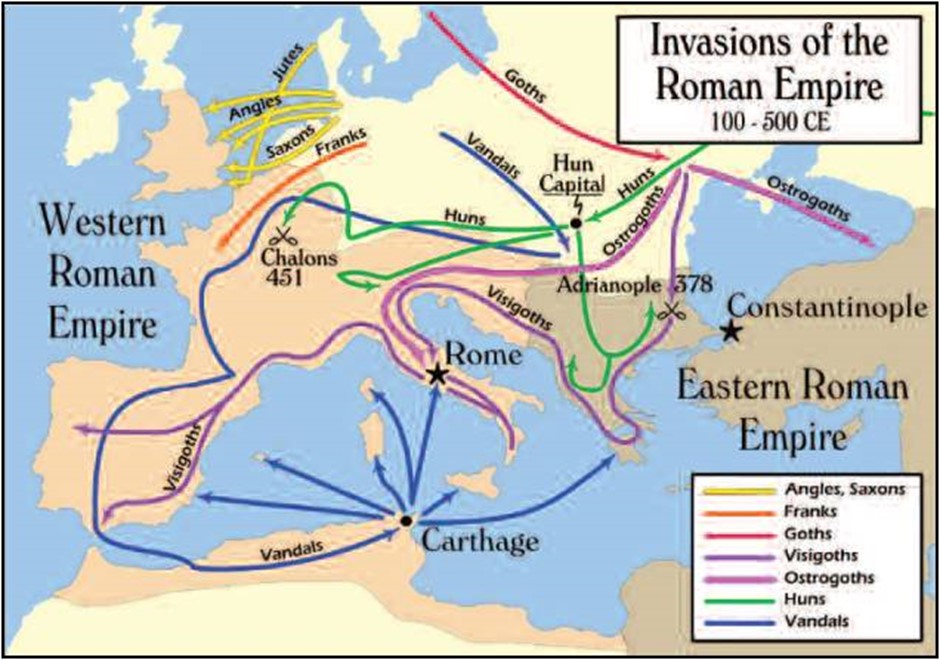

The third horse is black. His rider carries scales for weighing out daily food rations. The fourth is the colour of a corpse, and the skeleton on its back is accompanied by a symbolic grave, shovelling up the dead over a quarter of the earth.

Four Horsemen

The four coloured horses are taken from the Old Testament prophet Zechariah. It is not difficult to line up the four seals with the history of the Roman Empire after John’s death – an initial period of prosperity and peace, followed by civil war, then famine and pestilence, especially in the Italian division of the Empire, which was divided into four quarters at this time. The time period covers AD 100 to AD 270.

The next Seal introduces an altar said to represent the lives of Christian believers. Many of them were indeed martyred for their faith by the pagan (idol worshipping) Emperor Diocletian around 300 AD.

The Sixth Seal opens with dramatic sound-effects – an earthquake, and the removal of the sun, moon and stars – a traditional Bible symbol for a change of rulership.

This links with the revolutionary change that took place when Constantine battled successfully for control of the Empire. Pagan Rome became Christian Rome as he removed, once and for all, the persecution of those who refused to worship the ancient gods.  Constantine came to power in AD 312.

The 144,000

During the quiet time that follows, John sees in chapter seven 144,000 people, marked in the forehead by an angelic messenger, like those faithful men Ezekiel saw set aside for God before the fall of Jerusalem in his vision (Ezekiel 9:4). They come from the 12 tribes of Israel, but one is omitted from the list, for these are not literally Jews, but a harvest of believers, reaped under the new and favourable regime, in the lull before the destruction of the Empire by the barbarian tribes.

They form part of a huge multitude, from all nations under heaven, that John now hears praising God, in a comforting vision of the Kingdom of God. But before that reward can be given, there are others who must be called out to join them, and so Seal number seven introduces the seven trumpets – the next phase of “those things that must soon take place”.

By David M Pearce

See Book of Revelations Explained – Part 2

See Book of Revelations Explained – Part 3


Loading

The Book of Revelations Banner

Book of Revelation Explained – Part 2

The Book of Revelation Explained – Part 2

The Book of Revelations BannerIn the last issue, our first section on the fascinating Book of Revelation began to explain how the book is structured and what it is about. We looked at the opening verses of the book and saw that the writer, the Apostle John, was being shown things which must shortly take place (1:1) and traced the unfolding plan of God through the first seven chapters and to about 312AD.

In this article we take the next step as history unfolds and the Roman Empire comes under attack from external forces.

Western Rome DestroyedWestern Rome Destroyed

In the first section of the historical vision, seven seals were each broken and dramatic events followed in the vision seen by the apostle John. During that period, a storm of winds had been held back from devastating the earth:

After these things I saw four angels standing at the four corners of the earth, holding the four winds of the earth, that the wind should not blow on the earth, on the sea, or on any tree (Revelation 7:1).

These winds represented barbarian invasions that were going to sweep the Empire and snuff out the political power of Rome in the West. Now, seven trumpets will sound one after theTrumpets other, heralding the next stages in history as these barbarians attack:
  • As the first trumpet sounds, hail and fire (as seen in the plagues God brought on Egypt through Moses) strike one third of the earth as the Goths sweep into Italy (Revelation 8:7).
  • With the second trumpet, a burning mountain falls into the sea – the navy of the Vandals sinks the Romans from the Mediterranean (8:8–9).
  • The third trumpet sees a meteor strike the region of rivers and streams, as Attila and the Huns crashed into the Alpine region (8:10–11).
  • The fourth darkens the sun, moon and stars, which corresponds to Odoacer king of the Goths removing the last Emperor in the city of Rome, and crowning himself as king (8:12).

The Empire had three divisions in this period, and the Western third had now ceased to exist.

Eastern Rome Suffers

The Eastern side of the Empire, ruled from Constantinople, was not to escape the judgement of God. And so the fifth and sixth trumpets continued to sound.

  • The fifth trumpet blared, and a swarm of locusts emerged like smoke from a pit (this image links with Abraham’s cliff-edge view of the destruction of Sodom in Genesis 19:28) and covered the face of the earth. The star that led them was Mohammed, and his followers were to overpower the Mediterranean region for three hundred years (Revelation 9:1–12).
  • Trumpet six sees a huge force of cavalry race across the earth, as the Turks in turn subdue the Eastern Empire. In May 1453 they take Constantinople, and the Roman Empire comes to an end (9:13–21).

The sixth trumpet continues to reverberate for some time. Revelation chapter 10 has a vision that was kept sealed up, but in chapter 11, John sees two ‘witnesses’ speak out ‘in sackcloth’ against the evils of their time.

These men are linked with Moses, who turned the rivers of Egypt to blood, and Elijah, who caused it not to rain. These two great prophets from the Old Testament each had to stand up and witness for God to evil, godless rulers in their own day.

By the time these witnesses were in action, the Christian church itself had become corrupt, and those who protested risked their lives. The witnesses continued to preach for 1260 years (in Bible chronology a day stands for a year) but were eventually extinguished. This period would take us to the darkness that fell upon Europe at the time of the historic Massacre of St Bartholomew in 1572AD.

This in turn was only relieved by another great earthquake (Revelation 11:13), in which once more John sees a drastic change of rulership. This lines up with the French Revolution in AD 1789, which restored freedom of speech, overthrowing the total control of the church and kings over men’s lives, first in France and then spreading to the rest of the world.

In Revelation 11:15 we eventually come to the Seventh (and final) Trumpet:

“Then the seventh angel sounded: And there were loud voices in heaven, saying, “The kingdoms of this world have become the kingdoms of our Lord and of His Christ,” . The kingdom of God is announced because all of the prophecy in Revelation and the history it describes, is God’s plan leading to that kingdom.

However, this does not mean that the end has come and God’s plan is complete, for there is more history to follow. The kingdom will not actually be established until the last saint (believer set aside for God) has been called by Him. In fact men and women from all over the world are still responding to the Gospel and being baptized today. At this point in the Revelation, the narrative of the drama goes back in time, like a novel, to look at what has been happening on the religious front while all these political changes have come and gone.

By David M Pearce

See Book of Revelations Explained – Part 1

See Book of Revelations Explained – Part 3 

Loading

The Holy Spirit Gifts

The Gifts of the Holy Spirit

Are they available today?The Holy Spirit Gifts

The question is often asked whether believers may be blessed with these Pentecostal gifts today. Claims to have the gift of healing or of speaking with tongues are often made (though, strangely enough, the other gifts hardly ever seem to be claimed). What is the truth about this?

The Bible is a true guide, and all its evidence points to the same conclusion — that the gifts of the Spirit were intended by the Lord as help for his church in its early years and only then; and having done their work, the gifts were taken away.

The Early Church and its problems

Let it not be overlooked that some outstanding divine help for those early preachers of the gospel was absolutely necessary. Think for a moment of the difficulties and hindrances against which they had to struggle.

They no longer had their Lord with them to inspire and direct personally the work he had set them to do. Nor were those preachers men of outstanding influence or reputation, but — with the exception of the apostle Paul — humble folk drawn from obscurity. Nor did they have the inspired wisdom of the New Testament to direct their efforts, for in those early days that part of the Bible was only just being written. There was no big influential body of opinion to support their efforts and bring pressure to bear on people in high places. Instead, at first, only scattered groups of new believers, without any set pattern of church affairs to guide their way of life.

But, on the other hand, there was plenty of opposition from suspicious Roman governors, and especially from a strong well-organised body of clever and evil adversaries — the Pharisees and the men of the temple. Swimming against such a tide of opposition and difficulty, how could those early disciples hope to make headway, unless the Lord equip them with the gifts of his Spirit? Without such help how could they cope with a task that was otherwise too much for them?

As mentioned earlier, the circumstances were very special and called for special men specially equipped for a great work. But once the Christian gospel was well launched on its course and making good progress, the need for the gifts was no longer there…

All the available Bible evidence supports this approach to the problem of Holy Spirit gifts.

Given through the Apostles only

The account in Acts of how the Holy Spirit came to the believers in Samaria (Acts 8) is very helpful on this question.

Philip, one of the early evangelists (but not the Philip who was an apostle of the Lord) had a highly successful preaching mission to the Samaritans. Hearing about this, the apostles in Jerusalem promptly sent Peter and John to confirm the good work and also to impart gifts of the Holy Spirit by laying hands on the new converts.

It is useful to enquire here, why Philip did not do this himself? He certainly had the Holy Spirit. Why didn’t he impart the gifts to the believers? Why was it needful for the Spirit to be given through Peter and John? The only explanation that makes sense is that the Lord had left authority for passing on the Spirit in the hands of His apostles only, and with no one else.

Special to the Apostles

This conclusion is confirmed by the story of Simon who saw big opportunities of money-making and influence here. He came to the apostles offering to pay them well if only they would give him the same power and authority:

“Now when Simon saw that the Spirit was given through the laying on of the apostles’ hands, he offered them money, saying, ‘Give me also this power, that any one on whom I lay my hands may received the Holy Spirit” (Acts 8:18,19).

It was not the Holy Spirit which Simon was trying to buy, but the power to pass on the Spirit’s wonderful gifts to others. Clearly, he saw this as a good business investment. But he had already seen miraculous signs done by Philip (Acts 8:6,7). Then why hadn’t he come to Philip with his commercial proposition? The only reasonable answer is this: he recognized that only the twelve apostles, and later, Paul, had been given power and authority to impart the Spirit to others.

Two Generations Only

It follows from this, that when the Twelve passed off the scene, there would be no one left to give the marvellous powers of the Spirit to others. The generation after the apostles would be the last to know the presence of such gifts in the church. They were bound to die out.

The witness of writers in the early church confirms this conclusion. In the first two or three generations of believers the memory continued of the remarkable powers which the Spirit imparted, and then no more.

Gifts Passing Away

This is the witness of the apostle Paul also. In 1Co 13, only a few verses after his long chapter about the Holy Spirit’s gifts of healing, knowledge, tongues, and so on, he declared plainly:

“As for prophecy, it will pass away; as for tongues, they will cease; as for knowledge it will pass away” (1Co 13:8).

The pronouncement of this inspired apostle is surely decisive. The superhuman gifts of the Spirit were given to the church only for a time, until new believers were firm in the faith and a good sound pattern of Christian belief and living had been established. Today the completed Bible is all that is needed for that purpose. [As already mentioned, in the days of the apostles the New Testament was only gradually coming into existence. When the apostles died, few churches would have copies of a complete New Testament.]

Outpouring of the Spirit

The heading just above — “Given through the Apostles only” — was intended to indicate that no other men besides the apostles had this power and authority.

But there was, of course, another way of receiving the Spirit — by direct outpouring from heaven. This was most exceptional. Only four examples are mentioned:

  1. Our Lord, at his baptism (Mat 3:16).
  2. Pentecost (Acts 2:1-4).
  3. The assembly of thankful brethren (Acts 4:31).
  4. The household of Gentile Cornelius (Acts 10:44).

It follows that today those who claim to have received the Spirit’s gifts should have received them either by direct outpouring from heaven, or by laying on of the apostles’ hands.

The first of these was exceptional, even in New Testament times; and the second is no longer possible.

For those who today say they have this power, there is a problem here. How do they claim to have received the Spirit?

Always Temporary

It is worth noting that on all earlier occasions when God poured out his Spirit upon men, it was only for a while, and for a special purpose. Moses had seventy Spirit-blessed elders of Israel to aid his work (Num 11:24-30), but not so Joshua who succeeded him. Saul, anointed by Samuel, prophesied (1Sa 10:9-13), but later that Spirit was replaced by an evil spirit (1Sa 16:14).

During his ministry, the Lord Jesus gave the Spirit’s powers to the Twelve when he sent them out preaching (Mark 6:7,13), but some time later nine of them were unable to cure a boy who suffered from fits (Mark 9:17,18,28,29).

In the Last Days

The claim, sometimes made, that the Bible promises a revival of Holy Spirit powers in the last days, is correct, but the Scripture verses are often wrongly used, and nearly always misapplied.

“And it shall come to pass afterward, that I will pour out my Spirit on all flesh, your sons and your daughters shall prophesy, your old men shall dream dreams, and your young men shall see visions” (Joel 2:28).

The apostle Peter quoted these words at Pentecost (Acts 2:17), and applied them to Jews in Jerusalem in his time. If, as seems likely, there is to be a further fulfilment of these words, it can be expected to begin in Jerusalem as a blessing upon believing Jews, since the Joel passage specially mentions Mount Zion in Jerusalem (v 32); and then spread to believing Gentiles after the pattern of the bestowal of Spirit gifts in the first century.

This scripture would therefore throw considerable doubt on the claims of modern charismatic movements whose beginnings are claimed to be everywhere except Mount Zion in Jerusalem.


Loading

WHO IS GOD?

What the Bible reveals

MANY people say they believe in God but if you ask them what they believe about Him, an almost incredible vagueness emerges. Their general view of God reflects their view of themselves. Most people are inclined to be indulgent towards their own failings and they think of God in the same way: ‘I like to think of God’, they say, ‘as infinitely kind, always forgiving and never condemning anyone, even wrongdoers’. Others say, ‘Well, if God exists, and I do what I think is right, I shall get whatever reward there is’.

This article is written especially for those who confess that they believe in the God worshipped by Christians but who may not have thought much about His nature. What is God like? What are His attributes and characteristics? If we can discover the answers to these questions, it could make a profound difference to the way we revere and worship the Almighty Creator, the Father of the Lord Jesus Christ.

Just to give some idea of what follows, we hope to show that God – the God of the Bible – is the eternal Creator, infinitely powerful, holy, just, merciful and loving; a God to be obeyed, who has promised to reward those who try to serve Him faithfully, but who will reveal His wrath to those who reject His ways.

How do we find out about God?

Where do we turn for an understanding of God and His nature? There is only one answer to this question: the Bible. What is the point of turning to human wisdom, which has no authority? In any case, one source of human wisdom will often contradict another, because people down the ages have had so many varied ideas about God. The Bible is a God-given book: “All Scripture is given by inspiration of God …” (2 Timothy 3:16); “Holy men of God spoke as they were moved by the Holy Spirit” (2 Peter 1:21).

The Bible reveals to us a comprehensive and consistent picture of what God is like. This book can tell us all we need to know about the Almighty God. But there is an important consequence of going to the Bible: we cannot then ignore what it says; we dare not neglect what it tells us about God and His great plan for the earth and for mankind.

God’s self-revelation

So to the Bible let us go. What has it to tell us about God?

This information is not scanty – it is abundant. It commences in the first page of the Bible and is maintained right through to the last, that is to say, all through the Law, the Psalms and the Prophets of the Old Testament, and then through the Gospels and Epistles of the New Testament. But this picture of God is not complicated or confused, for there emerges one outstanding Personality with His own decisive character, closely concerned with the career of the human race and the future of the world. He cannot be relegated to the fringes of human concerns, nor pushed away “somewhere” in the distant heavens, to be conveniently ignored. If men and women do that, the consequences for themselves will be disastrous.

The commonest description in the Bible of the nature of God is “everlasting”. Consider these examples:

“Before the mountains were brought forth, or ever you had formed the earth and the world, even from everlasting to everlasting, You are God.” (Psalm 90:2)

“Have you not known? Have you not heard? The everlasting God, the LORD, the Creator of the ends of the earth, neither faints nor is weary. His understanding is unsearchable.” (Isaiah 40:28)

“The LORD is the true God; He is the living God and the everlasting King …” (Jeremiah 10:10)

Here is a quality of existence entirely outside our experience. Indeed God indicates so Himself through His prophet:

“The Egyptians are men, and not God; and their horses are flesh, and not spirit.” (Isaiah 31:3)

Here there is an obvious contrast between “men / flesh” and “God / spirit”. God’s nature is “Spirit”, and forms therefore an absolute contrast with human nature, which is limited in mind, weak in character, and perishing in death.

God is eternal

The most explicit descriptions in the New Testament are from the Apostle Paul:

“Now unto the King eternal, incorruptible, invisible, the only God, be honour and glory for ever and ever. Amen.” (1 Timothy 1:17, RV)

“He who is the blessed and only Potentate, the King of kings and Lord of lords, who alone has immortality, dwelling in unapproachable light, whom no man has seen or can see, to whom be honour and everlasting power. Amen.” (1 Timothy 6:15,16)

It is remarkable that in these descriptions the two most explicit terms about God’s nature are expressed as negatives. He is “incorruptible” (not corrupting) and “immortal” (not dying). God has a “nature” the direct opposite of “human flesh”. So He is “eternal”, literally “of the ages” (RV margin). It is significant that Paul uses this term three times in one verse: “… to the King eternal (of the ages) … be glory for ever and ever” (unto the ages of the ages – RV margin). How impressed he must have been with the thought of the everlasting nature of God.

The greatness of God

The sheer supremacy of God and the glory which should be ascribed to Him by puny mankind is a constant theme throughout Scripture. It was well expressed by David, King of Israel:

“Blessed are You, LORD God of Israel, our Father, forever and ever. Yours, O LORD, is the greatness, the power and the glory, the victory and the majesty; for all that is in heaven and in earth is Yours; Yours is the kingdom, O LORD, and You are exalted as head over all.” (1 Chronicles 29:10,11)

Greatness … power … glory … victory … majesty … all in heaven and earth … kingdom … exalted … head over all. We do well to read slowly through these terms to appreciate David’s profound sense of the majestic supremacy of God. It was shared by the Apostle Paul, as we have seen.

This deep conviction of God’s supreme majesty is shared by all the faithful of Old Testament times. Now we should not neglect the Old Testament, for in it are revealed the foundations of the character of God, basic truths about Him which are confirmed and expanded in the New Testament. Furthermore it was to Israel that was granted the great revelation of God’s supremacy over all the gods of mankind in the stirring events of their Exodus from Egypt. The Israelites saw the effects of the plagues upon the Egyptians and witnessed their own deliverance at the crossing of the Red Sea. Moses put it very strikingly forty years later:

“For ask now concerning the days that are past … whether any great thing like this has happened … Did any people ever hear the voice of God speaking out of the midst of the fire, as you have heard, and live? Or did God ever try to go and take for Himself a nation from the midst of another nation, by trials, by signs, by wonders … according to all that the LORD your God did for you in Egypt before your eyes?” (Deuteronomy 4:32-34)

Upon this open demonstration of His power and salvation on their behalf, God based His appeal for their service towards Him:

You have seen what I did to the Egyptians, and how I bore you on eagles’ wings and brought you to Myself. Now therefore, if you will indeed obey My voice and keep My covenant, then you shall be a special treasure to Me above all people …” (Exodus 19:4,5)

Notice particularly here that God’s appeal for faith in Himself was solidly based not upon His moral excellence (of which He would give plenty of evidence later on), but upon the demonstration of His supremacy over the greatest pagan system on earth at the time (the Egyptian). This is reinforced when God reveals through Moses His Law for Israel, for the very first clause begins:

“I am the LORD your God, who brought you out of the land of Egypt, out of the house of bondage.” (Exodus 20:2)

Then follow the Ten Commandments, the kernel of God’s Law for them.

The authority comes first; the moral teaching follows. It is impossible to dispense with this order. Strikingly, Jesus adopts the same position. The words he spoke, he said, were not his own, but his Father’s. In prayer to God, he addresses Him as “Father, Lord of heaven and earth” (Matthew 11:25). Though God was a Father to all who sought Him, yet He remained “Lord of heaven and earth”. Unhappily it has to be said that these priorities have been widely ignored in our days, even by many who would regard themselves as followers of Jesus Christ.

The uniqueness of God

From his recital of all God’s great works on behalf of His people, Moses drew the following conclusion:

“Therefore know this day, and consider it in your heart, that the LORD Himself is God in heaven above and on the earth beneath; there is no other.” (Deuteronomy 4:39)

This was a vital affirmation in a world of a multitude of pagan gods. It remained vital all through the centuries of Israel’s persistent neglect of the God who had delivered them. In His frequent reminders through the prophets that it was He who had delivered them from the oppression of Egypt, He declares that He is God alone:

“I am the LORD, and there is no other; there is no God besides Me.” (Isaiah 45:5)

In the New Testament the Apostle Paul recognises the existence of many cults and pagan gods; yet to the believers in Christ these idols are nothing:

“Therefore concerning the eating of things offered to idols, we know that an idol is nothing in the world, and that there is no other God but one. For even if there are so-called gods … yet for us there is one God, the Father, of whom are all things … and one Lord Jesus Christ.” (1 Corinthians 8:4-6)

And in writing to the Ephesians Paul says:

“There is one body … one Spirit … one hope … one Lord, one faith, one baptism; one God and Father of all …” (4:4-6)

This is a resounding declaration of the unity of the various aspects of the Christian faith, all depending on the “one God”.

Modern attitudes

All that we have considered so far of the greatness, the glory, and the majesty of the one God, the Creator of the heavens and the earth, implies that He should receive reverent worship from frail mankind – and so He does from the faithful all through the pages of the Bible.

But what are we to say about the attitudes towards God today, even among many professed Christians? Firstly, religious opinions in Western civilisation have greatly changed through the increase in followers of other cults. It is now held by many that all religions offer their own way to God and are all equally “valid”.

People reject the great claims of Christianity to be the sole way to “salvation”, expressed thus by the Apostle Peter:

“‘Nor is there salvation in any other (than Jesus Christ), for there is no other name under heaven … by which we must be saved.’” (Acts 4:12)

It is no wonder that, for modern man, God as portrayed in the Bible has receded from the centre of attention and is relegated to the fringes. A casualness and familiarity at times, even in religious exercises, show that God is no longer accorded the honour due to His Name. Even terms of holy significance like “Hallelujah” (which means “Praise the Lord”) are bandied about to evident approval by profane comedians.

To this must be added the humanist and materialistic spirit which exalts the human mind, and has little thought for the existence of God or for His worship. Even these brief reflections upon the state of modern opinion show what a gulf exists between today’s attitudes towards God and that manifested by Jesus and the apostles.

The character of God

But this one God, the Creator of the heavens and the earth, worthy of all reverent worship, is not just an impersonal Power. He is a Personality, with a character of His own. He has eternal moral principles, which He has made known to mankind through His commandments and precepts.

The first explicit description of the character of God occurs in a revelation to Moses about 1400 BC. Moses had received many communications from God during the events of the Exodus, but he evidently felt that he did not yet know God as a Personality, so he makes a request:

“If I have found grace in Your sight, show me now Your way, that I may know You …”

When God agreed to his request, Moses enlarges on it: “Show me Your glory”. Now Moses had on more than one occasion already witnessed the “physical” glory of God in the form of great light and demonstrations of power. Here he wants something more. God is aware of this:

“I will make all My goodness pass before you, and I will proclaim the name of the LORD before you.” (Exodus 33:13-19)

The way, the glory, the goodness of the Lord will all be expressed in His Name and will enable Moses to “know” Him. This Name is now proclaimed:

“The LORD, the LORD God, merciful and gracious, longsuffering, and abounding in goodness and truth, keeping mercy for thousands, forgiving iniquity and transgression and sin, by no means clearing the guilty.” (Exodus 34:6,7)

So emerges the great portrait of the God of the Bible given by Himself. He has a definite moral character, in which mercy, longsuffering (slow to anger, RV), goodness and forgiveness play a great part, but always consistent with His “truth”. Echoes of this description are frequently found in the subsequent books of the Old Testament, especially the Psalms (see Psalm 103, for example) and the Prophets.

This portrait of God expresses His “goodness” and also His “glory” of character. It is this aspect Jesus has in mind when he declares to the woman of Samaria, “God is Spirit” (not “Spirit” which misleads) (John 4:24). The character of God is described as “Spirit”. It forms a great contrast with the natural character of human flesh expressed in its thinking and desires, and described by John as “the spirit of the flesh … of the world … of error”.

The holiness of God

It follows from what we have just considered that God in His nature and character is quite different from man. He dwells in “light unapproachable”, unseen by mortal eyes, says Paul. But His “thoughts” (a term which always includes His purposes) are greater than man’s, as He said:

“For as the heavens are higher than the earth, So are My ways higher than your ways, And My thoughts than your thoughts.” (Isaiah 55:9)

So God is “holy”: that means He is “set apart” from mankind. Man cannot blunder heedlessly into His presence as if God were just another man. On account of their sins they cannot approach Him at all, except in the way He indicates. Israel were taught in the Law that approach in worship and sacrifice could only be through the priests, the sons of Aaron, whom God had Himself appointed. The aim of the Law was to develop in the people of Israel that mind and character which were like His. So He commanded them: “You shall be holy; for I am holy” (Leviticus 11:44); and Peter echoes this in writing to the early believers in Christ:

“But as He who called you is holy, you also be holy in all your conduct.” (1 Peter 1:15)

Jesus had already said as much to the woman of Samaria:

“But the hour is coming, and now is, when the true worshippers will worship the Father in spirit and truth; for the Father is seeking such to worship Him. God is Spirit, and those who worship Him must worship in spirit and truth.” (John 4:23,24)

The “holiness” which God requires from true believers is not that ascetic spirit shown in time past by hermits; nor is it to profess to worship God and to “go through all the motions”, and yet to manifest a spirit of mind which owes more to human self-indulgence, covetousness and pride than it does to the Spirit of God. God was not tolerant of such an attitude in Israel. Nor will Jesus be at the Judgement. There are some to whom he will say, “‘I never knew you; depart from Me” (Matthew 7:23).

God as Father

“Our Father in heaven …” This first line from “The Lord’s Prayer” used to be one of the best known in the New Testament. Today it is much less frequently repeated. But even at the height of its use, it is to be feared that the term “Father” was used in a conventional sense without much thought about its implications.

In Old Testament times God had already revealed Himself as a “Father”. “Israel is My son, My firstborn” (Exodus 4:22) was His declaration to Pharaoh in Egypt. Through the long centuries of their experience the faithful appreciated the relationship:

“As a father pities his children, so the LORD pities those who fear Him. For He knows our frame; He remembers that we are dust.” (Psalm 103:13,14)

In the New Testament the supreme manifestation of God as Father is in the person of His beloved Son. Jesus constantly refers to God as “my Father” and, when addressing the disciples, as “your heavenly Father”. The infinite grace of God, so dear to the psalmists and prophets, was shown in the giving of His Son as the atonement for sin. And so the faithful are granted a new relationship with God, in which they are not only “heirs with Christ” but “sons and daughters of God”. John exclaims:

“Behold what manner of love the Father has bestowed on us, that we should be called children of God!” (1 John 3:1)

But in these days of casual familiarity it is easy to slip into the habit of thinking of God, and indeed even addressing Him, as “one of us”. Jesus kept his priorities clear at all times, and particularly in his prayers. “I thank You, Father, Lord of heaven and earth” (Matthew 11:25) warns us that although God is truly our Father, He remains “Lord of heaven and earth” and should be worshipped as such. Twice in his prayer for the disciples shortly before his crucifixion, he addresses God direct: “Holy Father … O righteous Father” (John 17:11,25). There is no familiarity here, but a profound recognition of this “otherness” from man.

Similarly the Apostle Paul, quoting from the Law and applying the saying to the believers in Corinth, urges them to “be separate” from the idolatrous worship and practices in Greek society. God promises them, “I will be a Father to you, and you shall be My sons and daughters”; but Paul does not hesitate to complete the quotation, “says the Lord Almighty”, and to go on to urge his readers to cleanse themselves “from all filthiness of the flesh and spirit, perfecting holiness in the fear of God”, that is, in reverent worship (2 Corinthians 6:17-7:1).

And in the prayer Jesus taught his disciples he addressed God as: “Our Father in heaven” (Matthew 6:9). God is indeed a Father to the faithful, showing all the care and concern that a father would feel for his children. But those “sons and daughters”, while appreciating His grace and mercy towards them, must never presume to forget the reverent worship which is His due. This balanced attitude is severely threatened in our times of freedom of expression and human rights. The Bible alone enables us to preserve that balance.

The love of God

Today the most widely held view is that “God is love”. Does not the Apostle John say so in his epistle (1 John 4:16), and in his gospel? “God so loved the world that He gave His only begotten Son” that men and women should live and not die (John 3:16). God is all kindness, it is said, and He would not condemn or reject anyone. The result of this thinking is an emotional view of God, formed from human desires. C. S. Lewis once described this as the view of God as “a kindly grandfather”, anxious only to keep His children happy by gratifying their every wish.

But this is a gross perversion of the love of God revealed in the Bible. No human father, earnestly desiring his children’s welfare, believes this result can be achieved by gratifying their every wish. Now God is the Supreme Father, who created the human race that they might reflect His own character of truth, mercy and holiness. So “God created man in His own image” (Genesis 1:27) and gave men and women remarkable powers of reason, understanding, conscience and will – all denied in the same degree to the animals – so that they might use them to understand Him and develop characters fit for the eternal destiny He desired for them.

This attitude towards erring mankind, showing that He is “not willing that any should perish but that all should come to repentance” (2 Peter 3:9), “who desires all men to be saved and to come to the knowledge of the truth” (1 Timothy 2:4), is shown in His dealings with the nation of Israel, described in Scripture as His “son”, and also as His “wife”. Understanding these human relationships, and knowing that essentially their success lies in mutual dependence and selflessness, helps to explain the qualities of patience and compassion God exhibits to His individual children.

When Jesus was describing to his followers God’s never-failing interest in His children’s welfare, he told the story of the prodigal son. The father’s pain when his son demands his portion and his rights echoes God’s own hurt when men and women wish to strike out on their own, heedless of His ways and His loving care. In the parable, the father’s constant watchfulness mirrors God’s, who ever waits to receive repentant sinners who can be covered by the clothing for sin provided through the sacrifice of the Lord Jesus Christ.

Nor is this description of God found only in the New Testament or in the teaching of the Lord. The prophet Hosea’s personal experiences with a faithless wife were no different from the treatment God Himself received from the wayward nation of Israel. Just as Hosea took back his wife, so God always stretched out His arms to receive Israel again. In doing so, however, He did not show any approval of what His people had done: the experiences they endured because of their faithlessness were intended to teach them about the kind of lives His children should be living.

So there emerges the great principle that it is not the personal desires of men and women which have first place in God’s purpose for them, but their ultimate good. The attitude of God is indeed of mercy, kindness, grace and forgiveness towards His children, as the New Testament so abundantly declares; but it is all within the framework of their ultimate welfare in His purpose.

The wrath of God

But what if men and women turn their backs on Him, reject His authority, ignore His commandments and proceed to do their own will?

One thing is clear. Since God is Lord of heaven and earth, and Creator of mankind, He cannot ignore their rebellion, for that would be to abdicate His authority in the very world He has created. He must try to correct the situation, to get people to change their ways. This He does by bringing pressures to bear upon them. One of the clearest examples is the case of Israel under the Judges, after the death of Joshua:

“The children of Israel did evil in the sight of the LORD. They forgot the LORD their God, and served the Baals and Asherahs (RV, pagan gods). Therefore the anger of the LORD was hot against Israel, and He sold them into the hand of Cushan-Rishathaim king of Mesopotamia; and the children of Israel served Cushan- Rishathaim eight years. When the children of Israel cried out to the LORD, the LORD raised up a deliverer for the children of Israel, who delivered them …” (Judges 3:7-9)

The lessons are clear. Israel’s abandonment of their God, who had delivered them from Egypt, aroused His anger. He brings pressure to bear upon them in the form of foreign invasion and slavery. After a time the pressure has its effect – Israel repented. Their repentance was evidently genuine, for God was quick to respond and bring deliverance.

This pattern is repeated many times in Israel’s history. About 700 BC the Assyrians destroy the Northern Kingdom based on Samaria; and eventually the Babylonians overthrow the Southern Kingdom of Judah, about 600 BC. Why did God permit these invasions? Because, despite all His efforts in sending His prophets to appeal to the people and warn them, “they mocked the messengers of God, [and] despised His words”. The record ends with this significant comment: “… until the wrath of the LORD arose against His people, till there was no remedy” (2 Chronicles 36:16). When, despite all appeals, people will not repent, God puts an end to the situation. This is what He did at the Flood, when the earth was “corrupt” and “filled with violence … all flesh had corrupted their way on the earth” (Genesis 6:11,12). That generation of mankind would not repent; they could not be reformed. The only solution was to remove them, in order that the purpose of God could continue in a faithful remnant.

Before we come to the New Testament, two terms used of God in the Old need consideration. In a few passages God is declared to be “a jealous God”. The term gives offence to modern readers because it is taken in its popular sense and suggests a certain human pettiness. But this is to misunderstand its Scriptural meaning. There it is always used of God in warnings to Israel against forsaking Him and turning away to idols:

“You shall not go after other gods, the gods of the peoples who are all around you (for the LORD your God is a jealous God among you), lest the anger of the LORD your God be aroused against you and destroy you from the face of the earth.” (Moses to Israel, Deuteronomy 6:14,15)

Now it is significant that the same root word is sometimes translated “zeal” and “zealous”. God Himself tells us what He is zealous for: “I am the LORD, that is My name; and My glory I will not give to another, nor My praise to carved images” (Isaiah 42:8). The Lord God of heaven and earth is determined that the worship due to Him shall not be given instead to mere objects of human creation or imagination. This is His “zeal”. It is connected with His wrath, for ultimately He will judge those who despise His worship.

The second term is “the vengeance of the Lord”. Modern usage suggests a spirit of revenge, characteristic of human nature but unworthy of God. Again it is necessary to understand the term in its Biblical sense. The “vengeance of the Lord” is used of His judgement of sinners. But the same attribute is used in connection with the saving of the faithful. Isaiah well expresses this latter aspect:

“Strengthen the weak hands … Say to those who are fearful-hearted, ‘Be strong … Behold, your God will come with vengeance, with the recompense of God; He will come and save you.’” (Isaiah 35:3,4)

The vengeance of God is always righteous retribution. It is a judgement which is deserved because of persistent sin, the vindication of God’s holiness and truth in the face of human obduracy and pride.

The New Testament and judgement

As the judgement of God came upon the nation of Israel for their persistent apostasy and sin, so it will come upon our world for its godlessness and immorality. In a striking passage Jesus compares “the day when the Son of Man is revealed” (i.e. when he returns to the earth), to the judgements of the Flood and of Sodom and Gomorrah.

“As it was in the days of Noah, so it will be also in the days of the Son of Man …” (Luke 17:26-30)

It is the consistent theme of the New Testament that there is to be a day of judgement for the world. Paul assures the faithful in Thessalonica that God will judge “when the Lord Jesus is revealed from heaven with His mighty angels, in flaming fire taking vengeance on those who do not know God, and on those who do not obey the gospel of our Lord Jesus Christ” (2 Thessalonians 1:6-10 – the whole passage should be read).

This is such a forthright description of judgement that it shocks most modern thinkers. But Paul is using the language of the Law and the Prophets: the “vengeance” is that righteous retribution already discussed; those who “do not know God” are not so much the ignorant as those who do not “acknowledge Him”; and “not [to] obey” the gospel is really actively to reject and disobey. Whatever we may feel, there is no doubt about Paul’s message.

But the New Testament also declares that when Christ returns there will be an individual judgement for those who have known the gospel. A distinction will be made between “the righteous”, those who have sought to be faithful, and “the wicked”, the unfaithful. As Paul declares: “We shall all stand before the judgment seat of Christ … So then each of us shall give account of himself to God” (Romans 14:10-12). Judgement, then, is part of the revelation of the purpose of God, His determination not to tolerate lasting sin, sometimes called in the scriptures, “the wrath of God”.

Our God is real

Enough has been written to show that, far from being vague and shadowy, the portrait of God in the Bible is full of detail. The Lord God Almighty is not only eternal in nature and majestic in power; He is a God who deals in the realities of the world and of human nature. Having begun by creating the human race to dwell upon the earth, He has pursued ever since His resolute purpose “to take out of the nation’s a people for his name”. That purpose is now approaching its climax when, with the return of His Son to the earth in times of great perplexity and fear, His Name will be known from one end of the world to the other in preparation for the day when –

“… the earth will be filled with the knowledge of the glory of the LORD, as the waters cover the sea.” (Habakkuk 2:14)

Meantime, what of us who desire to be His faithful servants and to wait in patient service for the revelation of that day? Here are two New Testament statements which are very enlightening:

“… God [is] our Saviour, who desires all men to be saved and to come to the knowledge of the truth.” (1 Timothy 2:3,4)

“[God] is longsuffering toward us, not willing that any should perish but that all should come to repentance.” (2 Peter 3:9)

The first striking thought that emerges is that of the gracious will of God towards mankind. He desires the welfare of them all, that they should live and not die. But the second is that He requires some action of them. He has revealed His saving truth in His word, the Bible, and He expects them to get to know what it is. That truth, in the gospel proclaimed by Christ and the apostles, will inevitably bring them to recognise their own shortcomings in a “change of mind”, which is what repentance means. And that in turn will bring them into relationship with the God of heaven, with eventually the great prize of eternal life for faithful service.

In short, God is so real that He is proposing to alter the basic reality of our human nature with all its suffering and death, into another like His own and like that of His Son.

This God cannot be ignored. His word is waiting to be opened and read. What are we waiting for?

BY FRED PEARCE

Loading

WHERE DID GOD COME FROM?

An interesting science based answer for God.

Who is God?

“Where did God come from? “or “Who made God?” are classic questions asked by sincere children and hostile unbelievers alike. They are questions often asked with the intention of stopping us in our tracks and unfortunately, they do.  Before I begin an attempt to answer this question, I must state the following. The person asking this question, although he may be sincere, does not know God. He does not have a clue as to who God really is and often mistakenly applies the attributes of creaturehood to the Creator in an attempt to put God in the tiny box of his own brain (Psalm 50:21 ).

God did not need to be made. He has the power of Being within Himself. “It is precisely this concept of no origin which distinguishes that-which-is-God from whatever is not God.” A. W. Tozer said.

When this question is asked by a child, its good because it shows that their mind is working logically. Everything that is made needs to have a Maker.  This is what we observe in nature. When an older person asks this question, they are unknowingly admitting their own creaturehood. This acknowledging that there must be a higher being than themselves, with the power to create out of nothing! The only question is, Is this being nature itself or God?  However, the God of the Bible claims to be self-existent and independent from the creation that is derived from Him as is revealed in the Bible:

Genesis 1:1

“1 In the beginning God created the heaven and the earth.”

Psalm 90:1,2

“1  Lord, thou hast been our dwelling place in all generations. Before the mountains were brought forth, or ever thou hadst formed the earth and the world, even from everlasting to everlasting, thouart God.”

Psalm 102:25-27

“25 Of old hast thou laid the foundation of the earth: and the heavens are the work of thy hands. 26 They shall perish, but thou shalt endure: yea, all of them shall wax old like a garment; as a vesture shalt thou change them, and they shall be changed: 27 But thou art the same, and thy years shall have no end.”

Isaiah 40:28-31

“28 Hast thou not known? hast thou not heard, that the everlasting God, the LORD, the Creator of the ends of the earth, fainteth not, neither is weary? there is no searching of his understanding. 29 He giveth power to the faint; and to them that have no might he increaseth strength. 30 Even the youths shall faint and be weary, and the young men shall utterly fall: 31 But they that wait upon the LORD shall renew their strength; they shall mount up with wings as eagles; they shall run, and not be weary; and they shall walk, and not faint.”

Now back to the question, is the Creator nature or God?  Logic and science tell us that something can’t come from nothing! If you believe otherwise the burden of proof is on you! You can look as deep as you want into science and you cannot escape the fact that nothing cannot create something.  Since something can’t come from nothing, then if something exists now, then something has always existed! Is it God or matter? 

This is THE question of origins.  I don’t have the time or the scientific knowledge to write a book on the problems of the eternal matter position.  Allow me to make a few points that anyone can understand.

1.    The first law of thermodynamics states that matter and or energy cannot be created or destroyed.  So far our observation of matter has shown that it does not have the power to create itself.  This is a problem because the universe (all matter) displays incredible design, but matter itself displays no mechanism for design, just a necessity to be acted on by outside forces to design it.  (Does a tornado in a junkyard create a 7-47?)

2.    The usable energy in the universe is running down. If it were to continue running down infinitely, we would have run out of energy infinitely long ago! Thus the universe must have had a beginning from an outside power-source not subject to the laws of nature as declared in the Bible “In the beginning God created the heavens and the earth,” Genesis 1:1, and as stated in Hebrews 1:10-12 “10 And, Thou, Lord, in the beginning hast laid the foundation of the earth; and the heavens are the works of thine hands: 11 They shall perish; but thou remainest; and they all shall wax old as doth a garment; 12 And as a vesture shalt thou fold them up, and they shall be changed: but thou art the same, and thy years shall not fail.”

3.    If you believe that matter is eternal, then obviously God could be also, so you can’t even ask the question, “Where did God come from?”

In conclusion, all the laws of science point to the need for an uncaused first cause. God claims to be the uncaused first cause. God has the power of existence within himself, and that is what makes Him God.  God is not subject to the laws of nature. The laws of nature which can be observed independently of God are declared in the Bible:

Psalm 19 :1-6

“1  The heavens declare the glory of God; and the firmament sheweth his handywork. Day unto day uttereth speech, and night unto night sheweth knowledge. There is no speech nor language, where their voice is not heard. Their line is gone out through all the earth, and their words to the end of the world. In them hath he set a tabernacle for the sun, Which is as a bridegroom coming out of his chamber, and rejoiceth as a strong man to run a race. His going forth is from the end of the heaven, and his circuit unto the ends of it: and there is nothing hid from the heat thereof.”

And these laws of nature agree with God’s Word which is His special revelation to those who believe as declared in:

Psalm 19:7-14

“7 The law of the LORD is perfect, converting the soul: the testimony of the LORD is sure, making wise the simple. The statutes of the LORD are right, rejoicing the heart: the commandment of the LORD is pure, enlightening the eyes. The fear of the LORD is clean, enduring for ever: the judgments of the LORD are true and righteous altogether. 10 More to be desired are they than gold, yea, than much fine gold: sweeter also than honey and the honeycomb. 11 Moreover by them is thy servant warned: and in keeping of them there is great reward. 12 Who can understand his errors? cleanse thou me from secret faults. 13 Keep back thy servant also from presumptuous sins; let them not have dominion over me: then shall I be upright, and I shall be innocent from the great transgression. 14 Let the words of my mouth, and the meditation of my heart, be acceptable in thy sight, O LORD, my strength, and my redeemer.”

Isaiah 43:10-13

“10 Ye are my witnesses, saith the LORD, and my servant whom I have chosen: that ye may know and believe me, and understand that I am he: before me there was no God formed, neither shall there be after me. 11 I, even I, am the LORD; and beside me there is no saviour. 12 I have declared, and have saved, and I have shewed, when there was no strange god among you: therefore ye are my witnesses, saith the LORD, that I am God. 13 Yea, before the day was I am he; and there is none that can deliver out of my hand: I will work, and who shall let it?”

I hope I have given some food for thought. However the person asking the short direct question “Who made God” is demanding a short direct answer, or else you are considered to have lost the argument.  Before it began, we need a short, quick, powerful response and hopefully earn the right for further dialogue.  Here are a few ideas. If you have others, let me know.

1.    I’m glad you realize that everything made needs a Maker, God is not made.

2.    Due to the problems with infinite regress, there must be an uncaused first cause and God is the only one who fits the criteria.

3.    I’m glad you understand the law of causality, if you tell me who made this law, I’ll tell you who made God.

4.    If I answer this question to your satisfaction, will you change your mind?

5.    Would you like a long technically sound scientific answer or a short smart-alecky one?

6.    Did God give you the ability to think of a question like that or is the intellect that thought of this question the result of random chance?

7.    Who’s on first?  (Don’t use this one on a hostile person)

8.    Do you realize that by asking this question you are admitting that the universe needs a Creator? 

9.    My favorite so far –“God IS” – that is why I worship Him!

By Dave Curtis

God and the Laws of Science: The Law of Causality

By Jeff Miller. Ph.D.  http://www.apologeticspress.org/jm.aspx


The Law of Cause and Effect states that every material effect must have an adequate antecedent or simultaneous cause. The mass of a paper clip is not going to provide sufficient gravitational pull to cause a tidal wave. There must be an adequate cause for the tidal wave, like a massive, offshore, underwater earthquake (“Tsunamis,” 2000, p. 1064). Leaning against a mountain will certainly not cause it to topple over. Jumping up and down on the ground will not cause an earthquake. If a chair is not placed in an empty room, the room will remain chairless. If matter was not made and placed in the Universe, we would not exist. There must be an adequate antecedent or simultaneous cause for every material effect. Perhaps the Law of Cause and Effect seems intuitive to most, but common sense is foreign to many when God is brought into the discussion.

INTRODUCTION

CAUSALITY AND HISTORY

The Law of Cause and Effect, or Law/Principle of Causality, has been investigated and recognized for millennia. In Phaedo, written by Plato in 360 B.C., an “investigation of nature” is spoken of concerning causality, wherein “the causes of everything, why each thing comes into being and why it perishes and why it exists” are discussed (Plato, 1966, 1:96a-b, emp. added). In 350 B.C., Aristotle contributed more to the causality discussion by stipulating that causes can be “spoken of in four senses”: material, formal, efficient, and final (Aristotle, 2009, 1[3]). Moving forward two millennia in no way changed the established fact pressed by the Law of Cause and Effect. In 1781, the renowned philosopher Immanuel Kant wrote concerning the Principle of Causality in his Critique of Pure Reason that “everything that happens presupposes a previous condition, which it follows with absolute certainty, in conformity with a rule…. All changes take place according to the law of the connection of Cause and Effect” (Kant, 1781). Fast forwarding another 350 years, our understanding of the world still did not cause the law to be discredited. In 1934, W.T. Stace, professor of philosophy at Princeton University, in A Critical History of Greek Philosophy, wrote:

Every student of logic knows that this is the ultimate canon of the sciences, the foundation of them all. If we did not believe the truth of causation, namely, everything which has a beginning has a cause, and that in the same circumstances the same things invariably happen, all the sciences would at once crumble to dust. In every scientific investigation this truth is assumed (1934, p. 6, emp. added).

The truth of causality is so substantiated that it is taken for granted in scientific investigation.
A few decades later, the Law of Cause and Effect still had not been repealed. In The Encyclopedia of Philosophy, Richard Taylor wrote, “Nevertheless, it is hardly disputable that the idea of causation is not only indispensable in the common affairs of life but in all applied sciences as well” (1967, p. 57, emp. added). Even today, when scientific exploration has brought us to unprecedented heights of knowledge, the age old Law of Causality cannot be denied. Today’s dictionaries define “causality” as:

  • “the principle that nothing can happen without being caused” (“Causality,” 2009).
  • “the principle that everything has a cause” (“Causality,” 2008).

Indeed, the Law of Cause and Effect is not, and cannot rationally be, denied—except when necessary in order to prop up a deficient worldview. Its ramifications have been argued for years, but after the dust settles, the Law of Cause and Effect still stands unscathed, having weathered the trials thrust upon it for thousands of years.

THE LAW OF CAUSALITY—A PROBLEM FOR ATHEISTS

Creationists have absolutely no problem with the truth articulated by this God-ordained law from antiquity. The Bible, in essence, articulated the principle millennia ago when in Hebrews 3:4 it says that “every house is built by someone, but He who built all things is God.” A house must have a cause—namely, a builder. It will not build itself. However, evolutionists are left in a quandary when trying to explain how the effect of the infinitely complex Universe could have come about without a cause. Three decades ago, Robert Jastrow, founder and former director of the Goddard Institute for Space Studies at NASA, wrote:

The Universe, and everything that has happened in it since the beginning of time, are a grand effect without a known cause. An effect without a known cause? That is not the world of science; it is a world of witchcraft, of wild events and the whims of demons, a medieval world that science has tried to banish. As scientists, what are we to make of this picture? I do not know. I would only like to present the evidence for the statement that the Universe, and man himself, originated in a moment when time began (1977, p. 21).

When Jastrow says that there is no “known cause” for everything in the Universe, he is referring to the fact that there is no known natural cause. If atheism were true, there must be a natural explanation of what caused the Universe. Scientists and philosophers recognize that there must be a cause that would be sufficient to bring about matter and the Universe—and yet no natural cause is known.

The McGraw-Hill Dictionary of Scientific and Technical Terms says that “causality,” in physics, is “the principle that an event cannot precede its cause” (2003, p. 346). However, the atheist must concede that in order for his/her claim to be valid, the effect of the Universe not only preceded its cause, but actually came about without it! Such a viewpoint is hardly in keeping with science. Scientifically speaking, according to the Law of Cause and Effect, there had to be a Cause for the Universe. The only book on the planet which contains characteristics that prove its production to be above human capability is the Bible (see Butt, 2007).

The God of the Bible is its author (2 Timothy 3:16-17), and in the very first verse of the inspired material He gave to humans, He articulated with authority and clarity that He is the Cause Who brought about the Universe and all that is in it.

UNCAUSED CAUSE?

Often the atheist or skeptic, attempting to distract and side-step the truth of this law without responding to it, retorts, “But if everything had to have a beginning, why does the same concept not apply to God?” Notice that this statement is based on a misunderstanding of what the Law of Cause and Effect claims concerning the Universe. The law states that every material effect must have an adequate antecedent or simultaneous cause. The God of the Bible is a spiritual Being (John 4:24) and therefore is not governed by physical law.
Recall also what Professor W.T. Stace wrote in A Critical History of Greek Philosophy concerning causality. “[E]verything which has a beginning has a cause” (1934, p. 6, emp. added). As mentioned above, scientists and philosophers recognize that, logically, there must be an initial cause of the Universe. [Those who attempt to argue the eternality of the Universe are in direct contradiction with the Second Law of Thermodynamics (see Miller, 2007).] However, God, not being a physical, finite being, but an eternal, spiritual being (by definition), would not be subject to the condition of requiring a beginning. Therefore, the law does not apply to Him. Psalm 90:2 says concerning God, “Before the mountains were brought forth, or ever You had formed the earth and the world, even from everlasting to everlasting, You are God” (emp. added). The Bible describes God as a Being who has always been and always will be—“from everlasting to everlasting.” He, therefore, had no beginning. Hebrews 3:4 again states, “every house is built by someone, but He who built all things is God,” indicating that God is not constrained by the Law of Cause and Effect as are houses, but rather, is the Chief Builder—the Uncaused Causer—the Being who initially set all effects into motion. The point stands. The Law of Cause and Effect supports the creation model, not the atheistic evolutionary model.

REFERENCES:

Aristotle (2009), Metaphysics, trans. W.D. Ross, http://classics.mit.edu/Aristotle/metaphysics.1.i.html.
Butt, Kyle (2007), Behold! The Word of God (Montgomery, AL: Apologetics Press), http://www.apologeticspress.org/pdfs/e-books_pdf/Behold%20the%20Word%20of%20God.pdf.
“Causality” (2009), Collins English Dictionary—Complete & Unabridged, 10th ed. (New York, NY: HarperCollins Publishers), http://dictionary.reference.com/browse/Causality?x=35&y=25.
“Causality” (2008), Concise Oxford English Dictionary, (Oxford, U.K.: Oxford University Press), http://www.wordreference.com/definition/causality.
Jastrow, Robert (1977), Until the Sun Dies (New York: W.W. Norton).
Kant, Immanuel (1781), The Critique of Pure Reason, trans. J.M.D. Meiklejohn (London: Henry G. Bohn), 1878 edition, http://philosophy.eserver.org/kant/critique-of-pure-reason.txt.
McGraw-Hill Dictionary of Scientific and Technical Terms (2003), pub. M.D. Licker (New York: McGraw-Hill), sixth edition.
Miller, Jeff (2007), “God and the Laws of Thermodynamics: A Mechanical Engineer’s Perspective,” Reason & Revelation, 27[4]:25-31, April, http://www.apologeticspress.org/articles/3293.
Plato (1966), Plato in Twelve Volumes, trans. Harold North Fowler (Cambridge, MA: Harvard University Press), Stace, W.T. (1934), A Critical History of Greek Philosophy (London: Macmillan and Co.).
Taylor, Richard (1967), “Causation,” in The Encyclopedia of Philosophy, ed. Paul Edwards (New York: Philosophical Library).
“Tsunamis” (2000), The Oxford Companion to the Earth, ed. Paul L. Hancock & Brian J. Skinner (Oxford University Press).

LEARN GOD’S PURPOSE HERE: GOD’S PURPOSE

Loading

THE POWER OF GOD UNTO SALVATION

The Power of God unto Salvation

THE POWER OF GOD UNTO SALVATION

Introduction

Part 1: God wants all men and women to be saved.

How is God able to save US from sin and death?

Salvation is only through Christ

When will God save men and women?

Summary

Part 2: What must I do to be saved? 

The essential steps:

  • Humble ourselves, to accept Grace 
  • Have faith 
  • Repent 
  • Be baptized 
  • Live a life of obedience Once Saved, Always Saved? 


Introduction

In our hearts we know that there must be more to life than simply living and dying. We look into space and consider the wonder of creation and realize there is a greater power than ourselves. We look at the complexity of the human body and realize we are not here by accident or chance. So, why are we here and what is the meaning of our existence?

For many, life is full of suffering and misery. Life often seems unfair and without meaning or purpose. But the Creator of the heaven and earth has told us there is meaning and purpose to life. He has told us there is much more to life than simply living and dying. 

The Bible tells us that God wants to save all men and women from a meaningless existence and include them in His eternal plan. The Bible is a book of hope and it tells us of the way that leads to SALVATION. 


Part 1: God wants all men and women to be saved. 

God tells us that He wants to save all men and women: 

“This is good, and pleases God our Saviour, who wants all men to be saved and to come to a knowledge of the truth.” (1 Timothy 2:3-4) 

“The Lord is not slow in keeping his promise, as some understand slowness. He is patient with you, not wanting anyone to perish, but everyone to come to repentance.” (2 Peter 3:9) 

God also tells us that He will fill the earth with His glory and knowledge: 

“Praise be to his glorious name forever; may the whole earth be filled with his glory. Amen and Amen.” (Psalm 72:19)

“They will neither harm nor destroy on all my holy mountain, for the earth will be full of the knowledge of the LORD as the waters cover the sea.” (Isaiah 11:9) 

“For the earth will be filled with the knowledge of the glory of the LORD, as the waters cover the sea.” (Habakkuk 2:14)

God will fill the earth with His glory and knowledge by saving men and women who know God and reflect His glory.

However, today we see a world that is torn apart by war, disease, poverty, suffering and disaster, and many people do not know, or want to know, anything about God. It is a world that is far from reflecting the glory of God. 

When the earth is full of people disobeying God’s laws how can the earth be filled with His glory? Ever since the first human failure in the garden of Eden, all men and women have inherited a natural tendency to disobey God. As a result, all people sin and eventually die: 

“Therefore, just as sin entered the world through one man, and death through sin, and in this way death came to all men, because all sinned.” (Romans 5:12) 

Before the earth can be filled with God’s glory, sin must be removed. When sin is removed all the problems associated with sin will also disappear. For this to happen, God has told us about His plan of salvation. Without such a plan, the earth would never reflect the glory of God and we would be without hope. 

How is God able to save from sin and death? 

Consider the steps that led to the introduction of sin and death in the Garden of Eden: 

  1. The earth was full of God’s glory until Adam and Eve disobeyed God’s commandment (Genesis 2:16-17; 3:6-13). 
  2. They were punished with a mortal (dying) nature that would experience suffering (Genesis 3:15-19). 
  3. All people have inherited the same mortal nature (Romans 5:12, 1 Corinthians 15:21-22). 

To remove sin and death and fill the earth with God’s glory, the above steps must be REVERSED. And this is exactly what happened. Jesus Christ succeeded where Adam failed. Jesus never sinned, he was totally obedient to God and as a result he opened a way for God to save us and fill the earth with His glory. 

The steps leading to the removal of sin and death can be summarized as follows: 

  1. Jesus Christ obeyed God completely (Hebrews 4:15). 
  2. He was rewarded with an immortal nature that was not able to sin (Acts 2:22-24). 
  3. All CAN inherit an immortal nature (Romans 6:8-12). 

It is through Christ than God can save men and women from sin and death. We can be given a nature that will reflect God’s glory perfectly -one that does not experience suffering and does not die: 

“For since by man (Adam) came death, by man (Jesus) came also the resurrection of the dead. For as in Adam all die, even so in Christ shall all be made alive.” (1 Corinthians 15:21-22) 

It is understandable that Jesus could be raised from the grave and be given eternal life because he was perfect. But how can we, who are sinners, share in this blessing of salvation? 

It is by God’s ‘grace’ or favour that we are saved. Although we are personally sinners and deserve death (Romans 6:23), if we follow the essential steps for salvation we will be presented as perfect in the day of judgement (Colossians 1:22, Jude:24). And if we are perfect in the sight of God then we will be rewarded with the same reward He gave to His perfect son -eternal life. 

This is an incredible thing for God to do. He is willing to blot out all our failures, see us as perfect and give us a reward so great we cannot fully comprehend it. This highlights the enormous love of God and His great desire to save us. 

God’s plan of salvation is like a person putting on a coat to cover himself. When we sin we become symbolically naked in God’s eyes, our human weakness and imperfection is exposed before God. This idea can be seen when the first sin was committed in the garden of Eden. Adam and Eve felt naked and ashamed when they sinned and they tried to cover their nakedness with fig leaves (Genesis 3:7). However, this was not an acceptable covering for their sin and instead, God provided them a covering made from an animal skin (Genesis 3:21). 

From this time onwards, the shedding of blood which was required in the provision of the animal skin became an essential requirement for covering sin (Exodus 29:36, Leviticus 1:4, Hebrews 9:22). 

Because we are all sinners, we are all ‘naked’ in God’s eyes and need a covering if we are to be seen as perfect and be saved by God. 

Today, when we are baptized into Christ, we symbolically put on Christ, and he becomes our covering for sin: 

“For all of you who were baptized into Christ have clothed yourselves with Christ.”  (Galatians 3:27) 

This putting on of Christ is also likened to putting on a white robe that has been made clean by the blood of Christ (Revelation 7:13-14). 

Having provided this covering for our sins, God can count us as just and right like Jesus Christ (Romans 5:8-11). But this covering can be spotted by sin (Jude:23) and needs to be kept clean by seeking forgiveness (1 John 1:7-9). Christ also warns us in Revelation that we must ‘keep’ our garments. If we lose our garments by backsliding, we lose our covering for sin and God will not save us: 

“Behold, I come as a thief. Blessed is he that watcheth, and keepeth his garments, lest he walk naked, and they see his shame.” (Revelation 16:15) 


Salvation is only through Jesus Christ 

It is important to realize that salvation is only through Jesus Christ. No one else has lived a perfect life, therefore no one else is qualified to reverse the process that led to sin and death and provide hope for us.

There are Christians and non-Christians who will tell us that as long as we are genuine, sincere and love God we will be saved. They will say there are many roads that lead to salvation and the one we choose depends on our background.

However, the Bible tells us it is through Jesus Christ, and only Jesus Christ, that we can be saved: 

“Jesus answered, ‘I am the way and the truth and the life. No one comes to the Father except through me,” (John 14:6) 

“. . . It is by the name of Jesus Christ of Nazareth, whom you crucified but whom God raised from the dead, that this man stands before you healed. He is ‘the stone you builders rejected, which has become the capstone.’ Salvation is found in no one else, for there is no other name under heaven given to men by which we must be saved.” (Acts 4:10-12) 

“For God did not appoint us to suffer wrath but to receive salvation through our Lord Jesus Christ. He died for us so that, whether we are awake or asleep, we may live together with him.” (1 Thessalonians 5:9-10) 

“Although he was a son, he learned obedience from what he suffered and, once made perfect, he became the source of eternal salvation for all who obey him.” (Hebrews 5:8-9) 


Salvation by Grace 

If salvation is only through Christ that means we cannot earn salvation for ourselves. This means it is a gift: 

“For it is by grace, you are saved, through faith -and this not of yourselves it is the gift of God.” (Ephesians 2:8)

We will consider this subject in more detail in Part 2. 

When will God save men and women? 

The return of Jesus Christ back to the earth must happen before God can save us and fill the earth with His glory. We are told very clearly in the Bible that Jesus is coming back to the earth again: 

“Men of Galilee, they said, why do you stand here looking into the sky? This same Jesus, who has been taken from you into heaven, will come back in the same way you have seen him go into heaven.” (Acts 1:11) 

When Jesus Christ comes back to the earth, the reward of eternal life will be given to all those who have followed the essential steps required for salvation: 

“Behold, I am coming soon! My reward is with me, and I will give to everyone according to what he has done.” (Revelation 22:12) 

“For as in Adam all die, so in Christ all will be made alive. But each in his own turn: Christ, the first fruits; then, when he comes, those who belong to him.” (1 Corinthians 15:22-23) 

When Christ returns he will re-establish God’s kingdom on the earth. God did have a Kingdom in the past (1 Chronicles 28:5), but because of the wickedness of the kings they were removed and God said there would not be a king again until the return of Christ (Ezekiel 21:26-27 compare with 2 Samuel 7:12-16 and Luke 1:31-33). 

The great promises God made to Abraham and David were about this Kingdom on the earth. (For more information on the promises God made to Abraham and David or the Kingdom of God on earth please review our other pamphlet selections). 

We are told that the Kingdom will last for 1000 years on the earth (Revelation 5:10 and 20:4). After the 1000 years, sin and death will be completely removed and the earth will be filled with God’s glory (1 Corinthians 15:24-28). 


Summary of Part 1 

We have seen that:

God will fill the earth with His glory.

  • Before He can do this sin and death must be removed from the earth.
  • To remove sin and death God made a plan of salvation by sending His son Jesus.
  • Jesus never sinned and as a result he reversed the steps that led to death and was given eternal life.
  • By God’s grace, if we follow the essential steps for salvation God can see us as perfect and also reward us with eternal life.
  • Grace means we cannot earn salvation, it is a free gift.
  • The reward of eternal life will be given when Jesus returns to the earth and rules as King over God’s Kingdom.
  • After 1000 years, death will be destroyed and sin will be completely removed from the earth.
  • The earth will finally be full of God’s glory


Part 2: What must I do to be saved?WHAT MUST I DO TO BE SAVED

The essential steps 

There are five essential steps that God requires us to take if we want to be saved: 

  1. Humble ourselves -to accept Grace Romans 3:23-24; Titus 2:11 
  2. Have Faith in God and the Gospel Ephesians 2:8; Hebrews 11:6; Acts 8:12 
  3. Repent and be Converted Acts 3:19; Luke 13:3 
  4. Be Baptized Acts 2:38; Mark 16:16, Acts 8:16, Acts 10:43 
  5. Live a life of Obedience Matthew 28:19-20; 1 Timothy 4:16; Matthew 10:22; James 1:12 


  1. Humble ourselves -to accept Grace 

The first step is to humble ourselves because there is nothing we can do, or have done, that makes us deserve this wonderful gift of eternal life. We have all sinned and deserve death (Romans 6:23). Eternal life is a gift we cannot earn, we can never expect it as something that is rightfully ours. We are told that it is by God’s grace (favour) that we are justified (made right): 

“For all have sinned and fall short of the glory of God, and are justified freely by his grace through the redemption that came by Christ Jesus.” (Romans 3:23-24) 

Therefore, we must humble ourselves so we can prepare our minds for the coming of Christ who will bring us salvation:

“. . . All of you, clothe yourselves with humility toward one another, because, God opposes the proud but gives grace to the humble. Humble yourselves, therefore, under God’s mighty hand, that he may lift you up in due time.” (1 Peter 5:5-6) 


  1. Have faith in God and the Gospel 

God will only save us by His grace if we have faith: 

“For it is by grace you have been saved, through faith -and this not from yourselves, it is the gift of God.” (Ephesians 2:8) 

“And without faith it is impossible to please God, because anyone who comes to him must believe that he exists and that he rewards those who earnestly seek him.” (Hebrews 11:6) 

Not only must we believe that God exists and will reward us, we must also believe in the good news about the Kingdom of God and Jesus Christ. This message was at the very centre of Paul’s preaching: 

“Boldly and without hindrance he preached the kingdom of God and taught about the Lord Jesus Christ.” (Acts 28:31) 

Belief in the gospel was required before a person was baptized: 

“But when they believed Philip as he preached the good news of the kingdom of God and the name of Jesus Christ, they were baptized, both men and women.” (Acts 8:12) 

It is also important to have a correct belief about God and Jesus. We are told that true worshippers will worship God in truth: 

“Yet a time is coming and has now come when the true worshippers will worship the Father in spirit and truth, for they are the kind of worshippers the Father seeks.” (John 4:23) 

We are also told that our eternal life depends on knowing the only true God and Jesus Christ: 

“Now this is eternal life: that they may know you, the only true God, and Jesus Christ, whom you have sent.” (John 17:3) 

A correct knowledge of God, Jesus and the Kingdom of God can only come through reading the Bible. When Paul preached the good news to those in Berea they did not simply accept what he was saying, rather they searched the Bible to see if what they heard was the truth (Acts 17:11). We too must have this attitude and search for truth.

There are a number of examples in the Bible that show us how God views those who worship Him in the way that they think is acceptable without paying due regard to the way God commanded them to worship Him: 

-Cain worshipped God in his own way and was rejected by God. We are told in the New Testament that his works were evil (1 John 3:12). 

-The sons of Aaron, Nadab and Abihu, were destroyed by fire from God because they were disobedient in the way they approached and worshipped God (Leviticus 10:1-3). 

-In Christ’s day the Jews had turned their worship into one that God saw as vain and empty (Matthew 15:9). And they would be ‘thrust out’ of the Kingdom (Luke 13:28). 

Therefore: 

“Do your best to present yourself to God as one approved, a workman who does not need to be ashamed and who correctly handles the word of truth.” (2 Timothy 2:15) 


  1. Repent 

After hearing the truth about God, Jesus Christ and the Kingdom of God, we must repent. Paul tells us: 

“Repent, then, and turn to God, so that your sins may be wiped out.” (Acts 3:19) 

Repent means, “to change ones mind for the better”. Therefore, we must change the way we think and turn to God. Our whole life must be focused in the right direction as we prepare to make a life long commitment to serve God and walk in the footsteps of Christ. 


  1. Be baptized 

Although baptism may seem a simple and unimportant thing to do, it has great meaning and significance. We must take the time to understand the meaning of baptism and realize how important it is. Baptism is an essential step and not an optional extra. We are told clearly that belief must be followed by baptism: 

“Whoever believes and is baptized will be saved, but whoever does not believe will be condemned.” (Mark 16:16) 

The book of Leviticus taught the Jews how to make a sacrifice for sin. The person offering a sacrifice for sin would take the very best lamb and shed its blood. Before it was killed, the sinner would reach forward and place his hand on the head of the animal (Leviticus 4:27-29). In doing this, he would be making a connection with the sacrifice. As he saw this animal rapidly die, he would understand that this animal represented himself. It would remind him how serious sin was and how terrible it is in God’s eyes and he would appreciate the great love of God in providing a covering for his sin.

In a similar way we have forgiveness of our sins today. Through baptism we are making a connection with our perfect sacrificial Iamb -the Lord Jesus Christ. This connection with Christ through baptism is explained in the book of Romans:

“. . . all of us who were baptized into Christ Jesus were baptized into his death? We were therefore buried with him through baptism into death in order that, just as Christ was raised from the dead through the glory of the Father; we too may live a new life. If we have been united with him like this in his death, we will certainly also be united with him in his resurrection. For we know that our old self was crucified with him so that the body of sin might be done away with, that we should no longer be slaves to sin -because anyone who has died has been freed from sin. Now if we died with Christ, we believe that we will also live with him.” (Romans 6:3-8) 

In baptism we are symbolically dying, being buried in water and being raised out of the water just as Christ died, was buried and rose to a new life. 

After baptism we enter into a new relationship with God and our past sins are washed away and we become a new creation (2 Corinthians 5:17) 


  1. Live a Life of Obedience 

Once we are baptized we must obey the commandments of the Lord Jesus Christ and tell others about the wonderful hope of salvation: 

“Therefore go and make disciples of all nations, baptizing them in the name of the Father and of the Son and of the Holy Spirit, and teaching them to obey everything I have commanded you. And surely I am with you always, to the very end of the age.” (Matthew 28:19-20) 

In a letter to Timothy we read the following advice: 

“Watch your life and doctrine closely. Persevere in them. Because if you do, you will save both yourself and your hearers.” (1 Timothy 4:16) 

When we are baptized we change our master. No longer are we slaves to sin, but to righteousness (Romans 6:16-23).

The Lord Jesus Christ becomes our new master (Romans 1:1) and because we have been bought with a price (1 Corinthians 6:19-20), we must be 100% committed to him. The commitment we make to our Lord is for life and we are required to remain faithful to him and persevere until the end: 

“All men will hate you because of me, but he who stands firm to the end will be saved.”  (Matthew 10:22) 

“Blessed is the man who perseveres under trial, because when he has stood the test, he will receive the crown of life that God has promised to those who love him.” (James 1:12) 

The commandments of Christ are for our own good now and in the future. They are designed to prepare us for God’s kingdom. 

We read Christ’s commandments in the gospels (Matthew, Mark, Luke and John), in addition, the apostle Paul tells us in 1 Corinthians 14:37 that the things he writes are also the commands of Christ and cannot be ignored. While we must try hard to live a life of obedience to these commands, we will fail. However, because we are connected to Christ we can come to God in prayer and seek for the forgiveness of our sins (1 John 1:7-9, 2:1-2). 

The struggle to remain obedient is not easy. Because God knows the struggle is not easy for us, He has left us with some very valuable resources to help us overcome our weaknesses and remain faithful to Him. 


They are as follows: 

  1. Bible reading -God has preserved His word for us to read. As we need food each day to give us physical strength. we also require a regular intake of God’s word to give us spiritual strength. To help you in regular reading of the Bible, the Christadelphians have a daily reading planner that takes you through the entire Old Testament once each year and the New Testament twice (please write for a free copy). 
  2. Prayer -At any time we can talk to God in prayer and ask Him for strength and help when we are feeling weak. Communication with our Father in heaven is something we cannot afford to neglect. Jesus tells us that we should always pray (Luke 18:1). There is no minimum or maximum number of times we must pray each day, and there are no set times to pray ¬God can hear our prayers at any time. Daniel set a good example for us to follow when he made it a habit to pray each day in the morning, at noon and in the evening (Daniel 6:10). 
  3. Fellowship -Sharing fellowship through eating bread and drinking wine with those who have the same faith, as was commanded by Christ (1 Corinthians 11:23-29), will serve as a great source of strength and help. In the bread and wine we remember the Lord’s life and death and are encouraged by his perfect example. Other believers can also give us strength and encouragement just as we can also encourage and strengthen them. 


Once saved, always saved? 

The Bible never says that salvation is guaranteed. Immortal life is only given at the judgement when Jesus Christ returns to those found worthy. Simply attending a church and saying that we “accept Jesus as our personal saviour” (a popular phrase, but one not found in the Bible) will, sadly, not guarantee our salvation. 

The Bible teaches that even after we are baptized there is no guarantee of salvation. We are told that we must strive to enter into the Kingdom (Luke 13:23-24), and that not everyone who seeks eternal life will find it (Matthew 1:13). Christ will reject even some who are confident of their own salvation, because they did not do the will of God (Matthew 1:21-23). Christ tells us that observing his commandments is part of our Christian walk (Matthew 28:19-20), and seeking to obey them is required for our salvation (1 Timothy 4:16, Hebrews 5:9). 

Many Christians sincerely believe that they know the day and hour they were saved”, and yet time and time again such overconfidence so easily leads them to make mistakes. 

“Therefore let him who thinks he stands be careful in case he should fall.” (1 Corinthians 10:12) 

The Bible clearly teaches that: 

Eternal life is not a present possession of believers (see Matthew 10:22, 1 Corinthians 15:1-2, Titus 1:2, Hebrews 3:12-14, 2 Peter 1:10, compare Titus 3:7 with Romans 8:24, compare Matthew 24:46 with Daniel 12:2). 

Salvation is given to those who have accepted Christ AND have ‘overcome’ the trials they experience throughout their lives (see Revelation 2:7,17,26, 3:5,12,21). 

Salvation is ultimately a future experience (Romans 13:11, 1 Thessalonians5:8, Hebrews 1:14). 

Eternal life is to be given at the “last day” (John 6:39-40,54, 1 Corinthians 15:22-23). 

The great apostle Paul, although confident of his salvation, recognized that he could be disqualified from the race to receive the incorruptible crown of life (1 Corinthians 9:24-27). From another of Paul’s letters, it is clear he understood that his salvation was not guaranteed (Philippians 10:10-14). Paul also tells the Gentile believers in Rome that they must ‘continue’ in God’s kindness otherwise they would be cut off as many of the Jews were: 

“Behold then the goodness and severity of God; on those who fell severity, but to you goodness -if you continue in his goodness -otherwise you will be cut off.” (Romans 11:21-22). 

There are three quotations in Hebrews that leave us without doubt that salvation is not guaranteed when you accept Christ and become a believer. Read the following verses and ask yourself whether the salvation of these believers was guaranteed; 

  (i) Hebrews 3:12-14

  (ii) Hebrews 6:4-6 

  (iii) Hebrews 10:26-29 

God requires us to struggle against our selfish human natures and remain obedient to Him. Overcoming temptation is not easy and it will require great effort and perseverance combined with sincere prayer and a constant reading of the Bible. Paul described this struggle as a ‘war’ within himself. There was a battle between doing good and doing evil and often when he wanted to do good he found himself doing evil (Romans 7:14-25). 

At the judgment every person will be rewarded according to his or her works, it is to the one who continues in well doing that eternal life will be given. In contrast, the disobedient will receive indignation and wrath (Romans 2:5-10). 

The confusion surrounding salvation revolves around the uses of the word ‘saved’. The following example shows us how the word ‘saved’ can be used in more than one way: 

Imagine that an airplane crashed in the middle of a large ocean. The people from the plane are struggling for survival. When one of them sees a life raft nearby he cries, “Thank God, I’m saved”. However, he is not completely out of danger, first, he must reach the life raft. Once in the life raft he is still not totally safe. The life raft may sink or there may not be enough food and water to last until a rescue plane is sent. Even when in the rescue plane, there is a risk of the plane crashing -he is not ‘saved’ in the ultimate sense until he sets foot on land. 

When we come to the Bible, we also find clear examples of the word ‘saved’ being used in a number of different ways. There are three distinct uses of the word “saved” in Scripture. Care in their use is required to avoid misleading conclusions: 

1) “Saved” in the past tense referring to the sacrificial work of Christ or when the believer connects him or herself with that sacrifice at baptism (see 2 Timothy 1:9 and Titus 3:5 for examples). This is like the person stranded in the middle of the ocean seeing a life raft and saying, “Thank God, I’m saved”. 

2) “Saved” in the present tense (continuous tense in the Greek, more accurately “being saved”). The following quotations indicate that salvation is a continuing process throughout the entire life of the believer (see Acts 2:47, 1 Corinthians 1:18, 1 Corinthians 15:2 and 2 Corinthians 2:15). This is like the person on the life raft. 

3) “Saved” in the future tense and ultimate sense (see Matthew 10:22, 1 Corinthians 3:15, 5:5 and 1 Timothy 4:16). This is like the person safely setting foot on land. 


Conclusion 

Because of the perfect obedience of Christ, God is able to fulfill His purpose and fill the earth with His glory. When Christ returns, he will re-establish the Kingdom of God and this kingdom will grow until it fills the entire earth. 

We can be part of this coming Kingdom if we follow the steps that God has recorded for us in the Bible. If we follow these steps, God will count us as righteous and we will be saved from spending eternity in the grave and be given eternal life. 

The hope we are given by God is real. God’s purpose will continue to unfold and we have the option now of being saved and being part of His eternal plan. There are only two ways for us to go. We can chose the broad way that leads to death, or the narrow way that leads to life ¬the decision is ours. 

Let us consider the words of Moses to the children of Israel: 

“I have set before you life and death, blessings and curses. Now choose ilfe, so that you and your children may live and that you may love the LORD your God, listen to his voice, and hold fast to him. For the LORD is your life,” (Deuteronomy 30:19-20) 

By JAMES AND DEB FLINT

Loading

A Religion That Makes Sense

A Religion that makes sense

1. WHERE MODERN CHRISTIANITY FAILS

Starting right – A Religion that Makes Sense

Somebody once said that you will never find atheists on a life raft. This is another way of saying that when people are in desperate situations, they cannot afford to leave God out of their reckoning.

The stark fact is that we are all in a desperate situation, always. When people swagger and snap their fingers in God’s face, they are living in a dream world. They are not awake to the fact that life, at its best, is brief and precarious.

That is at its best!

And in these days of world wars and hydrogen bombs, life is more uncertain than ever. There is but a step between us and death.

Let us then begin by acknowledging that we need God. We are all on the same life raft; the sea is rough, and the sky is dark and threatening. We dare not pretend that we don’t believe in Him.

As believers in God, we ask the question: can we find a sensible and satisfying way of worshipping this God in whom we believe?

Would I be right in assuming that we believe in Jesus Christ too? Good! So it looks as if we ought to be enthusiastic members of the community that Christ founded.

What’s missing?

But someone may protest; it’s not so easy as that. Much as we respect and admire Jesus Christ, we don’t feel too happy about modern Christianity. It’s difficult to explain, but there seems to be something missing.

Yes, there is something inadequate about modern Christianity, Many Christians are agreed about this, and fervently wish it were otherwise. Although the sects of Christendom are many and varied, there is a basic sameness about most of them and there is something missing.

Out of touch …

Where does modern Christianity fail? To begin with, it isn’t modern enough in the things that matter. Don’t misunderstand me! Many Christian communities are trying desperately hard trying too hard to be “with it”, but they are quite out of touch with the real issues of our day. The world is bristling with problems that modern Christians cannot answer.

Here are some of the problems that are too big for the Christians of today:

Will there be another world war?

Will civilization be destroyed?

What is God’s answer to the bomb?

Can we look forward, confidently, to a time when there will be “glory to God in the highest, and on earth, peace, goodwill toward men”?

Ought Christians to take part in war?

Can we expect God to intervene in human affairs?

Do world politics fit into a programme, or are they a matter of chance?

What is really happening in the Middle East?

If God is a God of love, why does He permit suffering?

There must be something wrong with a Christianity that cannot tackle such vital questions as these.

To pursue the matter just a little further: suppose we were to put the first question. Will there be another world war? To people qualified to speak for some of the larger and more respected Christian denominations. There would be no re-assuring uniformity about the answers, and they would not really tell us anything at all. The answers would probably be of two types. One type could be expressed something like this: “It is impossible to predict precisely what the future holds for us, but it is clear that unless men learn to live at peace with each other, war is inevitable.” A pious truism that helps nobody. The other type of answer would be a dogmatic assertion that, to a true Christian, a third world war would be unthinkable; but not a shred of evidence would be offered to support this pleasing sentiment.

… with Christ

Modern Christianity isn’t modern enough. It cannot grapple with the problems of our day. But, paradoxically, it isn’t ancient enough either. The sober truth is that the Christianity of most Christians today is not the Christianity of Christ. If it were, it would be as relevant now as it was when Christ was on earth. The Christianity of our day is out of touch with this modern world because it is not the Christianity of the first century.

Let us come back to an earlier comment. I said that many Christian communities are trying desperately hard to be “with it”. That’s just the trouble. They are too concerned about keeping up to date. They feel that they have lost their grip, and are afraid that their stock will go down still further if they appear old-fashioned. Accordingly, they have “trimmed” their Christianity, and in their attempts to bring it in line with modern thinking, have robbed it of the very things that have made it unique. See the irony: modern Christians cannot deal with modern problems because they are trying too hard to be modern!

If only the Christians of our day knew the authority and power of the religion that Christ founded, they would lose all their inhibitions and hold their heads high. They would also be able to give a good account of themselves. God knows the answers to the problems that perplex men today: and His servants are invited to learn the answers too.

I have spoken about modern Christians trimming their Christianity to try to bring it into line with modern thinking. Let me be more explicit. In their anxiety to keep in step, many Christians have denied, or played down, two distinctive and essential features of the Christianity of Christ:

1.  The authority of Scripture.

2.  The miraculous element.

There is a striking similarity between the attitude of modern Christians and that of the Sadducees of our Lord’s day. Of the Sadducees, the Lord Jesus said:

“You are wrong, because you know neither the scriptures nor the power of God” (Matt 22:29)

Only a Christianity that accepts the absolute authority of Scripture, and believes that God performs miracles, will make sense.

2. A MESSAGE FROM THE CREATOR

God Gives the Instructions

Let us get down to basic things. We believe in God, and we want to worship Him acceptably. How do we set about it?

We can do one of two things. Either we can make our own decisions about how to worship God, and hope that they will be acceptable to Him; or we can follow God’s instructions.

Obviously, the second way is the right one. We are being foolish and arrogant if we try to work out our own system of worship, when God has issued His instructions. We are asking for trouble.

Did you say that you are not sure what God’s instructions are? So you find it hard to make up your mind how you should regard the Bible? Of course you admit that the Bible is an exceptional book; you are very impressed by some parts, especially those about the Lord Jesus Christ; indeed, you have no doubts in your mind that some parts of the Bible are divine; but you would say that other parts so clearly bear the marks of human imperfection that you have no confidence in them.

Drawing the Line – Somewhere

A bit of hard thinking will help here. You say that you believe that some parts of the Bible are divine, but that other parts are human and imperfect. So somewhere in the Bible you have to draw the line between what is human and what is divine. You must agree that the divine parts, because they are divine, are as valuable as anything could be, whereas the human parts are of little worth in comparison. So this business of drawing the line is just about the most important job you will ever be called upon to do. Have you treated it seriously, and really got down to it?

And how has it worked out? What did you make of the letters of Paul: human or divine? Don’t forget that Paul was the one who gave us that beautiful chapter about love 1 Corinthians 13. Would you say that he was moved by God to write this? I wonder whether you were thinking that some of Paul’s utterances don’t measure up to this “love” chapter.

So you have to distinguish between the divine and the human parts of Paul’s writings. It’s getting a bit complicated, isn’t it?

How do you regard the book of Proverbs? Some people think that the advice that Proverbs gives us is marvelous and divine, in fact. Others have their doubts. When people start drawing lines between some scriptures and others, different people draw their lines in different places. What it amounts to is that different people have different Bibles.

And how about the Psalms? A bit grim in places, did you say? Strange then, that Jesus himself got so much out of them!

You see the point? If you believe in a Bible that is partly human and partly divine, you will never know where to draw the line; and even if you think you know, other people will disagree with you. The result is bound to be confusion and uncertainty. Being human, people will tend to accept those parts of the Bible that they like, and reject the parts that they don’t like. Inevitably, the authority of the whole book, including its best parts (if we must distinguish) will be diminished. Which brings us back to where we started. When we regard the Bible as a mixture of divine wisdom and human folly, we can never be sure what God’s instructions are.

Is it seriously thought that the Creator of the universe, having prepared a vitally important message for us human-beings, would let it get so mixed up with human writings that no one could say with certainty which parts were human and which divine? Would we act so unintelligently ourselves?

The Link between the Testaments

Some people think that the line must be drawn between the Old and New Testaments. They regard the Old Testament as human, and the New Testament as divine.

This proves that they have very little knowledge of the New Testament, although they claim to regard it as divine. One important feature of the New Testament scriptures is that they repeatedly recommend the Old Testament as divine, authoritative and infallible.

Thus, speaking of the Old Testament, Paul says:

“All scripture is given by inspiration of God, and is profitable for doctrine, for reproof, for correction, for instruction in righteousness: that the man of God may be perfect, thoroughly furnished unto all good works” (2 Timothy 3:16, 17).

And Peter:

“The prophecy came not in old time by the will of man: but holy men of God spoke as they were moved by the Holy Spirit” (2 Peter 1:21).

And the Lord Jesus:

“The scripture cannot be broken” (John 10:35).

These are three amongst many New Testament passages that instruct us to think of the Old Testament as divine, authoritative and infallible. If we believe the New Testament, we must believe these passages, as parts of the New Testament; and if we accept these passages, we must likewise accept the Old Testament that they recommend. There is no escape from it. Old and New Testaments must both be regarded as divine. Or, if you prefer it that way, both must be rejected.

The Power of Bible Prophecy

Perhaps you would like some positive evidence that the Scriptures are a message from God. Consider the following passages concerning the people of Israel:

“I will make your cities waste, and bring your sanctuaries unto desolation … And I will bring the land into desolation: and your enemies which dwell therein shall be astonished at it. And I will scatter you among the heathen, and will draw out a sword after you: and your land shall be desolate, and your cities waste” (Leviticus 26: 31 33).

“And thou shall become an astonishment, a proverb, and a byword, among all nations whither the Lord shall lead thee” (Deuteronomy 28:37).

“And the Lord shall scatter thee among all people, from the one end of the earth even unto the other: and there thou shall serve other gods … And among these nations shall thou find no ease, neither shall the sole of thy foot have rest: but the Lord shall give thee there a trembling heart, and failing of eyes, and sorrow of mind: and thy life shall hang in doubt before thee; and thou shall fear day and night . . .” (Deut 28:64-66).

“Though I make a full end of all nations whither I have scattered thee, yet will I not make a full end of thee: but I will correct thee in measure, and will not leave thee altogether unpunished” (Jeremiah 30:11).

“Hear the word of the Lord, O ye nations, and declare it in the isles afar off, and say, He that scattered Israel will gather him, and keep him, as a shepherd doth his flock” (Jeremiah 31:10).

Here we have clear predictions that if the people of Israel were disobedient:

1  They would be scattered all over the world.

2  They would be a proverb and a byword.

3  They would suffer terrible persecutions.

4  Their land would be desolate.

5  They would survive as a race, despite scattering and persecution.

6  They would ultimately be gathered to their own land again.

Nobody can deny that this chain of unlikely prophecies has been fulfilled. The fact that the Scriptures have foreseen the whole course of Jewish history demands an explanation. The explanation submitted here is that the Bible is able to make these, and many other, unlikely predictions because it is a message from God. Do you know a better explanation?

Prophecies of the Messiah

I have referred to other unlikely predictions. Consider, for example, that chain of prophecies concerning the life and mission of the Lord Jesus. It is not an exaggeration to say that the life of Jesus is written in advance upon the pages of the Old Testament. His birthplace, his preaching, his friends, his enemies, the conspiracy, the treachery of a friend, the thirty pieces of silver, the mocking, the sharing of garments, the casting of lots for his “vesture”, the piercing of hands and feet, the vinegar drink, the cry from the cross, the rich man’s grave, the resurrection, the ascension: these and other daring predictions were written hundreds of years before Jesus came on the scene. There can only be one explanation for this amazing feature. The Bible is divine.

The Bible provides the answers

Remember those questions that modern Christians cannot answer? Readers of the Bible can take them in their stride. Already, in our quick look at prophecies about Israel, we have picked up some clues about what is happening in the Middle East. Jeremiah’s prophecy about the gathering of Israel is being fulfilled. We have discovered some indications, too, that there could well be a prophetic programme of world events, after all. And a climax to the programme?

But it is not my purpose to pursue these matters further just now. My immediate purpose is to show that it makes sense to regard the Bible, the whole Bible, as the Word of God. It does not make sense to do otherwise.

3. MIRACLES MAKE SENSE

Many years ago, Moses, the prophet, said to Pharaoh, king of Egypt,

“Thus saith the Lord God of Israel, Let my people go” (Exodus 5:1).

Pharaoh asked Moses for a sign. Although Pharaoh was an unreasonable man, he was not being unreasonable on this occasion. Moses had claimed to be speaking for God: how was Pharaoh to know that the claim was valid? A sign, or a miracle, would settle the matter quickly and effectively. Accordingly, Moses matched his wonderful claim with a wonderful act. He threw down his rod, and it became a serpent.

Whether you believe this story or not, you must agree that, in the circumstances, the miracle would have fulfilled a real purpose. If it is reasonable to believe that God has spoken to men, it is also reasonable to believe that His communications have been supported by miracles. Divine revelation and miracle belong to each other. Without miracle, divine revelation would never get off the ground. How could reasonable people be expected to believe that messages had come from God without supporting signs?

It’s stupid to say loftily, “Miracles don’t happen”, as though that settles the matter once and for all. Certainly miracles don’t happen every day. If they were so commonplace, they would not be miracles. The Scriptures represent miracles as exceptional signs designed to support exceptional claims. Is the claim that the Creator of heaven and earth has sent a message to man an exceptional one? Then it must be supported by exceptional signs.

There is an appropriateness about the miracles of Scripture. The Creator of the universe is obviously in control of the universe He has created. He is the God of nature. What more effective method could the Creator employ to demonstrate that He was directly involved in some situation than that of performing an act that interrupted the normal course of nature? Only God could perform such a wonder, so here would be convincing evidence that the communication had indeed come from Him.

Miracle and Prophecy

Someone might protest that miracles, if they ever happened, would only have carried conviction as far as eye-witnesses were concerned. They might have been signs to those who saw them that God had spoken, but all that we have is the accounts of the alleged miracles. We can hardly be expected TO feel convinced by this sort of evidence. This is reasonable as far as it goes; but whereas we suffer the disadvantages of not having witnessed the signs, we have the advantage of having seen prophecies fulfilled. So God has provided both for the people of the prophets’ days, and for us. To the contemporaries of the prophets, who were not able to witness the fulfillment of long-term prophecies, God gave miracles. To us, who have not seen the miracles, God has given the evidence of fulfilled prophecy. Those who witnessed the miracles would have good reason to believe that the prophecies would be fulfilled, although they would not be there to witness them. And we, who have seen the wonders of fulfilled prophecy, have good reason to believe that the miracles happened, although we were not there at the time.

Can’t Win !

But some people are as stubborn and intractable as Pharaoh of old. If they had been living in Bible days, they would have demanded bigger and more spectacular miracles before believing God’s messengers. When, however, they read the accounts of these dramatic signs in Scripture (such signs as they would have clamoured for), they say, “How can we believe a book that tells us such unlikely stories?”

4. THE MIRACLE OF MIRACLES

The Credulity of Unbelief

Here we shall begin with a little discussion.

You believe in Jesus Christ: tell me, do you think he is alive today?

Careful! If the answer is, “Yes”, you are a believer in miracles. If Jesus is alive today, he must have been raised from the dead; and he must also have been made immortal. Two mightier miracles it would be difficult to imagine.

Miracle is an essential part of the life of Christ. Cut out the miracles and you are left with a dead man, and a few unreliable stories about him.

Why unreliable stories? Because Matthew, Mark, Luke and John all speak of the miracles that Jesus performed. If miracles never happen, these stories are untrue, and all the rest of the gospel narrative must be suspect too.

Be clear about this: if you do not believe in miracles, then you have to believe in a completely different Christ. All the uniqueness is gone. He has been dead for nearly two thousand years. Yet, somehow, this ordinary person gave multitudes the impression that he had raised the dead, healed lepers and given sight to the blind. Somehow people imagined that they were eye-witnesses of these wonderful events.

Does it ring true? Frankly, I find it much more reasonable to believe in miracles. The alternative imposes too great a strain on one’s credulity.

Lives Transformed

Let us come back to the resurrection of Christ. This tremendous miracle made an immense impression on those who witnessed it. It completely transformed many lives.

It didn’t stop there. By their lives and their words these changed men affected others. Others felt the impact of the miracle, just as if they had witnessed it themselves. They in turn impressed others: and so it went on. It was much more than a sign for that generation. Men are still being shaken by the reverberations of the resurrection earthquake. Lives are still being transformed.

Vindication

Why did the resurrection of Christ make such a difference to men’s lives? Why did those who were impressed by this great miracle feel a compelling urge to develop such noble, unselfish characters? Why were they willing to lose status, possessions, homes, and even life itself, rather than abandon their faith? Obviously, they had an unshakable conviction that their religion made sense. But why?

It is this matter of miracle and revelation again. The resurrection of Jesus Christ was an exceptional sign that supported exceptional claims. Or, to put it more strongly, it was a unique sign that supported unique claims.

Jesus of Nazareth (as they called him) had made some amazing claims. He had claimed that he was bringing blessings to mankind from the Creator Himself. Indeed, he had said that he was God’s own Son, and that he was able to bring men to his Father. This could have been dismissed as absurd, if it had not been supported by a really spectacular miracle. Only an amazing demonstration of divine power could establish such amazing claims. And so it happened. The resurrection settled the issue decisively. The claims of Jesus were true. He was God’s Son, and God had vindicated him.

Of course the resurrection was more than a sign. It was an act of God that meant the difference between a living Christ and a dead Christ. But as a sign alone its importance was immense. Jesus had made some other impressive claims too and his resurrection demonstrated the truth of these claims. He had said that he had been appointed to save men from sin and its consequence, death. He had said that he would come again to raise the dead, and to be a judge and a king. The resurrection of Jesus Christ was God’s way of demonstrating to humanity that he was the man appointed to fulfill these purposes.

Peter spoke of the resurrection of Jesus Christ in this way, on the Day of Pentecost:

“This Jesus hath God raised up, whereof we all are witnesses … Therefore let all the house of Israel know assuredly, that God hath made that same Jesus, whom ye have crucified, both Lord and Christ” (Acts 2:32, 36).

And Paul declares:

“The times of ignorance God overlooked, but now he commands all men everywhere to repent, because he has fixed a day on which he will judge the world in righteousness by a man whom he has appointed, and of this he has given assurance … by raising him from the dead” (Acts 17:30-31).

All this is wonderful news for those who treat it with the respect that it deserves.

And it provides the answer to another of those questions that modern Christians are unable to answer.

And it makes sense.

5. COMMON SENSE AND BIBLE READING

The Bible is a message from God. If this proposition is true, or rather, because this proposition is true, it is obvious that we all ought to be diligent readers of the Bible.

It is astonishing how many people one meets who profess to believe that the Bible is divine, but yet cannot find time to read it. This just doesn’t make sense. One would have thought that it would be impossible to stop people from reading a message from the Creator of the universe.

Some people excuse themselves by saying that the Bible is an unattractive sort of book. It is so big, and so difficult to understand, they say, that one needs to be an intellectual to get down to it.

True, the Bible is a big book. Parts of it are difficult too; but other parts make very interesting reading, without much effort. Remember the story of Joseph? And have you tried the Acts of the Apostles? And for a thriller, the book of Esther will take some beating.

But what is the point? Is it seriously suggested that God could have made a much better job of His message, and that a shorter, simpler book would have been far more practicable?

How naive can people get? Need it be emphasized that God is the Creator, and that He knew exactly what He was doing when He gave us the Scriptures? The Bible comes to us in the form that it does because this is the best way. We may be assured that a shorter, simpler message would not have been adequate, for the simple reason that God has not given us a shorter, simpler message. If we do not like the Bible, the fault lies with us, and not with God. If we do not feel attracted to the Bible, it is time for us to start taking stock of ourselves.

Self Selection

A moment’s reflection will enable us to see why God has communicated to us in the way that He has done. The gift that God offers us is nothing less than eternal life. Our minds are not big enough to understand the greatness of this offer: but at least we know that it is an amazing gift.

Yes, eternal life is a gift. God does not expect us to earn it, nor indeed could we if we wanted to. One thing, however, God does require of us. That is, that we should appreciate His gift, and desire it intensely. The Scriptures are admirably designed to test and to develop our desire for God’s blessings.

If we say, “The Bible is too big and difficult”, and make no effort to read and understand it, we show that we are not particularly interested in God’s gift. It is not so much that God eliminates us from His scheme of salvation, as that we eliminate ourselves by not even attempting to get over the first hurdle.

If, later, we come to see that a little effort on our part would have been well worth it, we have no one to blame but ourselves. There is evidence that people will reproach themselves bitterly when they catch a glimpse of the blessings that might have been theirs. “There shall be weeping, and gnashing of teeth.”

If, on the other-hand, we say, “The Bible is big, and parts of it are difficult, so I must really get down to studying it”, we demonstrate our desire to receive of God’s wisdom, and to have a part in His eternal purpose.

Persistency

The Bible is a book to be studied, not dabbled with. Expressed in another way, God’s wisdom is given to those who seek it with all their hearts. See how this thought is brought out in Proverbs:

“My son, if thou wilt receive my words, and hide my commandments with thee; so that thou incline thine ear unto wisdom, and apply thine heart to understanding; yea, if thou criest after knowledge, and liftest up thy voice for understanding; if thou seekest her as silver, and searchest for her as for hid treasures; then shalt thou understand the fear of the Lord, and find the knowledge of God. For the Lord giveth wisdom: out of his mouth cometh knowledge and understanding.” (Proverbs 2:1-6).

There is a persistency, and an intensity of desire here: and there is a fulfillment of that desire.

Developing a Taste

A man may begin reading the Scriptures out of a sense of duty, but as he continues reading, his taste for Scripture will develop. Ultimately, he will find Bible study a sheer delight. Like the Psalmist, he will say:

“O how love I thy law! It is my meditation all the day … How sweet are thy words unto my taste! yea, sweeter than honey to my mouth!” (Psalm 119:97,103).

Not only does the Bible student develop a taste for more Bible study: he develops a taste for spiritual things generally. The laws of God become the principles that direct his life. Like the Lord Jesus, he learns to love righteousness and hate iniquity; and in accordance with the Lord’s instructions, he seeks first the Kingdom of God. And thus that desire for divine blessing that leads him to the Bible in the first place is nurtured by Bible reading, and becomes so intense that it becomes the mainspring of his life. He completely changes his life’s priorities. He becomes more and more like the Christians of the first century, and more and more like the man whom he strives to follow.

One need not be an intellectual to study the Bible. It is true that some intellectual people have approached the Scriptures with a wise humility, and have received richly from God’s treasury. But many clever people get nothing from the Bible because they approach the book as people who already know all the answers. Humility and a desire to learn are basic qualifications.

“He gives wisdom unto the wise.” (Daniel 2:21)

6. MAKING A START

Suppose we decide to make a start with our Bible reading: how do we set about it? Where do we begin?

Well, we know that the New Testament is concerned with the Lord Jesus Christ, so why not start with the beginning of the New Testament, and see how we get along? We turn to Matthew 1:1, and read:

“The book of the generation of Jesus Christ, the son of David, the son of Abraham.”

What a strange beginning for a biography of Jesus Christ! Why does Matthew begin by telling us about two of Jesus’ ancestors, who lived so many years before him?

Just a Jewish custom, perhaps. Surely, we need not concern ourselves unduly about this. Let us move on to the real stuff. How does the next verse go?

“Abraham begat Isaac; and Isaac begat Jacob; and Jacob begat Judas and his brethren …”

And so it goes on, name after name, to verse 16 where we read:

“And Jacob begat Joseph the husband of Mary, of whom was born Jesus, who is called Christ.”

By this time it should have dawned on us that Matthew would not have troubled to link up Abraham and David with Jesus, generation by generation, if it were not very important. Here, right at the beginning of the story of Jesus, is probably a key to his mission. We must keep this thought in mind: Jesus is the son of David and the son of Abraham.

Starting in the Right Place

But something else ought to have occurred to us by this time too. The opening words of Matthew are telling us that before we can understand the mission of Jesus Christ, we have to know something about the Old Testament. That is where we should begin our reading. We started in the wrong place!

Rather obvious, isn’t it? The only sensible place to start reading any book is at the beginning. It is extraordinary how many people start reading the Bible in the wrong place. Little wonder that they find it a difficult book to understand. They are depriving themselves of essential facts.

Little wonder that there are so many questions that modern Christians cannot answer.

Fact Number One

We take the point, and go right back to the first verse in the Bible:

“In the beginning God created the heaven and the earth.” (Genesis 1:1)

There follows a summary of God’s creative activity connected with the earth. We read of the creation of plant and animal life, and finally there is a brief statement concerning the creation of man.

Creation is, logically, the beginning of the whole story. Fact number one is: God is Creator. A world of consequences flows from this fact. Because God is the Creator, everything belongs to Him. God is in command. God makes the decisions. God’s standards are the right standards. The great question, “To be, or not to be”, rests ultimately with God.

All this finds expression in Psalms:

“The earth is the Lord’s, and the fullness thereof; the world, and they that dwell therein. For he hath founded it upon the seas, and established it upon the floods” (Psalm 24:1-2).

Verse 3 follows logically:

“Who shall ascend into the hill of the Lord? or who shall stand in his holy place?”

(24:3) And so God proceeds to lay down the conditions. Human Rebellion This is the principle that operated in Eden. God created a man, and prepared a garden. He put the man in the garden, and told him that he could remain in the garden and enjoy its benefits if he were obedient to God’s law. If he disobeyed, he would die.

By an act of disobedience, Adam became a sinner, and was sentenced to death. This is the beginning of the human tragedy, and the background to the whole Bible story. Paul puts it like this:

“As by one man sin entered into the world, and death by sin; and so death passed upon all men, for all have sinned …” (Romans 5:12)

The history of Adam’s descendants, as told in the Bible, is a fascinating story of human sin and divine grace. Ultimately divine grace triumphs through the Lord Jesus Christ.

7. PROMISES OF BLESSING

Trouble and More Trouble

A fascinating story of human sin and divine grace: this is a fair summary of the theme of the Bible.

Calamity follows calamity in the early chapters of Genesis. First there is the curse of Eden, next the flood, then the curse upon the Canaanites, and then the curse at Babel.

Breakthrough!

Then comes the breakthrough. To Abraham God said:

“I will make of thee a great nation, and I will bless thee, and make thy name great; and thou shalt be a blessing: And I will bless them that bless thee, and curse him that curseth thee: and in thee shall all families of the earth be blessed” (Gen. 12:2, 3).

Blessing and more blessing! Seven times God made gracious promises to Abraham. He was to be the channel of God’s blessing to humanity: Abraham and his seed.

Concerning Abraham’s seed God said:

“ … Thy seed shall possess the gate of his enemies: and in thy seed shall all the nations of the earth be blessed; because thou hast obeyed my voice” (Gen. 22:17, 18).

Who was the seed of Abraham, and what was the blessing?

Let Peter supply the answer. Speaking to the Jews in Jerusalem, he refers to the promise to Abraham, “In thy seed shall all nations of the earth be blessed”, and adds:

“Unto you first God, having raised up his Son Jesus, sent him to bless you, in turning away every one of you from his iniquities” (Acts 3:26) .

The promised seed of Abraham, who should bring a blessing to mankind, was Jesus; and the blessing was righteousness. So this great son of Abraham was appointed to reverse the effects of Adam’s disobedience.

This is a great theme, upon which the very issues of life depend. Although this is not the place to develop the theme, a reminder of the first verse of the New Testament may be appropriate:

“The book of the generation of Jesus Christ, the son of … Abraham.”

Jesus had come to fulfill the promise to Abraham, and bring righteousness to a world troubled by sin. Paul explains that by baptism into Christ a man joins the family of Abraham, and shares the blessing:

“As many of you as have been baptised into Christ have put on Christ. There is neither Jew nor Greek; there is neither bond nor free, there is neither male nor female: for ye are all one in Christ Jesus. And if ye be Christ’s, then are ye Abraham’s seed, and heirs according to the promise” (Gal 3:27-29).

The Covenant with David

We are making progress. Because the opening verse of the New Testament describes Jesus Christ as the son of David, the son of Abraham, and because a substantial part of the first chapter of Matthew is concerned with proving this relationship, we inferred that this was probably a key to the mission of Christ. Now we have discovered that this was true, at least as far as Abraham was concerned. Against a background of sin and trouble, God promised Abraham that a way of reconciliation and blessing would be provided to humanity through his son. Jesus Christ, the son of Abraham, came to fulfill this promise.

But Jesus Christ is also described as the son of David, in the first chapter of Matthew. We could almost expect to find in the Old Testament some comparable promises to David, which find their fulfillment in Christ.

And we can find such promises. God said to David:

“And it shall come to pass, when thy days be expired that thou must go to be with thy fathers, that I will raise up thy seed after thee, which shall be of thy sons; and I will establish his kingdom. He shall build me an house, and I will establish his throne for ever. I will be his father, and he shall be my son … I will settle him in mine house and in my kingdom for ever: and his throne shall be established for evermore”  (1 Chronicles 17:11-14).

A great king should come whose kingdom should be established forever. He was to be a son of David and son of God. Do we recognise him? Lest there should be any doubts, hear the words of the angel Gabriel, to a woman named Mary:

“Fear not, Mary: for thou hast found favour with God. And behold, thou shalt conceive in thy womb, and bring forth a son, and shall call his name Jesus. He shall be great and shall be called the Son of the Highest: and the Lord God shall give unto him the throne of his father David: and he shah reign over the house of Jacob forever; and of his kingdom there shall be no end” (Luke 1:30-33).

Yes, Jesus, son of David and son of God, was born to be a king.

Yet he never reigned! Has God’s purpose failed? Indeed not! Jesus is coming again “with power and great glory”, as he himself announced. (Luke 21:27)

There are about three hundred references to the second coming of Christ in the New Testament. One must suffice here: the words that the angels spoke to the eyewitnesses of the Lord’s ascension, immediately after his departure:

“Ye men of Galilee, why stand ye gazing up into heaven? This same Jesus, which is taken up from you into heaven, shall so come in like manner as ye have seen him go into heaven” (Acts 1:11).

Signs of the Second Coming

Just one further matter here, to complete this line of thought. The question follows naturally: when will Christ, the king, return to the earth? The Scriptures tell us that certain signs will be fulfilled immediately before the second corning. There are three important signs:

1  War, trouble and fear, on an unprecedented scale.

2  Wickedness, comparable to that in the days of Noah.

3  The revival of Jewish life in Palestine.

Many supporting scriptures could be quoted, but all three points are briefly covered by the two following quotations:

“They (the Jews) shall fall by the edge of the sword, and shall be led away captive into all nations: and Jerusalem shall be trodden down of the Gentiles, until the times of the Gentiles be fulfilled. And there shall be signs in the sun, and in the moon and in the stars; and upon the earth distress of nations, with perplexity; the sea and the waves roaring; men’s hearts failing them for fear, and for looking after those things which are coming on the earth: for the powers of heaven shall be shaken. And then shall they see the Son of man coming in a cloud with power and great glory” (Luke 21:24-27).

“But as the days of Noah were, so shall also the coming of the Son of man be. For as in the days that were before the flood they were eating and drinking, marrying and giving in marriage, until the day that Noah entered into the ark, and knew not until the flood came, and took them all away; so shall also the coming of the Son of man be” (Matt 24:37-39).

Judge for yourself. Some of us are convinced that the Lord’s return will happen soon.

A concluding thought: the prayer, “Thy kingdom come” (Matthew 6:10), means, ‘Send Christ the king soon’. Is this really our desire? Are we preparing for this great event?

8. FITTING THE PIECES TOGETHER

A brief summary of our conclusions may be helpful here. We have seen:

1.   That modern Christianity is out of touch with the real issues of the day.

2.   The reason for this is because there has been a departure from the Christianity of Christ. Modern Christianity loses its relevance and its vitality by playing down (1) the authority of Scripture; and (2) the miraculous element.

3.   A Bible that is a mixture of divine wisdom and human folly would be useless. The book must be taken as a whole for acceptance or rejection. The fulfillment of Bible prophecy is one good reason for believing that the Bible is the Word of God.

4.   The unlikely history of the Jewish Nation, and the unique life of the Lord Jesus Christ have been written in advance in the Old Testament.

5.   If it is reasonable to believe that God has spoken to men, it is also reasonable to believe that His messages would be supported by miracles, Revelation and miracle belong to each other.

6.   The resurrection of Jesus Christ is a miracle that made an immense impact on humanity. It transformed lives in the first century, and it has been doing so ever since.

7.   The Lord Jesus had made some amazing claims. He had claimed to be: the son of God and the saviour of the world; the man who would raise the dead, and be a judge and a king. The resurrection proved that all these claims were valid.

8.   Because the Bible is a message from God, the sensible thing to do is to read it diligently. It is so valuable that we must persist, despite initial difficulties. Ultimately, we shall develop a taste for Bible study, and for God’s standards.

9.   Obviously we should start reading the Bible at the beginning. Many people are confused and discouraged because they do not begin at the beginning.

10. The first chapters of Genesis are, logically, the beginning of God’s revelation. The first fact is that God is the Creator. Because of this, He is in charge. The human tragedy began because man rebelled against God’s authority.

11.  Nevertheless, God provided a way of escape. His plan or salvation is based upon promises made to Abraham and David, and fulfilled in Christ. This explains why the first verse of the New Testament describes Jesus Christ as the son of David, the son of Abraham.

12.  To Abraham God promised a son who should provide a way of reconciliation for sinners. To David God promised a son who should be a great king.

13.  Jesus is coming again to fulfill God’s promises, and set up the kingdom of God on earth. When this happens, there will be “glory to God in the highest, and on earth peace, good will towards men”.

14.  The signs of world trouble, wickedness, and the restoration of Israel are being fulfilled today. The second coming must be near.

15.  We must prepare for that great event.

9. IN CONCLUSION

Many people are dissatisfied with the Christianity of today and with good reason. It doesn’t make sense. It doesn’t bring peace to their minds, or joy to their hearts.

But what most people do not realise is that the Christianity of today is far removed from the religion that Christ founded. If they had been diligent readers of the Bible, they would have discovered this for themselves.

My purpose has been to show that Bible Christianity, or the Christianity of Christ, does make sense. It is now for you to decide whether or not a fair case has been presented.

First, ask yourself whether it is reasonable to believe in an authoritative Bible. And if the answer is yes, check up and see whether the beliefs set out briefly in this little booklet are in accordance with the Bible or not. This will take a little time, of course. You have a double check here. If these beliefs are scriptural, they ought also to make sense. In other words, they ought to appeal to reason, and they ought to hang together. Do they?

Appeal to the Heart

The God who gave us reasoning powers has also equipped us with emotions. A God-given religion should satisfy the heart as well as the head.

Of necessity, the emphasis has been on reason, in this booklet. But the Christianity of the Bible makes a powerful emotional appeal too. The Scriptures tell us what we already know, deep in our hearts: we are fighting a losing battle against sin. How moving then is a contemplation of the Lord Jesus Christ, the Lamb of God that takes away the sin of the world! With awe and gratitude we follow him to the cross. We suffer with him; by baptism we die with him. We are raised with him to “newness of life” (Romans 6:4). Eagerly we await his second coming and the glorious prospect of a world at peace with God. This is something to live for, and to die for. And it carries with it a promise of resurrection from the dead.

Questions

You remember that list of questions that modem Christians cannot answer? In the course of our discussion, answers have been suggested, directly or indirectly, to most of these questions. But not all.

May I suggest that you do some Bible study on your own account and see whether the answers are scripturally based or not. And perhaps you can find the answers to the other questions too.

If you should decide that this is worth following up, may I recommend that you get in touch with the Christadelphians. Because they are a community of Bible reading Christians,

It is not surprising that their beliefs are in accordance with Scripture, and that they make sense. But there, that is for you to judge! Please do so! You will be well qualified to judge if you start regular Bible reading now.

By PETER WATKINS

Learn here how you too can be a part of this great HOPE

Loading

God's Purpose with the Earth

GOD’S Purpose with the EARTH

God’s Purpose with the EARTHGod's Purpose with the Earth

WHAT IS GOD’S TRUE PURPOSE WITH THE EARTH AND CREATION?

God’s very Purpose with the Earth is stated in one verse by an oath “as truly as I live (says God) all the earth will be filled with the Glory of the LORD”  Numbers 14:21

See this Article which explains what God’s Kingdom on Earth will be like

God’s word sets out for us just how He will accomplish this.

Just How God wanted to achieve this in the beginning is made clear: “And God blessed them: and God said unto them, Be fruitful, and multiply, and replenish the earth, and subdue it; and have dominion over the fish of the sea, and over the birds of the heavens, and over every living thing that moveth upon the earth.” (Genesis 1:28 ASV)

“For thus saith The LORD that created the heavens, the God that formed the earth and made it, that established it and created it not a waste, that formed it to be inhabited: I am The LORD; and there is none else.” (Isaiah 45:18 ASV)

“For evil–doers shall be cut off; But those that wait for The LORD, they shall inherit the land. For yet a little while, and the wicked shall not be: Yea, thou shalt diligently consider his place, and he shall not be. But the meek shall inherit the land, And shall delight themselves in the abundance of peace.” (Psalm 37:9-11 ASV)

“The righteous shall inherit the land, And dwell therein forever.” (Psalm 37:29 ASV)

“For the upright shall dwell in the land, And the perfect shall remain in it. But the wicked shall be cut off from the land, And the treacherous shall be rooted out of it.” (Proverbs 2:21-22 ASV)

“After this manner therefore pray ye. Our Father who art in heaven, Hallowed be thy name. Thy kingdom come. Thy will be done, as in heaven, so on earth.” (Matthew 6:9-10 ASV)

So with all these verses in mind (there are many more we could add) it is clear that God’s Purpose has to do with Firstly His Glory and Secondly Righteous People. 

In Exodus 33:18 Moses asks God “I beseech thee, show me your glory”, and in reponse God (actually it was the angel representing God) revealed to Moses a Glorious Character which is God’s Character.  In Exodus 34:6  “And the LORD passed by before him, and proclaimed, The LORD, The LORD God, merciful and gracious, longsuffering, and abundant in goodness and truth, 7 Keeping mercy for thousands, forgiving iniquity and transgression and sin, and that will by no means clear the guilty…”

And so from this and the rest of the Bible we learn that God’s very Purpose is to Cover this Earth with a People who will show in their own lives His Glorious Character.  What a wonderful purpose this is and how wonderful for us to be invited to be a part of this.

Literal earth stays in existence.

“Who laid the foundations of the earth, That it should not be moved for ever.” (Psalm 104:5 ASV)

“Thy faithfulness is unto all generations: Thou hast established the earth, and it abideth.” (Psalm 119:90 ASV)

“One generation goeth, and another generation cometh; but the earth abideth for ever.” (Ecclesiastes 1:4 ASV)

Men can not change Gods intention.

“And the nations were wroth, and thy wrath came, and the time of the dead to be judged, and [the time] to give their reward to thy servants the prophets, and to the saints, and to them that fear thy name, the small and the great; and to destroy them that destroy the earth.” (Revelation 11:18 ASV)

“so shall my word be that goeth forth out of my mouth: it shall not return unto me void, but it shall accomplish that which I please, and it shall prosper in the thing whereto I sent it.” (Isaiah 55:11 ASV)

“For The LORD of hosts hath purposed, and who shall annul it? and his hand is stretched out, and who shall turn it back?” (Isaiah 14:27 ASV)

Symbolic earth shall be abolished.

“but the heavens that now are, and the earth, by the same word have been stored up for fire, being reserved against the day of judgment and destruction of ungodly men.” (2 Peter 3:7 ASV)

“And I saw an angel standing in the sun; and he cried with a loud voice, saying to all the birds that fly in mid heaven, Come [and] be gathered together unto the great supper of God; that ye may eat the flesh of kings, and the flesh of captains, and the flesh of mighty men, and the flesh of horses and of them that sit thereon, and the flesh of all men, both free and bond, and small and great.” (Revelation 19:17-18 ASV)

“And the beast was taken, and with him the false prophet that wrought the signs in his sight, wherewith he deceived them that had received the mark of the beast and them that worshipped his image: they two were cast alive into the lake of fire that burneth with brimstone:” (Revelation 19:20 ASV)

“And I saw a new heaven and a new earth: for the first heaven and the first earth are passed away; and the sea is no more.” (Revelation 21:1 ASV)

“A noise shall come even to the end of the earth; for The LORD hath a controversy with the nations; he will enter into judgment with all flesh: as for the wicked, he will give them to the sword, saith The LORD.” (Jeremiah 25:31 ASV)

“And the slain of The LORD shall be at that day from one end of the earth even unto the other end of the earth: they shall not be lamented, neither gathered, nor buried; they shall be dung upon the face of the ground.” (Jeremiah 25:33 ASV)

“Behold, the day of the LORD cometh, cruel, with wrath and fierce anger; to make the land a desolation, and to destroy the sinners thereof out of it.” (Isaiah 13:9 ASV)

Liberation.

“And as [were] the days of Noah, so shall be the coming of the Son of man. For as in those days which were before the flood they were eating and drinking, marrying and giving in marriage, until the day that Noah entered into the ark, and they knew not until the flood came, and took them all away; so shall be the coming of the Son of man.” (Matthew 24:37-39 ASV)

“that aforetime were disobedient, when the longsuffering of God waited in the days of Noah, while the ark was a preparing, wherein few, that is, eight souls, were saved through water:” (1 Peter 3:20 ASV)

“And every living thing was destroyed that was upon the face of the ground, both man, and cattle, and creeping things, and birds of the heavens; and they were destroyed from the earth: and Noah only was left, and they that were with him in the ark.” (Genesis 7:23 ASV)

“but in the day that Lot went out from Sodom it rained fire and brimstone from heaven, and destroyed them all: after the same manner shall it be in the day that the Son of man is revealed.” (Luke 17:29-30 ASV)

“Then The LORD rained upon Sodom and upon Gomorrah brimstone and fire from The LORD out of heaven; and he overthrew those cities, and all the Plain, and all the inhabitants of the cities, and that which grew upon the ground. But his wife looked back from behind him, and she became a pillar of salt. And Abraham gat up early in the morning to the place where he had stood before The LORD: and he looked toward Sodom and Gomorrah, and toward all the land of the Plain, and beheld, and, lo, the smoke of the land went up as the smoke of a furnace. And it came to pass, when God destroyed the cities of the Plain, that God remembered Abraham, and sent Lot out of the midst of the overthrow, when he overthrew the cities in which Lot dwelt.” (Genesis 19:24-29 ASV)

“Behold, The LORD maketh the earth empty, and maketh it waste, and turneth it upside down, and scattereth abroad the inhabitants thereof.” (Isaiah 24:1 ASV)

“The earth shall be utterly emptied, and utterly laid waste; for The LORD hath spoken this word.” (Isaiah 24:3 ASV)

“Therefore hath the curse devoured the earth, and they that dwell therein are found guilty: therefore the inhabitants of the earth are burned, and few men left.” (Isaiah 24:6 ASV)

“For if God spared not angels when they sinned, but cast them down to hell, and committed them to pits of darkness, to be reserved unto judgment; and spared not the ancient world, but preserved Noah with seven others, a preacher of righteousness, when he brought a flood upon the world of the ungodly; and turning the cities of Sodom and Gomorrah into ashes condemned them with an overthrow, having made them an example unto those that should live ungodly; and delivered righteous Lot, sore distressed by the lascivious life of the wicked (for that righteous man dwelling among them, in seeing and hearing, vexed [his] righteous soul from day to day with [their] lawless deeds): the Lord knoweth how to deliver the godly out of temptation, and to keep the unrighteous under punishment unto the day of judgment;” (2 Peter 2:4-9 ASV)

Godless shall be cut off and righteous to stay alive.

“The LORD preserveth all them that love him; But all the wicked will he destroy.” (Psalm 145:20 ASV)

“The righteous shall never be removed; But the wicked shall not dwell in the land.” (Proverbs 10:30 ASV)

“For if God spared not angels when they sinned, but cast them down to hell, and committed them to pits of darkness, to be reserved unto judgment; and spared not the ancient world, but preserved Noah with seven others, a preacher of righteousness, when he brought a flood upon the world of the ungodly; and turning the cities of Sodom and Gomorrah into ashes condemned them with an overthrow, having made them an example unto those that should live ungodly; and delivered righteous Lot, sore distressed by the lascivious life of the wicked (for that righteous man dwelling among them, in seeing and hearing, vexed [his] righteous soul from day to day with [their] lawless deeds): the Lord knoweth how to deliver the godly out of temptation, and to keep the unrighteous under punishment unto the day of judgment;” (2 Peter 2:4-9 ASV)

“The wicked are overthrown, and are not; But the house of the righteous shall stand.” (Proverbs 12:7 ASV)

“In the way of righteousness is life; And in the pathway thereof there is no death.” (Proverbs 12:28 ASV)

Blessings by the Kingdom of God shall come unto those who live on the earth.

Reign from heaven and God’s Kingdom on the earth.

“After this manner therefore pray ye. Our Father who art in heaven, Hallowed be thy name. Thy kingdom come. Thy will be done, as in heaven, so on earth.” (Matthew 6:9-10 ASV)

“Then shall the kingdom of heaven be likened unto ten virgins, who took their lamps, and went forth to meet the bridegroom.” (Matthew 25:1 ASV)

“I saw in the night–visions, and, behold, there came with the clouds of heaven one like unto a son of man, and he came even to the ancient of days, and they brought him near before him. And there was given him dominion, and glory, and a kingdom, that all the peoples, nations, and languages should serve him: his dominion is an everlasting dominion, which shall not pass away, and his kingdom that which shall not be destroyed.” (Daniel 7:13-14 ASV)

“And in the days of those kings shall the God of heaven set up a kingdom which shall never be destroyed, nor shall the sovereignty thereof be left to another people; but it shall break in pieces and consume all these kingdoms, and it shall stand for ever.” (Daniel 2:44 ASV)

“Behold, a king shall reign in righteousness, and princes shall rule in justice.” (Isaiah 32:1 ASV)

“Instead of thy fathers shall be thy children, Whom thou shalt make princes in all the earth.” (Psalm 45:16 ASV)

There shall be justice.

“But, according to his promise, we look for new heavens and a new earth, wherein dwelleth righteousness.” (2 Peter 3:13 ASV)

“inasmuch as he hath appointed a day in which he will judge the world in righteousness by the man whom he hath ordained; whereof he hath given assurance unto all men, in that he hath raised him from the dead.” (Acts 17:31 ASV)

“And his delight shall be in the fear of The LORD; and he shall not judge after the sight of his eyes, neither decide after the hearing of his ears; but with righteousness shall he judge the poor, and decide with equity for the meek of the earth; and he shall smite the earth with the rod of his mouth; and with the breath of his lips shall he slay the wicked. And righteousness shall be the girdle of his waist, and faithfulness the girdle of his loins.” (Isaiah 11:3-5 ASV)

“With my soul have I desired thee in the night; yea, with my spirit within me will I seek thee earnestly: for when thy judgments are in the earth, the inhabitants of the world learn righteousness.” (Isaiah 26:9 ASV)

“In those days, and at that time, will I cause a Branch of righteousness to grow up unto David; and he shall execute justice and righteousness in the land.” (Jeremiah 33:15 ASV)

“but of the Son [he saith], Thy throne, O God, is for ever and ever; And the sceptre of uprightness is the sceptre of thy kingdom. Thou hast loved righteousness, and hated iniquity; Therefore God, thy God, hath anointed thee With the oil of gladness above thy fellows.” (Hebrews 1:8-9 ASV)

Health and happiness.

“And I saw a new heaven and a new earth: for the first heaven and the first earth are passed away; and the sea is no more. And I saw the holy city, new Jerusalem, coming down out of heaven from God, made ready as a bride adorned for her husband. And I heard a great voice out of the throne saying, Behold, the tabernacle of God is with men, and he shall dwell with them, and they shall be his peoples, and God himself shall be with them, [and be] their God: and he shall wipe away every tear from their eyes; and death shall be no more; neither shall there be mourning, nor crying, nor pain, any more: the first things are passed away.” (Revelation 21:1-4 ASV)

“Happy is the people that is in such a case; [Yea], happy is the people whose God is The LORD.” (Psalm 144:15 ASV)

“And they shall build houses, and inhabit them; and they shall plant vineyards, and eat the fruit of them. They shall not build, and another inhabit; they shall not plant, and another eat: for as the days of a tree shall be the days of my people, and my chosen shall long enjoy the work of their hands.” (Isaiah 65:21-22 ASV)

Children shall be brought up under good circumstances.

“For, behold, I create new heavens and a new earth; and the former things shall not be remembered, nor come into mind.” (Isaiah 65:17 ASV)

“They shall not labor in vain, nor bring forth for calamity; for they are the seed of the blessed of The LORD, and their offspring with them.” (Isaiah 65:23 ASV)

“And there shall come forth a shoot out of the stock of Jesse, and a branch out of his roots shall bear fruit.” (Isaiah 11:1 ASV)

“And righteousness shall be the girdle of his waist, and faithfulness the girdle of his loins.” (Isaiah 11:5 ASV)

“And the sucking child shall play on the hole of the asp, and the weaned child shall put his hand on the adder’s den. They shall not hurt nor destroy in all my holy mountain; for the earth shall be full of the knowledge of The LORD, as the waters cover the sea.” (Isaiah 11:8-9 ASV)

Dead shall stand up in Resurrection.

“Marvel not at this: for the hour cometh, in which all that are in the tombs shall hear his voice, and shall come forth; they that have done good, unto the resurrection of life; and they that have done evil, unto the resurrection of judgment.” (John 5:28-29 ASV)

“having hope toward God, which these also themselves look for, that there shall be a resurrection both of the just and unjust.” (Acts 24:15 ASV)

“Women received their dead by a resurrection: and others were tortured, not accepting their deliverance; that they might obtain a better resurrection:” (Hebrews 11:35 ASV)

“And I saw the dead, the great and the small, standing before the throne; and books were opened: and another book was opened, which is [the book] of life: and the dead were judged out of the things which were written in the books, according to their works. And the sea gave up the dead that were in it; and death and Hades gave up the dead that were in them: and they were judged every man according to their works.” (Revelations 20:12-13 ASV)

Eternal life for those who prove to be obedient.

“For the wages of sin is death; but the free gift of God is eternal life in Christ Jesus our Lord.” (Romans 6:23 ASV)

“and having been made perfect, he became unto all them that obey him the author of eternal salvation;” (Hebrews 5:9 ASV)

“And I saw a new heaven and a new earth: for the first heaven and the first earth are passed away; and the sea is no more.” (Revelations 21:1 ASV)

“and he shall wipe away every tear from their eyes; and death shall be no more; neither shall there be mourning, nor crying, nor pain, any more: the first things are passed away.” (Revelations 21:4 ASV)

“For he must reign, till he hath put all his enemies under his feet. The last enemy that shall be abolished is death.” (1 Corinthians 15:25-26 ASV)

“He hath swallowed up death for ever; and the Lord The LORD will wipe away tears from off all faces; and the reproach of his people will he take away from off all the earth: for The LORD hath spoken it.” (Isaiah 25:8 ASV)

“And death and Hades were cast into the lake of fire. This is the second death, [even] the lake of fire.” (Revelation 20:14 ASV)

Whole humanity shall be united to honor the one true God.

“They shall not hurt nor destroy in all my holy mountain; for the earth shall be full of the knowledge of The LORD, as the waters cover the sea.” (Isaiah 11:9 ASV)

“For thy Maker is thy husband; The LORD of hosts is his name: and the Holy One of Israel is thy Redeemer; the God of the whole earth shall he be called.” (Isaiah 54:5 ASV)

“And it shall come to pass, that from one new moon to another, and from one sabbath to another, shall all flesh come to worship before me, saith The LORD.” (Isaiah 66:23 ASV)

Earth shall become a Paradise under God’s Kingdom on Earth

“And he said, Jesus, remember me when thou comest in thy kingdom. And he said unto him, Verily I say unto thee, To–day shalt thou be with me in Paradise.” (Luke 23:42-43 ASV)

“And The LORD God planted a garden eastward, in Eden; and there he put the man whom he had formed.” (Genesis 2:8 ASV)

“And The LORD God took the man, and put him into the garden of Eden to dress it and to keep it.” (Genesis 2:15 ASV)

“I made me gardens and parks, and I planted trees in them of all kinds of fruit;” (Ecclesiastes 2:5 ASV)

Necessaries of life in abundance.

“There shall be abundance of grain in the earth upon the top of the mountains; The fruit thereof shall shake like Lebanon: And they of the city shall flourish like grass of the earth.” (Psalm 72:16 ASV)

“The earth hath yielded its increase: God, even our own God, will bless us.” (Psalm 67:6 ASV)

“And the tree of the field shall yield its fruit, and the earth shall yield its increase, and they shall be secure in their land; and they shall know that I am The LORD, when I have broken the bars of their yoke, and have delivered them out of the hand of those that made bondmen of them.” (Ezekiel 34:27 ASV)

Everywhere shall be peace and certainty.

“For unto us a child is born, unto us a son is given; and the government shall be upon his shoulder: and his name shall be called Wonderful, Counselor, Mighty God, Everlasting Father, Prince of Peace. Of the increase of his government and of peace there shall be no end, upon the throne of David, and upon his kingdom, to establish it, and to uphold it with justice and with righteousness from henceforth even forever. The zeal of The LORD of hosts will perform this.” (Isaiah 9:6-7 ASV)

“and he will judge between many peoples, and will decide concerning strong nations afar off: and they shall beat their swords into plowshares, and their spears into pruning–hooks; nation shall not lift up sword against nation, neither shall they learn war any more. But they shall sit every man under his vine and under his fig–tree; and none shall make them afraid: for the mouth of The LORD of hosts hath spoken it.” (Micah 4:3-4 ASV)

“And he will judge between the nations, and will decide concerning many peoples; and they shall beat their swords into plowshares, and their spears into pruning–hooks; nation shall not lift up sword against nation, neither shall they learn war any more.” (Isaiah 2:4 ASV)

“Come, behold the works of The LORD, What desolations he hath made in the earth. He maketh wars to cease unto the end of the earth; He breaketh the bow, and cutteth the spear in sunder; He burneth the chariots in the fire. Be still, and know that I am God: I will be exalted among the nations, I will be exalted in the earth. The LORD of hosts is with us; The God of Jacob is our refuge. Selah” (Psalm 46:8-11 ASV)

“And I will make with them a covenant of peace, and will cause evil beasts to cease out of the land; and they shall dwell securely in the wilderness, and sleep in the woods. And I will make them and the places round about my hill a blessing; and I will cause the shower to come down in its season; there shall be showers of blessing. And the tree of the field shall yield its fruit, and the earth shall yield its increase, and they shall be secure in their land; and they shall know that I am The LORD, when I have broken the bars of their yoke, and have delivered them out of the hand of those that made bondmen of them.” (Ezekiel 34:25-27 ASV)

Animals and humans shall live in peace with each other.

“And the wolf shall dwell with the lamb, and the leopard shall lie down with the kid; and the calf and the young lion and the fatling together; and a little child shall lead them. And the cow and the bear shall feed; their young ones shall lie down together; and the lion shall eat straw like the ox. And the sucking child shall play on the hole of the asp, and the weaned child shall put his hand on the adder’s den. They shall not hurt nor destroy in all my holy mountain; for the earth shall be full of the knowledge of The LORD, as the waters cover the sea.” (Isaiah 11:6-9 ASV)

“And in that day will I make a covenant for them with the beasts of the field, and with the birds of the heavens, and with the creeping things of the ground: and I will break the bow and the sword and the battle out of the land, and will make them to lie down safely.” (Hosea 2:18 ASV)

Learn how you too can be a part of God’s Purpose

A Religion that MAKES SENSE

Loading